Everyday cake bakers
If you weigh sugar for sponges, biscuits or cupcakes, look for a stated gram increment and a tare function that lets you zero your mixing bowl.


For ordinary cake recipes, choose a digital scale that states 1 g increments and has a tare function, so you can zero the mixing bowl before adding sugar. If you make larger batches, check the maximum load against the weight of your bowl and ingredients; if your bowl hides the screen, prioritise a display you can still read.
If you weigh sugar for sponges, biscuits or cupcakes, look for a stated gram increment and a tare function that lets you zero your mixing bowl.
If you double recipes or add several ingredients to a large bowl, allow enough capacity for the bowl and its contents together. Tare makes it easier to weigh successive ingredients.
If storage space is tight but your bowl covers an ordinary scale’s screen, consider both the stored size of the scale and whether you can read its display during use.
Start with the stated gram increment and tare function, then match the maximum load, display position and power arrangement to the way you bake.
| Concern | What to check | Who this matters to |
|---|---|---|
| Sugar measurement and tare | Check the exact model’s stated gram increment and whether tare lets you zero a bowl. | When I add sugar directly to my cake bowl, I want to read the weight in grams without counting the bowl. Around 36% of consumers would put measurement and bowl zeroing first. |
| Capacity | Compare the maximum load with your bowl and all the ingredients you expect to weigh together. | For doubled recipes, I need room for a heavier bowl and several additions before reaching the limit. Roughly 29% of consumers would make capacity their main concern. |
| Display and storage | Check whether your usual bowl hides the display and whether the scale fits its storage space. | I use a large mixing bowl but have little cupboard space, so I need a readout I can see on a scale I can put away. Around 21% of consumers would prioritise that combination. |
| Power and cleaning | Check the power type and the manufacturer’s cleaning instructions for the exact model. | I would rather avoid interruptions to replace batteries or clean up flour and sugar. Approximately 14% of consumers would put power and cleaning convenience first. |
A digital display does not, by itself, establish the scale’s increment or its accuracy. Which? assesses kitchen-scale accuracy using calibrated weights from 1 g to 1 kg, separately from manufacturers’ stated specifications.
Check the increment for the exact model; if measurement confidence is especially important to you, consider independent accuracy testing as well.
It is harder to stop adding sugar at the intended reading when you must lift or reposition the bowl to see the display.
Compare the scale with your usual bowl where possible, or look for a design that keeps its display visible while the bowl is in place.
The maximum load includes the bowl and any other ingredients already in it, not just the sugar you are adding.
Base your capacity choice on the heaviest bowl-and-ingredient combination you expect to weigh.
Scales can use different battery types or rechargeable power. Button-cell batteries need particular care: the UK Office for Product Safety and Standards warns that swallowing one can seriously injure or kill a child.
Check the exact model’s power type. If it uses button cells, keep spare batteries out of children’s reach and ensure the battery compartment is secure.
Salter lists digital baking scales with different stated capacities and power arrangements, so compare individual models rather than treating the brand as one specification.
OXO’s Everyday Glass Food Scale is a conventional platform option for weighing ingredients in a bowl.
The Vision Compact model addresses display visibility when a larger mixing bowl sits on the scale.
These kitchen scales offer different approaches to weighing cake ingredients: a compact model, a bowl-oriented model and a stated 10 kg option. Check tare operation and bowl fit for the particular scale you are considering.
 No image available
If you measure sugar into your usual mixing bowl, check whether the RENPHO Calibra 1 lets you zero that bowl before adding ingredients.
Check the maximum load against the combined weight you plan to weigh.
 No image available
If you prefer weighing successive ingredients in a bowl, consider how the RENPHO Calibra 1L’s tare operation fits your routine.
Check the maximum load against the bowl and ingredients together, particularly for a larger cake batch.
 No image available
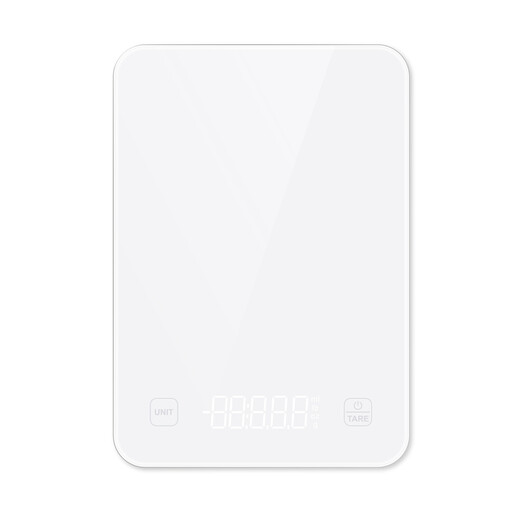
For a heavier bowl or batch baking, this scale’s stated 10 kg capacity allows for the bowl and ingredients within that maximum load.
The product name states 1 g precision. Check whether it has tare and whether your usual bowl leaves the display visible.
A scale that states 1 g increments is a practical starting point for ordinary cake ingredients. Check the exact model rather than assuming every digital scale has that increment; if accuracy is especially important, look beyond the stated increment to independent testing.
Put the empty bowl on a flat scale and use tare to return the reading to zero before adding sugar. If you add another ingredient afterwards, tare again between additions, provided the combined load remains within the scale’s capacity.
Not necessarily for a single ordinary cake. Consider 10 kg capacity if your bowl and ingredients together could approach a 5 kg limit, as may happen with doubled recipes or batch baking; also check the stated increment on the model you choose.
Keep spare button-cell batteries out of children’s reach and ensure the device’s battery compartment is secure. The UK Office for Product Safety and Standards warns that swallowing a button battery can cause serious injury or death; Joseph Joseph specifies CR2032 button cells for its Vision Compact scale.