Everyday single-portion muesli makers
If you want the same amount of dried fruit in each bowl, whole-gram weighing gives you a repeatable target instead of a spoonful or handful. NHS guidance identifies 30g of dried fruit as one 5 A Day portion.


For one bowl of muesli, start with a digital kitchen scale that displays whole grams, has a tare control to exclude the bowl’s weight and remains readable with your bowl in place. NHS guidance counts 30g of dried fruit as one 5 A Day portion, so 0.1g resolution is more relevant if you also measure much smaller quantities; if storage is the bigger concern, check a compact model’s platform and display against your usual bowl.
If you want the same amount of dried fruit in each bowl, whole-gram weighing gives you a repeatable target instead of a spoonful or handful. NHS guidance identifies 30g of dried fruit as one 5 A Day portion.
If the scale comes out briefly each morning, a folding or slim design may be easier to put away. With a wide bowl, check the display position too: Joseph Joseph and OXO describe models with movable displays designed to remain visible beside a bowl.
If you use the scale for ingredients measured in fractions of a gram, a fine-measurement platform may serve another purpose beyond muesli. Salter specifies 0.1g increments on the smaller platform of its Heston Blumenthal Precision dual-platform model; check that platform’s capacity for your other ingredients.
Choose around the bowl and portion you use each day, then decide whether easy storage or finer measurement would change your routine.
| Concern | What to check | Who this matters to |
|---|---|---|
| Repeatable portions | Look for a readable 1g display and a tare control that resets the reading with your bowl on the scale. | If I make one bowl at a time, I want to add dried fruit to a consistent whole-gram target without subtracting the bowl’s weight. Around 50% of consumers put repeatable portions first. |
| Storage and display | Compare stored dimensions and check whether your usual bowl covers the display. | With little drawer space, I want a scale I can put away after breakfast and still read when the bowl is on it. Roughly 33% of consumers prioritise storage and an unobstructed display. |
| Fine measurement | Check the stated 0.1g measurement steps and the capacity of the platform that provides them. | If I also weigh tiny amounts for other recipes, I need finer displayed steps than a whole-gram scale offers. About 17% of consumers place sub-gram measurement first. |
For the 30g dried-fruit portion described by the NHS, a whole-gram display gives you a practical target. A 0.1g feature is more relevant when another ingredient in your routine calls for smaller displayed steps.
Start by checking for 1g increments and tare. Consider a fine-measurement model if you have a separate use for its smaller steps, and check the capacity at which they apply.
A readable specification on paper will not help much if your usual bowl covers the numbers while you add fruit.
Compare your bowl with the platform dimensions and display placement. A sliding or pull-out display is worth considering when the bowl would otherwise block your view.
A manufacturer’s 1g or 0.1g specification describes the stated measurement steps, not an independent finding about accuracy or consistency. Which? describes using calibrated weights when testing kitchen scales.
If unusually precise weighing matters to you, look for independent testing under relevant conditions as well as the model’s stated resolution.
UK government guidance says batteries and electrical products should go through appropriate recycling routes rather than household rubbish.
Use a suitable battery collection point for accessible spent batteries and an electrical-waste collection route for the scale.
These brands illustrate different kitchen-scale designs; the features below apply to the named models, not every scale each brand makes.
Salter offers everyday digital scales alongside models aimed at smaller measurements.
Joseph Joseph has compact and storage-led kitchen-scale designs.
OXO offers scales with display-focused designs and a separate precision model with a timer.
These choices include nutritional scales for everyday food weighing, a coffee-oriented scale for finer measurement and a Bluetooth kitchen scale with a stated larger capacity. For one bowl of muesli, compare their bowl fit and controls before deciding which additional features you would use.
 No image available
For dried fruit measured into a bowl, check that its tare control and display arrangement suit how you add ingredients. This is the 1L black-glass variant; confirm its maximum weighing capacity if you also plan to use it for larger quantities.
 No image available
Consider this coffee-oriented scale if you also weigh very small ingredients; its name states 0.1g precision, a 2000g capacity, a timer and a flow-rate function. For muesli, check whether your bowl leaves the display visible and follow the model’s cleaning instructions.
 No image available
If you want one scale for a breakfast workspace, compare this stainless-steel variant’s footprint with your available storage. Before weighing fruit directly into a bowl, check for a tare control and make sure you can see the display with that bowl in place.
 No image available
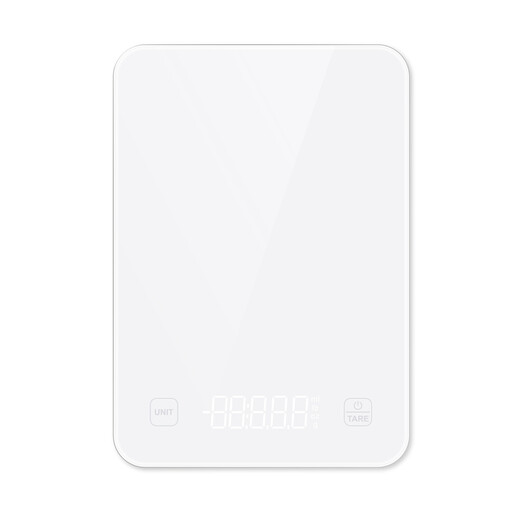
If you also weigh larger quantities of ingredients, consider its stated 10 kg capacity. The product name specifies 1 g precision, multiple units, a tempered-glass platform and app integration; confirm tare, storage dimensions and display visibility for your muesli bowl.
A scale displaying whole grams is a practical choice for a repeatable dried-fruit portion: NHS guidance counts 30g as one 5 A Day portion. Check that the display is readable with your bowl in place; consider finer steps if you also measure ingredients in fractions of a gram.
Tare lets you reset the reading with your bowl on the scale, so you can weigh the dried fruit without calculating the bowl’s weight. An add-and-weigh control can also help when you measure successive ingredients into the same bowl.
No: GOV.UK states that domestic scales cannot be used to weigh goods intended for sale in the UK. If you are preparing products for sale, check the equipment requirements for that activity with your local Trading Standards service.
Use an appropriate electrical-waste collection route rather than putting the scale in household rubbish, in line with UK government guidance. Take accessible spent batteries to a suitable battery collection point.