
24/7 全天候客户支持

免费退货

当日/次日达

品质保障

开启新人专享福利: 全场免邮 | 低至 2 折 | 免费试用 30 天 JoyPlus 会员
下载 Joybuy
A reliable set of digital kitchen scales is the foundation of a successful recipe. Whether you are a passionate baker striving for the perfect rise or a health-conscious cook managing portion control, precision is paramount. Yet, the market is filled with options that look good on the surface but fail in practice. Many of us have been there: a recipe ruined by fluctuating measurements or a scale that gives up mid-weigh.
As the Joybuy Product Recommendation Officer, my role is to help you navigate past the marketing clutter. Before you make a decision, let’s look at the common pitfalls that lead to buyer's remorse and how to identify a scale that will genuinely serve your kitchen for years to come.
To ensure you get a tool that performs reliably, focus on these key specifications. They are far more important than flashy colours or exaggerated marketing claims.
For most home use, from baking to meal prep, a scale with a 1g graduation is the standard. This means it can detect changes in weight as small as a single gram, which is essential for ingredients like yeast, spices and baking powder. In terms of total capacity, a 5kg kitchen scales model is typically sufficient for weighing everything from a few grams of herbs to a large bowl of dough. If you regularly batch cook or handle larger quantities, a 10kg model might be more suitable.
The weighing platform is where function meets durability. The two most common materials each have their advantages:
Ensure the platform is large enough to accommodate your most-used mixing bowls without obscuring the display.
Beyond the basics, a few features are non-negotiable for modern food weighing scales:
Instead of a generic list, we have matched specific models to different user needs. This ensures you find a scale that not only works well but fits your lifestyle.
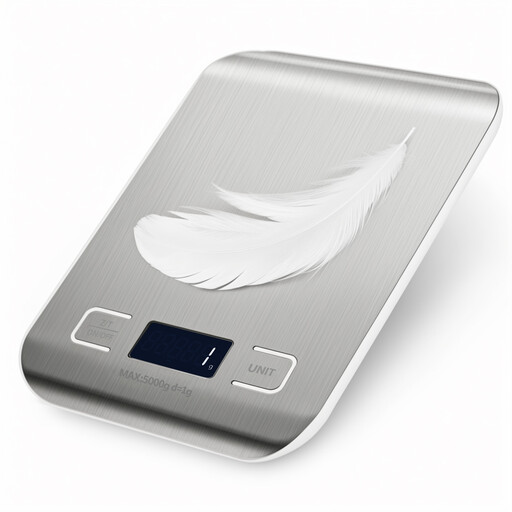
Why This Fits Their Persona: This is a reliable, no-fuss workhorse for daily cooking, baking and meal prep. It focuses on the essentials: accuracy, a clear display and a practical surface that stands up to regular use in a busy UK kitchen.
Its single-sheet stainless steel platform has a fingerprint-resistant coating, making it exceptionally easy to wipe clean and avoiding the "difficult-to-clean" trap. The sensor provides quick, stable readings.
Durable stainless steel construction and a large, clear LCD screen that is easy to read from any angle.
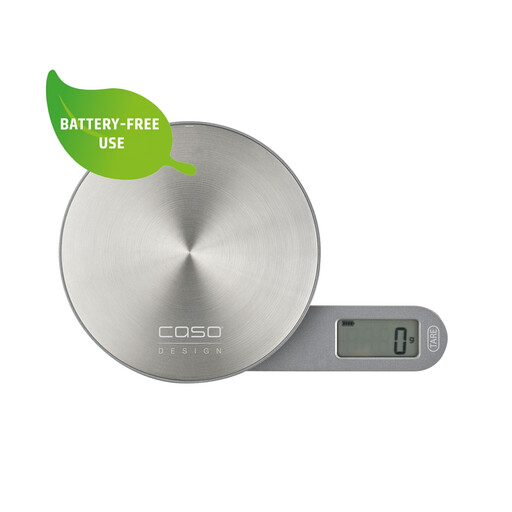
Why This Fits Their Persona: For the user who prioritises sustainability and clever engineering, this scale is a perfect fit. It eliminates the need for disposable batteries, reducing both waste and long-term cost.
It completely solves the "constant battery drain" problem by using kinetic energy. A few turns of the power wheel generate enough charge for several minutes of use, ensuring it is always ready.
Completely battery-free operation. It also features a magnetic base, allowing it to be stored conveniently on a fridge door to save counter space.

Why This Fits Their Persona: This user needs more than just weight; they need data for precise portion control scales. The Bluetooth connectivity and companion app are ideal for tracking calories and macros, while the high 10kg capacity is perfect for large-batch meal prepping.
The high-precision sensor and robust build quality are designed for consistent, heavy use, avoiding the "unstable reading" flaw of less capable models. The tempered glass surface is seamless and simple to clean.
Bluetooth connectivity for app-based nutritional tracking and a generous 10kg maximum capacity.
We have compiled a complete, real-time list of products that fully satisfy these strict selection criteria and UK safety regulations.
The 'tare' function is one of the most important features of any digital scale. It allows you to place an empty bowl or container on the scale and press a button to reset the weight to zero. This means you can then add your ingredients and measure only their weight, ignoring the weight of the container. You can even use it multiple times to add different ingredients to the same bowl, zeroing the scale before adding each new one.
Yes, and it is often more accurate than using a measuring jug. You can weigh liquids like water, milk or oil directly in grams. Some scales also have a specific 'ml' mode, which provides a volume estimate based on the density of water or milk. For most baking and cooking, weighing liquids in grams provides the highest level of precision.
Most home kitchen scales do not require manual calibration. The most critical step is to always place them on a completely flat, hard and stable surface before use. Avoid using them on uneven countertops, chopping boards or soft mats, as this can cause inaccurate readings. Turning the scale on only after it is on a stable surface will also help ensure it starts from a correct zero point.