Single-batch bun bakers
If you weigh a modest portion of raisins alongside other ingredients, look for whole-gram measurement and tare before deciding whether you need a higher maximum capacity.


For a one-person batch of buns whose ingredients are measured in whole grams, choose a digital scale with documented 1 g increments and a tare function so you can weigh raisins directly into a bowl. Consider finer increments only if your recipe calls for sub-gram amounts; otherwise, a readable display, cleaning method and storage footprint are more useful checks than maximum capacity alone.
If you weigh a modest portion of raisins alongside other ingredients, look for whole-gram measurement and tare before deciding whether you need a higher maximum capacity.
If a recipe specifies amounts below one gram, check the exact scale’s stated increment and minimum load. OXO describes one precision model as reading from 0.5 g in 0.1 g intervals.
If you bake occasionally and put the scale away afterwards, consider how its platform cleans and whether its bowl or base fits your storage space.
For raisins in a one-person batch, start with the smallest amount your recipe asks you to weigh. Then decide how you want to clean and store the scale.
| Concern | What to check | Who this matters to |
|---|---|---|
| Whole-gram weighing | Check the stated increment and whether tare lets you zero a bowl before adding raisins. | If I measure raisins and other bun ingredients in whole grams, I want to add them to a bowl without weighing it separately. About 40% of consumers put this straightforward weighing first. |
| Finer additions | Check the stated increment, minimum load and capacity for the bowl you plan to use. | When my recipe specifies a sub-gram addition, a whole-gram reading cannot show the change I need. For around 30% of consumers, finer measurement is the primary concern. |
| Cleaning and storage | Check the cleaning instructions, dimensions and whether a supplied bowl stores over the base. | If I bake occasionally in a small kitchen, I need a scale I can clean and put away easily. Compact, low-maintenance ownership comes first for roughly 30% of consumers. |
Maximum load and measurement increment answer different questions. Salter describes a 10 kg British Bakes model with 1 g accuracy, while Lakeland specifies 1 g increments for its 5 kg bowl scale.
Check both figures separately. For a recipe measured in whole grams, focus on a suitable increment and tare rather than treating a higher capacity as evidence of finer measurement.
A scale used for an occasional small batch still needs a practical place to sit, be cleaned and be stored. Lakeland describes a bowl that fits over its scale’s base for storage; other designs use flat platforms.
Compare dimensions and cleaning instructions for the exact model, then decide whether you would rather store a bowl with the scale or use one you already own.
These details can matter if you pause while adding ingredients. Lakeland states that its bowl scale uses two AAA batteries and switches off after two minutes when the weight is unchanged or zero.
Check the battery requirement and shut-off behaviour of the model you are considering, particularly if you tend to prepare ingredients slowly.
Salter offers digital baking scales with tare, including models with different maximum loads and platform designs.
Lakeland’s bowl-based scale is worth considering if you want to weigh ingredients in its supplied bowl and store the two parts together.
OXO has separate scale designs for flat-platform kitchen weighing and finer measurements; check which model matches your recipe.
These scales offer different ways to weigh small-batch ingredients: compare bowl use, stated measurement details and storage needs against your recipe. The TIMEMORE model is primarily a coffee scale, so check that its controls also suit your baking routine.
 No image available
If you plan to add raisins to a bowl on the scale, check its tare control and displayed increments against your recipe. Confirm the maximum load for this 1L variant before using a heavier mixing bowl.
 No image available
For raisins weighed directly into a bowl, confirm that this exact model has tare and displays the increments your recipe requires.
 No image available
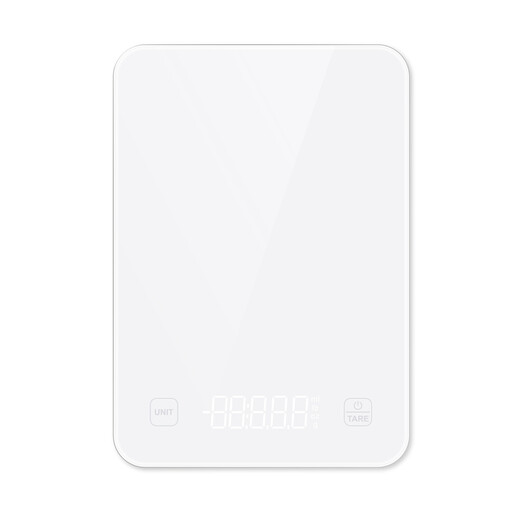
For whole-gram ingredient weighing, its title states 1 g precision and 10 kg capacity; precision wording alone does not establish its displayed increment. The title also specifies tempered glass, multi-unit support and app integration. Check tare before planning to zero a bowl, and check the dimensions if storage space is tight.
 No image available
If you also make pour-over coffee, this model’s title specifies a timer, flow-rate function and 2000 g capacity. Its stated 0.1 g precision does not by itself establish the display increment or minimum load for tiny baking additions; check both before relying on it for that purpose.
A scale with 1 g increments is a sensible choice when your recipe measures raisins in whole grams. Check that the exact model also has tare if you want to zero a bowl; a recipe specifying sub-gram additions calls for a documented finer increment.
No: raisins are a dry ingredient, so readable gram measurements and tare are the relevant checks. Salter lists an Aquatronic liquid-measuring function on a separate stainless-steel model, which may matter if you also intend to measure liquids with the scale.
Check the exact model’s cleaning instructions, battery requirement and automatic shut-off behaviour. Salter describes its British Bakes model as washable and waterproof; Lakeland states that its bowl scale uses two AAA batteries and switches off after two minutes of unchanged or zero weight.