
24/7 Customer Support

Free returns

Same-day & Next-day Delivery

Quality Guaranteed

Unlock Your Welcome Offers: FREE Delivery | Up to 80% OFF | Free 30-day JoyPlus trial
Download the APP
Whether you are weighing flour for a weekend bake, portioning meals for the week or tracking macronutrients, the right digital kitchen scales can make everyday food preparation more consistent. However, product listings often highlight connectivity and sleek design while leaving out details that affect practical use.
Before buying, look beyond the headline features. Capacity, measurement increments, power source, cleaning requirements and app compatibility all determine whether a scale remains useful after the initial novelty wears off.
A display showing measurements in 1g increments does not automatically mean every reading is accurate to 1g in every situation. Performance can vary with the scale’s surface, load position, battery level and maximum capacity.
For reliable results, place the scale on a solid, level worktop, avoid touching the bowl while weighing and check whether the product specifies both its maximum capacity and minimum weighing amount. A scale suitable for 10kg loads may not be designed for very small quantities.
Smart kitchen scales can connect to an app and provide nutritional estimates, but this functionality depends on a compatible phone, Bluetooth connection and a useful food database. Some users only need a simple tare function for cooking and baking.
If you want nutritional tracking, check whether the app supports your preferred foods, custom recipes and the health platform you already use. “App-connected food scale” should mean more than a Bluetooth logo on the packaging.
Glass and stainless steel platforms are generally simple to wipe, but electronic kitchen scales should not be submerged unless the manufacturer specifically permits it. Removable bowls may be dishwasher-safe, while the weighing unit itself usually is not.
Also check the dimensions. A slim scale that fits in a drawer or hangs from a rail is more convenient than a larger model that stays on the worktop permanently.
For most home cooking, food scales with 1g precision are practical for weighing flour, sugar, pasta, coffee and meal-prep ingredients. Bakers may also value units such as ounces, pounds and millilitres.
Capacity should match your typical bowls and recipes:
Remember that the container counts towards the total load. Kitchen scales with a tare function let you reset the display to zero after placing a bowl on the platform, then add ingredients one at a time.
A responsive tare button is one of the most useful features on digital cooking scales. It reduces washing-up and helps you follow recipes directly in one bowl. Check whether the scale supports the units you actually use, such as grams, ounces, pounds, millilitres or cup measurements.
Some models include separate settings for water and milk, but these are conversions rather than direct volume measurements. For dependable results, use the correct unit and follow the scale’s instructions.
Battery-powered scales are straightforward, but batteries need replacing. Rechargeable models reduce disposable battery use and can be charged by USB-C. Battery-free kitchen scales use alternatives such as kinetic energy, although their operating time may be limited after each activation.
For Bluetooth kitchen scales, check:
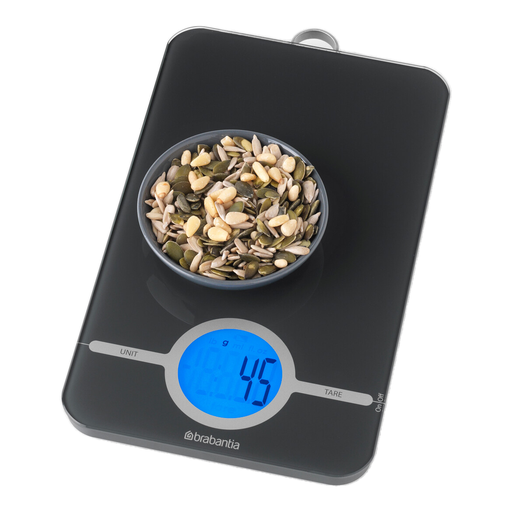
Why This Fits Their Persona: A practical choice for UK households that want straightforward baking scales without app setup or nutritional subscriptions. Its slim profile is suitable for drawer storage.
It focuses on core weighing functions rather than features you may not use, with an add-and-weigh function and automatic power-off.
1g graduations up to 5kg, backlit LCD display, tempered glass platform and included AAA batteries.
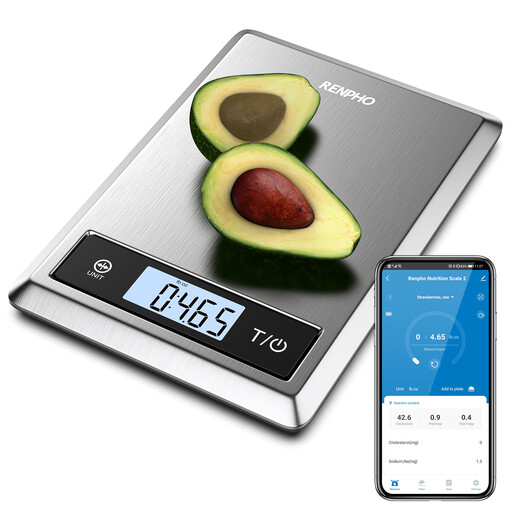
Why This Fits Their Persona: Suitable for shoppers who want a durable surface alongside nutritional food scale functions for meal planning and household use.
The listing clearly identifies its 5kg capacity, 1g increment, supported apps and battery type, making the ongoing setup easier to assess.
Stainless steel platform, Bluetooth app connection, 20+ nutrient categories, multiple units and unlimited user profiles.
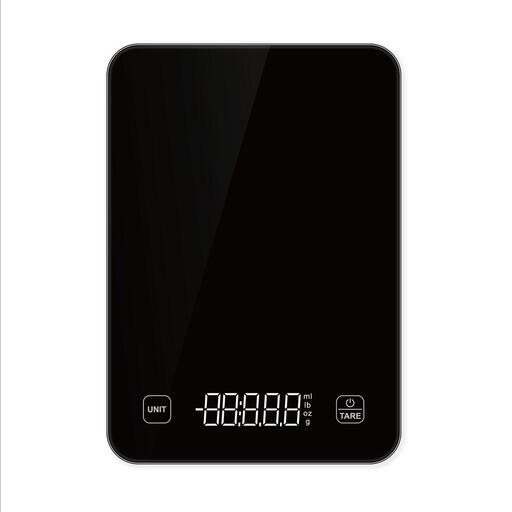
Why This Fits Their Persona: Designed for larger meal-prep batches, bulk ingredients and users who want app-assisted portion control without a low load limit.
Its published 10kg maximum capacity helps avoid choosing a compact model that cannot support heavy bowls or batch cooking.
1g graduation, Bluetooth connectivity, app integration, tempered glass surface and support for grams, millilitres, ounces and pounds.
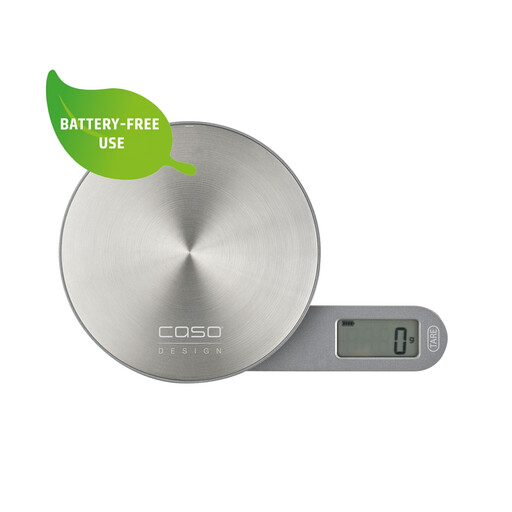
Why This Fits Their Persona: A practical fit for cooks who prefer not to buy or recharge batteries and value compact storage in a smaller UK kitchen.
The kinetic power system is clearly specified, including up to three minutes of operation per wind, so running expectations are transparent.
5kg capacity, 1g increments, tare function, stainless steel surface, magnetic base and automatic switch-off.
We have compiled a complete, real-time list of products that fully satisfy these strict selection criteria and UK safety regulations.
For repeatable readings, place the scale away from draughts and vibration. Switch it on before adding the container, press tare, then add ingredients gradually. Do not exceed the stated capacity and keep liquids away from buttons and the battery compartment.
Wipe the platform with a slightly damp cloth after use. Avoid abrasive cleaners, prolonged pressure on the weighing surface and storage in a humid area. If the scale has moved, check the instructions for recalibration before weighing.
Yes, particularly when recipes use weight rather than volume. Measuring flour and other ingredients by weight can make quantities easier to repeat. A model with 1g increments and a tare function is generally suitable for common home baking.
Most Bluetooth kitchen scales can still display weight without app connection, but nutritional analysis and saved meal tracking normally require the companion app. Check the individual product instructions before purchase.
Small battery-powered and rechargeable scales generally use very little power during short weighing sessions. Automatic switch-off helps limit battery drain. Battery-free models avoid electrical batteries altogether, but they may require manual activation before use.