Everyday one-person grain portioner
If you weigh dry rice, couscous or oats into one bowl before lunch, focus on the stated graduation, a tare function and whether your bowl leaves the display visible.


For a one-person lunch of dry grains, look for stated 1 g increments and a tare function so you can zero the weight of your bowl; Salter and Joseph Joseph list these features on specific models. Check that you can read the display with your usual bowl in place. Folding storage, rechargeable power and finer graduation matter only if you have those additional needs.
If you weigh dry rice, couscous or oats into one bowl before lunch, focus on the stated graduation, a tare function and whether your bowl leaves the display visible.
If drawer or worktop space is tight, a folding design may be easier to put away. Check that the scale still accommodates your usual bowl and lets you see the reading.
If you also measure very small additions for other recipes, compare the stated graduation of the exact model or platform. An ordinary 1 g scale and a finer-graduation scale serve different measurement needs.
Start with the bowl-and-grains weighing routine. Then decide whether smaller ingredients, limited storage or your preferred power source change the specification you need.
| Concern | What to check | Who this matters to |
|---|---|---|
| Repeatable grain portions | Look for stated 1 g increments, tare and a display you can see beside your usual bowl. | If I weigh grains into the same bowl most lunchtimes, I want to zero the bowl and stop at my chosen whole-gram amount. Around 50% of consumers put this straightforward portioning need first. |
| Very small ingredients | Check the graduation for the exact model and, on a dual-platform scale, for the platform you would use. | When a recipe calls for a very small addition as well as a grain portion, I need to know whether whole-gram steps are fine enough. For around 17% of consumers, that finer-measurement need comes first. |
| Storage and power | Check folded or stored size and the stated power source; for button-cell models, check that the battery compartment closes securely. | With little space to put a scale away, or a preference not to replace disposable batteries, I care about convenience between lunches. Around 33% of consumers prioritise storage or power arrangements. |
A precision label or an extra platform does not, by itself, tell you the smallest displayed step. The cited household scales specify 1 g increments, which is a different requirement from measuring smaller additions.
Read the graduation and capacity for the exact model and for the platform you intend to use.
A scale can have ample capacity yet be awkward to use if your usual bowl covers the reading. Joseph Joseph describes a sliding display on its Vision Compact model for use with larger bowls.
Compare your bowl’s footprint with the platform and display position, or use a smaller bowl.
Some kitchen-scale models use CR2032 button cells. GOV.UK warns that button and coin batteries pose a severe risk to children and pets if swallowed or inserted.
Keep spare batteries secured and out of reach, and stop using a scale if its battery compartment does not close securely.
Weighing dry rice helps you choose how much to cook, but it does not make leftover cooked rice safe to store or reheat.
If you keep cooked rice, follow Torbay Council’s guidance to cool it quickly, refrigerate it once cooled and reheat it no more than once.
Salter lists household scales with features relevant to weighing a bowl of grains.
Joseph Joseph has model-specific designs for buyers concerned about storage or seeing the display beside a bowl.
Beurer’s kitchen-scale range includes ordinary digital scales and separate precision options.
These nutritional and kitchen scales are choices to consider for weighing lunch ingredients. For portions measured in a bowl, check the exact variant’s graduation and tare function before choosing.
 No image available
For dry grains weighed in a bowl, check this Calibra 1 variant’s graduation and tare function before relying on it for your portioning routine.
 No image available
For one-bowl grain preparation, check that this Calibra 1L variant’s graduation and tare function suit your routine. Confirm its maximum capacity against the weight of your usual bowl and ingredients, as the stated capacity figures differ.
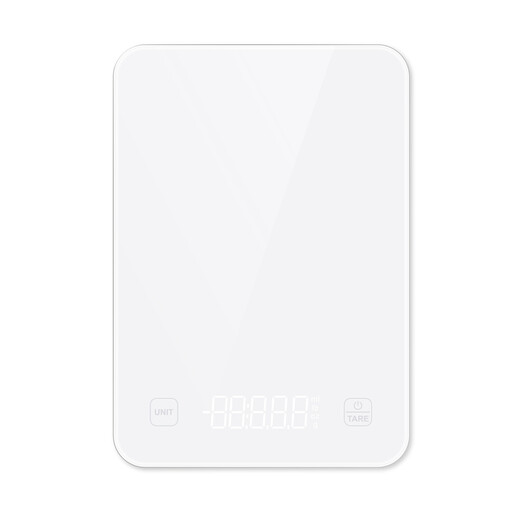 No image available
The stated 1 g precision is relevant to whole-gram grain portions; confirm that this model has tare if you intend to zero a bowl.
For an ordinary dry-grain portion measured in whole grams, look for stated 1 g increments and tare so you can exclude the bowl’s weight. Salter lists both functions on cited 5 kg models; check the specification of whichever model you choose.
Not for an ordinary whole-gram portion of rice or couscous. A finer-graduation platform is worth considering if you also measure very small recipe additions; check its stated graduation rather than relying on a precision label.
Put the empty bowl on the scale, press tare to return the display to zero, then add the dry grains. On a model with add-and-weigh, you can zero the display again before adding another ingredient to the same bowl.
No. Measuring a portion does not replace safe handling of cooked rice. Torbay Council advises cooling rice quickly if it is not eaten immediately, refrigerating it once cooled and reheating it no more than once.
Take a spent scale battery to an appropriate battery collection point rather than putting it in general waste. GOV.UK says most waste batteries can be taken to a local supermarket; keep button batteries secured and away from children and pets until you dispose of them.