
24/7 Customer Support

Free returns

Same-day & Next-day Delivery

Quality Guaranteed

Unlock Your Welcome Offers: FREE Delivery | Up to 80% OFF | Free 30-day JoyPlus trial
Download the APP
Digital kitchen scales can make baking more consistent, simplify meal preparation and help households measure portions with less guesswork. However, not every model suits every task. A compact digital food scale may be convenient for everyday recipes, while smart kitchen scales with app connectivity are designed for users who want nutritional records. Coffee enthusiasts may need timing and flow-rate functions rather than calorie data.
The challenge is separating practical features from persuasive packaging. Before buying digital kitchen scales, watch for these common pitfalls.
A scale advertised with 1g increments may still have a relatively small maximum capacity. That may be suitable for weighing individual ingredients, but less convenient when using a large mixing bowl. Check both measurements: the graduation tells you how finely the scale displays weight, while the maximum capacity tells you how much it can safely weigh.
For general cooking and baking scales, a capacity around 5kg is useful for bowls, flour and multiple ingredients. A compact nutritional food scale may prioritise app features and portability instead.
Bluetooth kitchen scales and kitchen scales with app integration can record calories, protein, carbohydrates and other information. These functions are useful for meal-prep users and people who already maintain digital food logs, but they may add complexity if you only want to weigh flour or vegetables.
Check whether the app is compatible with your phone and preferred services. For example, some products list integration with Apple Health, Google Fit or MyFitnessPal. Also consider whether you are comfortable creating an account, enabling Bluetooth and entering branded or homemade foods manually.
Food residue around buttons, seams or a permanently attached bowl can make a scale inconvenient to maintain. A smooth glass or stainless-steel platform is generally easier to wipe than heavily textured surfaces. Nevertheless, electronic scales should not be submerged unless the manufacturer specifically allows it.
Also check the dimensions. A slim model may fit a kitchen drawer, while a larger platform can be more stable beneath a mixing bowl.
For most recipes, 1g increments offer a practical balance between readability and everyday usability. Coffee brewing can require more repeatable measurements, particularly when monitoring coffee-to-water ratios and timing.
For liquids, a millilitre setting can be convenient, but it should not be treated as a universal substitute for weighing. Water and other liquids have different densities, so the displayed volume may not represent the same mass for every ingredient.
The tare function resets the display to zero after placing a bowl on the platform. This allows you to add ingredients one after another without weighing each container separately. It is particularly useful for baking and batch cooking.
Look for the units you actually use, such as grams, ounces, pounds, millilitres or cups. Unit conversion can be helpful in UK kitchens where recipes may come from different sources, but cup measurements can vary depending on ingredient and packing method.
A backlit display is easier to read under kitchen cabinets or in lower light. Auto-on and auto-off functions can make daily use simpler and help reduce battery consumption. Check whether the scale uses replaceable AAA batteries or a rechargeable USB-C battery.
For nutritional and smart scales, review the wireless connection type, app compatibility and user-profile support. These are practical considerations for families or anyone tracking meals across several devices.
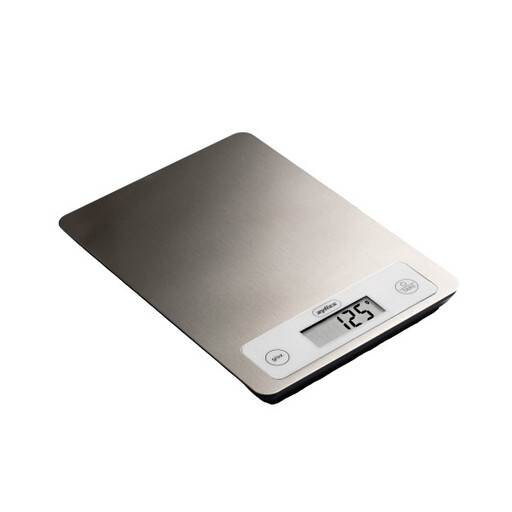
Why This Fits Their Persona: A straightforward option for UK households that want digital food scales for baking, cooking and portion measurement without app-based tracking.
It focuses on core weighing functions rather than features that may be unnecessary for occasional cooking.
Compact format; intended for recipe accuracy and portion control.

Why This Fits Their Persona: Suitable for health-conscious households wanting a stainless-steel platform, nutritional data and shared meal tracking through an app.
Its listed 5kg capacity and 1g increment should be considered together, rather than judging precision alone.
Stainless-steel surface; Bluetooth connection; listed support for 20+ nutrients and multiple user profiles.

Why This Fits Their Persona: A practical match for batch cooking, large bowls and users who want Bluetooth-supported dietary tracking.
The stated 10kg capacity reduces the limitation associated with small platforms, while the minimum weighing figure is clearly listed.
10kg capacity; 1g graduation; g, ml, oz and lb:oz settings; tempered-glass surface.

Why This Fits Their Persona: Designed for espresso and pour-over routines where timing, coffee-to-water ratio and flow rate matter more than nutritional logging.
It prioritises coffee-specific controls instead of presenting general nutritional functions as suitable for every brewing method.
Coffee-to-water ratio, water-flow-rate and timer functions; supports ounce and kilogram units.
A calorie counting scale estimates nutritional values from a food database and the weight entered. It does not replace checking food labels, especially for packaged products or homemade recipes with changing ingredients.
A body composition scale is a separate product category. Models using bioelectrical impedance analysis may display metrics such as body fat percentage, muscle mass or BMI. These readings can vary with factors including hydration and positioning, so they are more suitable for observing trends than treating a single figure as a definitive measurement. They are not the same as digital kitchen scales and should not be used for medical decisions.
We have compiled a complete, real-time list of products that fully satisfy these strict selection criteria and UK safety regulations.
Yes, particularly when recipes use grams or require repeatable ingredient ratios. A tare function lets you weigh ingredients in one bowl, reducing washing-up and helping avoid measurement differences caused by packed cups or uneven spoonfuls.
Lifespan depends on battery care, cleaning and protection from spills. Wipe the platform after use, avoid placing heavy items on it for long periods and keep the unit dry. Do not exceed its stated capacity, as overloads can affect the sensors.
They may require replacement batteries or charging, and app-based models also rely on a compatible smartphone. Bluetooth itself generally uses little power, but the practical cost comes from batteries, charging habits and whether you use the app regularly. For occasional cooking, a basic cooking scale may be simpler; for meal preparation and nutritional records, the additional functions may be useful.