
24/7 Customer Support

Free returns

Same-day & Next-day Delivery

Quality Guaranteed

Unlock Your Welcome Offers: FREE Delivery | Up to 80% OFF | Free 30-day JoyPlus trial
Download the APP
A digital kitchen scale can improve baking accuracy, simplify portion control and make coffee preparation more repeatable. However, choosing one based only on a large display or an attractive app can lead to wasted money. The right model depends on what you weigh, how often you use it and whether you need simple measurements or connected nutritional data.
A scale showing measurements in 1g increments is useful, but that does not automatically mean it is suitable for every task. Small coffee scales may prioritise responsiveness and timer controls, while baking weighing scales may need a broader platform and higher maximum capacity.
Check both:
A model with 1g precision and a 10kg capacity, such as the Unique Bluetooth Kitchen Scale, may suit large mixing bowls and family meal preparation. A compact coffee scale may be more practical for espresso equipment but less suitable for heavy cookware.
A smart food scale can connect to an app, calculate nutritional information and store food records. These features are useful for people who regularly track calories or macronutrients, but they may add complexity if you only need to weigh flour or vegetables.
Before purchasing a Bluetooth kitchen scale, check:
App-based nutritional estimates should be treated as guidance rather than a substitute for checking food packaging, especially with branded or homemade recipes.
A scale used with flour, liquids and raw ingredients needs a surface that can be wiped clean easily. Gaps around buttons, a non-removable bowl or a platform too small for your usual cookware can make daily use frustrating.
Look for tempered glass or stainless steel surfaces, a tare function and clear instructions about water exposure. Even a water-resistant-looking surface should not be submerged unless the manufacturer specifically says it is suitable.
For most home cooking, 1g increments offer a practical balance between precision and usability. The tare function allows you to reset the display after placing a bowl on the platform, so ingredients can be added sequentially without mental calculations.
Useful unit options include:
A nutritional kitchen scale may provide additional food information, but the underlying weight reading still depends on placing the scale on a stable, level surface.
Measure your available worktop and consider the bowls you normally use. A compact scale is convenient to store, while a larger platform can make it easier to read the display around a mixing bowl.
For heavier ingredients, compare the stated capacity carefully. The Unique model supports up to 10kg, whereas the RENPHO Calibra 1 supports up to 5kg. A 1-litre bowl-based design may be convenient for ingredients and liquids but has a lower stated capacity than a large flat platform.
Battery-powered models are easy to move around the kitchen, while USB-C rechargeable designs reduce the need for disposable batteries. A backlit LCD or bright LED display can be helpful in kitchens with limited lighting.
For a coffee scale with timer, consider whether the timer is built in, whether the display is easy to read while pouring and whether the surface leaves enough room for your brewer. Connectivity is useful only when it supports a routine you are likely to maintain.
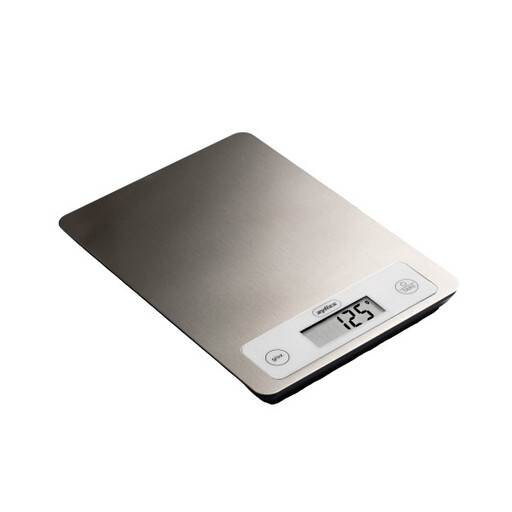
Why This Fits Their Persona: A straightforward option for UK households starting with baking, cooking or basic portion control without needing app connectivity.
Its compact format and clear display focus on the core weighing task rather than features you may not use.
Compact design, easy-to-read display and suitability for recipe accuracy and portion control.

Why This Fits Their Persona: Suitable for households wanting a durable stainless steel surface alongside connected food and nutrient logging.
The specification clearly states its 5kg capacity, 1g increment, Bluetooth connection and supported apps, making the feature set easier to assess before purchase.
Stainless steel platform, backlit LCD, multiple units and compatibility with RENPHO Health, MyFitnessPal, Apple Health and Google Fit.

Why This Fits Their Persona: A practical match for batch bakers, family meal preparation and users who need more capacity than a small digital food scale provides.
Its stated 10kg limit helps avoid overloading when using large bowls, while the minimum weighing specification of 3g gives useful context for smaller portions.
1g graduation, tempered glass surface, Bluetooth app integration and support for grams, millilitres, ounces and pounds.

Why This Fits Their Persona: Designed around espresso and pouring routines, making it more relevant to coffee preparation than general-purpose meal tracking.
The built-in timer and water-flow-rate function address coffee-specific requirements instead of adding unrelated nutrition features.
Timer function, water-flow-rate measurement and switchable ounce/kg units for espresso, baking and cooking tasks.
A body composition scale is designed for weighing a person and may use bio-electrical impedance analysis to provide additional readings such as body fat percentage, muscle mass and BMI. It is not a replacement for a digital kitchen scale. Readings can vary with factors such as hydration and measurement conditions, so use the same routine when tracking changes and avoid treating app estimates as medical assessments.
The RENPHO MorphoScan Smart Body Scale is intended for household body tracking, with Bluetooth connectivity, app synchronisation, multiple user profiles and a stated weight limit of 180kg. It may suit families or fitness-focused users who want body data kept separately from food measurements.
We have compiled a complete, real-time list of products that fully satisfy these strict selection criteria and UK safety regulations.
A model displaying 1g increments is generally suited to everyday home baking and cooking, provided it is placed on a flat surface and not overloaded. For very small quantities, check the minimum weighing weight and consider whether the scale responds consistently when adding ingredients gradually.
Lifespan depends on battery care, cleaning and mechanical use. Keep the platform dry, avoid exceeding the stated capacity and store the scale where it will not be knocked or exposed to heat. Rechargeable models should be charged according to the supplied instructions, while battery models should have batteries removed during long-term storage if recommended.
Connected nutritional scales can link a measured weight to food data in a companion app and may display calories, protein, carbohydrates and fats. The result depends on selecting the correct food entry and entering recipes accurately. For packaged food, compare app information with the product’s UK nutrition label before recording it.