For dry polenta on a small worktop, choose a scale that fits your usual bowl and storage space, reads in grams and has a tare function if you add ingredients to one vessel. Salter’s compact 3 kg Arc is a space-first option but does not measure liquids; a slim 5 kg scale or a bowl-and-platform design may suit heavier bowls, while a pull-out display addresses a bowl that hides the readout.
Who these scales suit
Space-first supper cooks
If you mostly weigh dry polenta and put the scale away after cooking, compare its full dimensions with both your free worktop and your drawer. Salter’s Arc and Ultra Slim models illustrate why a compact label alone does not tell you how much counter depth a scale needs.
One-bowl recipe followers
If you add polenta and other ingredients to the same bowl, a tare or add-and-weigh control lets you reset the reading between additions. Salter and Joseph Joseph describe this function on the models discussed here.
Large-bowl and batch cooks
If you use a heavy or wide bowl, consider its weight as part of the scale’s maximum load and check whether you can still see the display. A bowl-and-platform design or a pull-out display may address different parts of that problem.
What matters when choosing
Start with the space needed for your scale and usual bowl, then check tare and maximum load. A readable display matters too if the bowl extends beyond the platform.
| Concern | What to check | Who this matters to |
|---|
| Worktop and storage space |
Compare the full dimensions with your clear worktop and drawer space; allow room for your usual bowl. |
If I put the scale away after making supper, it needs to fit without taking over the prep area. Around 42% of consumers place space and storage first. |
| One-bowl measuring |
Look for a stated tare, zero or add-and-weigh function; check how readily the platform wipes clean. |
When I add polenta and other ingredients to one bowl, I want to reset the reading between them. Roughly 33% of consumers make that workflow their primary concern. |
| Capacity and display |
Include the bowl in the maximum load, and check whether it blocks the readout. |
A heavier or wider bowl makes the load limit and a visible reading more important to me. About 25% of consumers put those larger-bowl needs first. |
Buying pitfalls
-
Choosing by the word ‘compact’ alone
A thin scale can still need more worktop depth than you have. Salter states dimensions of 2.65 × 18 × 18 cm for the Arc and 2 × 16 × 23 cm for the Ultra Slim.
Measure your free worktop and storage space against the full dimensions. If you also weigh liquids, check that function on the exact model: Salter states that the Arc does not measure liquids.
-
Assuming your bowl leaves the display visible
A wide bowl may hide a fixed readout. OXO describes a pull-out display that moves clear of bowls and plates.
Check the display position with a bowl similar in size to yours, or look for an explicitly stated pull-out display if this happens regularly.
-
Counting capacity as ingredient weight alone
The maximum load includes the bowl. That leaves less room for ingredients on a 3 kg scale than the headline capacity might suggest.
Consider your heaviest empty bowl together with the largest quantity of ingredients you expect to weigh, then choose an adequate load limit.
-
Putting an old scale or spent batteries in general rubbish
GOV.UK advises taking unwanted electrical products and batteries marked with the crossed-out wheelie-bin symbol to an appropriate collection point rather than putting them in household rubbish.
Use a suitable electrical-waste collection route for the scale and a battery collection point for removable batteries.
Relevant brands to consider
Salter
Salter offers compact and slim digital-scale formats relevant to weighing dry polenta in a small kitchen.
- The Arc is specified at 3 kg with add-and-weigh; the Ultra Slim offers a 5 kg option with add-and-weigh.
- Salter states that the Arc does not measure liquids. Check each model’s dimensions and functions rather than applying one model’s specifications to the range.
Joseph Joseph
The SwitchScale is a format to consider if you want a supplied weighing bowl as well as a platform.
- Joseph Joseph specifies a reversible bowl-and-platform top, add-and-weigh and a 5 kg capacity for the SwitchScale.
- Its stated 9 cm height needs more storage clearance than a flat scale.
OXO
OXO’s pull-out-display scale is a reference for cooks whose bowls obscure a fixed readout.
- OXO describes a display that pulls away from the weighing platform and slides back for storage.
- The described model appears on OXO’s US product page; check current UK availability and local warranty terms before choosing it.
Joybuy product choices
These kitchen scales are options to assess for weighing polenta; compare each one with your available space, usual bowl and need for one-bowl measuring.
 No image available
RENPHO Calibra 1 Smart Nutritional Scale, Stainless Steel
For dry polenta in a small kitchen, compare this scale’s size and platform with your available space and usual bowl.
If you add ingredients in sequence, confirm that this version has a tare control.
Joybuy
 No image available
RENPHO Calibra 1L Smart Nutritional Scale, Black Glass
For polenta preparation in one bowl, check how this model’s bowl arrangement fits your worktop and storage space.
Confirm its maximum load against the combined weight of your bowl and ingredients, and check its tare control if you plan to add ingredients in sequence.
Joybuy
 No image available
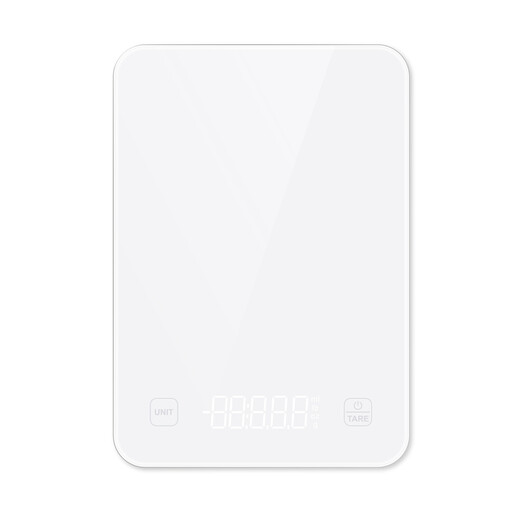
Unique Bluetooth Kitchen Scale, 10 kg, 1 g, White
For larger quantities of dry polenta or other ingredients, compare the stated 10 kg capacity with the total weight you intend to place on the scale.
The product name specifies 1 g precision, tempered glass and app integration. Check its dimensions, tare control and display visibility with your bowl if those affect your choice.
Joybuy
Common questions
Do I need 0.1 g increments to measure polenta?
Choose increments that match your recipe rather than assuming you need 0.1 g. If the recipe specifies fractions of a gram, check the exact scale’s stated increments; a 1 g specification is not equivalent to 0.1 g.
How do I weigh polenta and other ingredients in one bowl?
Put the empty bowl on a scale with tare or add-and-weigh, reset the reading to zero, then add the polenta. Reset it again before each further ingredient that the recipe measures separately; Salter and Joseph Joseph describe this function on the models discussed above.
How should I dispose of an old battery-powered kitchen scale in the UK?
Take a scale or batteries marked with the crossed-out wheelie-bin symbol to an appropriate collection point rather than putting them in household rubbish, as GOV.UK advises. Use an electrical-waste collection route for the scale and a battery collection point for removable batteries.


