Cooks stepping away from the hob
If you will be unpacking, setting the table or preparing other food, choose an alert you can notice and a display you can check quickly when you return.


For a sauce simmering in a holiday cottage, choose a digital countdown timer with an alarm you can hear, a display you can read at a glance and a position where you can keep it in view. Check the maximum countdown against your cooking plan: a longer-duration model makes more sense if a single timing period could exceed 99 minutes. A battery-free mechanical timer is an alternative for a short, single-stage check, but the documented examples are limited to one hour.
If you will be unpacking, setting the table or preparing other food, choose an alert you can notice and a display you can check quickly when you return.
If one countdown must cover more than the sauce’s next check, compare its maximum duration with your longest planned timing period.
For a short, single-stage simmer, a mechanical timer avoids reliance on spare batteries. The documented Salter and Taylor examples run for up to 60 minutes.
For a cottage sauce, decide which need governs your choice: noticing the reminder, keeping the countdown in view or avoiding batteries.
| Concern | What to check | Who this matters to |
|---|---|---|
| Audible alert and timing range | Check the maximum countdown and test whether you can hear the alert from where you expect to be. | When I step away to set the table, I need a reminder I can notice before the cooking plan outlasts it; around 46% of consumers would put audible, long-duration monitoring first. |
| Visibility and placement | Check the display and whether the timer can stand securely if there is no suitable magnetic surface. | In an unfamiliar kitchen, I want to see the remaining time without searching for the timer; around 36% of consumers would prioritise a clear view and practical placement. |
| Battery-free simplicity | Check whether a mechanical timer’s dial and maximum duration suit your planned interval. | For one short simmer check, I would rather not depend on spare batteries; roughly 18% of consumers would put battery-free operation first. |
A timer can cover one sauce check yet still need resetting during a longer cooking plan. Salter specifies up to 19 hours 59 minutes 59 seconds for its Loud Digital Kitchen Timer; the Taylor's Eye Witness SSD022 and Lakeland Extra Loud Digital Kitchen Timer are specified up to 99 minutes 59 seconds.
Before buying, compare the longest single countdown you intend to set with the timer’s stated limit.
Magnetic placement needs a suitable surface in a position where you can see the timer. A freestanding option gives you another place to put it.
Check for a stable counter position and keep the timer away from heat and splashes.
A timer measures elapsed time, not whether food is cooked through. GOV.UK’s food-hygiene guidance for businesses says reheated food should be steaming hot all the way through and reheated only once.
Use the alarm as a prompt to check and stir the sauce, following the recipe and appropriate food-safety guidance rather than relying on time alone.
GOV.UK consumer guidance says batteries and electrical products bearing the crossed-out-wheelie-bin symbol should be recycled rather than put in household rubbish.
Take portable batteries to an appropriate collection point and use an electrical-waste recycling or eligible retailer take-back route for the timer.
Salter’s kitchen-timer range includes digital and battery-free mechanical options.
The SSD022 Professional Digital Kitchen Timer offers a portable digital option.
Lakeland’s Extra Loud Digital Kitchen Timer is a simple digital option with magnetic or freestanding placement.
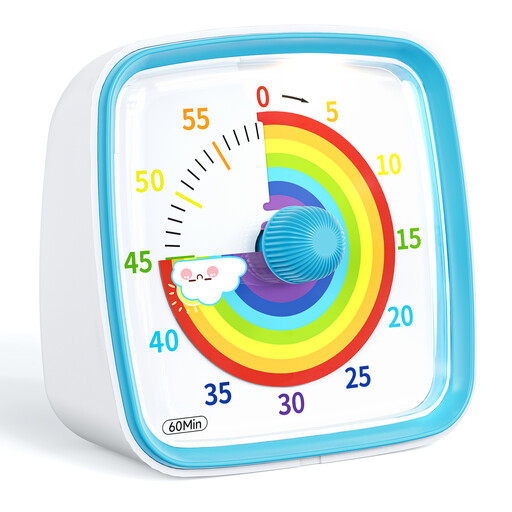
This visual countdown option is suited to considering for a single sauce-check interval of up to 60 minutes. If you need a numeric digital display or a particular place to mount it, confirm those details before choosing it.
 No image available
For a single sauce-check interval lasting no more than 60 minutes, this visual timer offers a countdown without relying on the cottage’s cooker timer.
The Blue Rainbow variant is described as a 60-minute timer with a mute alarm function. Check whether its alert is noticeable where you plan to be, and confirm the display and placement if those features matter to you.
Start with an alert you can hear and a countdown you can see from a practical position. Then compare the maximum duration with your longest planned interval: the Lakeland Extra Loud Digital Kitchen Timer is specified to 99 minutes 59 seconds, while Salter’s Loud Digital Kitchen Timer is specified to 19 hours 59 minutes 59 seconds.
No. The alarm tells you that the set time has passed, not that food is cooked through. GOV.UK’s food-hygiene guidance for businesses says reheated food should be steaming hot all the way through and reheated only once; follow the recipe and appropriate food-safety checks as well as the timer.
Yes, if a short, single-stage reminder is enough. The documented Salter and Taylor mechanical timers need no batteries but run for no more than 60 minutes, so check that limit against the interval you need to time.
Use an appropriate battery collection point for portable batteries and an electrical-waste recycling route for the timer. GOV.UK consumer guidance says batteries and electrical products bearing the crossed-out-wheelie-bin symbol should not go in household rubbish; an eligible retailer take-back route may also be available.