Who needs which features?
The useful features depend on whether the harder part is sharing a visible countdown, repeating a duration or noticing that time is up.
Shared-kitchen bread bakers
When bowls and other users occupy the worktop, a timer that everyone can locate and read gives the proving interval a clear reference point. Check the display from its intended position and whether a magnet or stand works there.
Long or repeat-proving planners
If a proving interval may exceed a short countdown, compare the longest planned duration with the model’s stated limit. For a routine that uses the same duration repeatedly, check whether that exact timer offers memory.
Missed-alert avoiders
If you leave the worktop or work near noisy appliances, consider where you will be when the countdown ends. Adjustable volume may help in some settings; a light alert helps only when you can see the timer.
What matters when choosing?
Start with the longest interval you need to time, then decide where the countdown will sit and how its end alert will reach the person responsible for the dough.
| Concern |
What to check |
Who this matters to |
| Shared visibility |
Read the display from the proving location; check for a suitable magnetic surface or stable place for a stand. |
When others share the worktop, I want to find the active countdown without moving bowls or interrupting preparation. Around 36% of consumers put a visible shared reference first. |
| End alert |
Look for adjustable volume or a visual alert, and consider where you will be able to hear or see it. |
If I step away or appliances are running, I need a notification I am likely to notice. Alert reliability comes first for around 29% of consumers. |
| Duration and repeat use |
Compare the maximum countdown with your longest interval; check for memory if you reuse a setting. |
For a long prove or a familiar repeated schedule, I do not want to reset the timer partway through or enter the same duration each time. Around 21% of consumers primarily need sufficient range or repeatability. |
| Placement and upkeep |
Find a position away from spills and check the model’s care instructions and battery requirements. |
In a busy shared space, I want a timer that is straightforward to position and maintain without leaving it in the preparation area. A manageable setup is the main concern for around 14% of consumers. |
Brands to consider
These model-specific examples show different ways to handle duration, placement and alerts; a feature listed for one timer should not be assumed across its brand.
Hygiplas
Nisbets lists both a long-range Big Digit Timer CF916 and a shorter-range Magnetic Countdown Timer DP028.
- The CF916 has a large screen, magnetic arm and a stated maximum countdown of 99 hours, 59 minutes and 59 seconds, according to Nisbets.
- Nisbets specifies a 99-minute-59-second range for the DP028, so the compact model needs a separate duration check.
Salter
Its Loud Digital Kitchen Timer offers a combination of extended timing, adjustable sound and repeat-setting features.
- Salter specifies count-up or countdown to 19 hours, 59 minutes and 59 seconds, three volume levels, large buttons and memory for this model.
- Those features describe the named timer, not every Salter model; an audible alert still needs to suit your kitchen.
Taylor
The Taylor Pro Super Loud Digital Timer pairs an audible alert with a red light alert.
- The Range lists an adjustable ringer up to 95 dB, magnetic back and stand for this model.
- Its listed maximum countdown is 99 minutes and 59 seconds, and its two required AAA batteries are not included.
Lakeland
The Extra Loud Digital Kitchen Timer is a straightforward option when the intended interval fits a shorter range.
- Lakeland lists a large screen, magnetic or freestanding placement and count-up or countdown to 99 minutes and 59 seconds.
- Check that the duration and audible alert meet your needs rather than assuming this model offers memory or a light alert.
Joybuy product choices
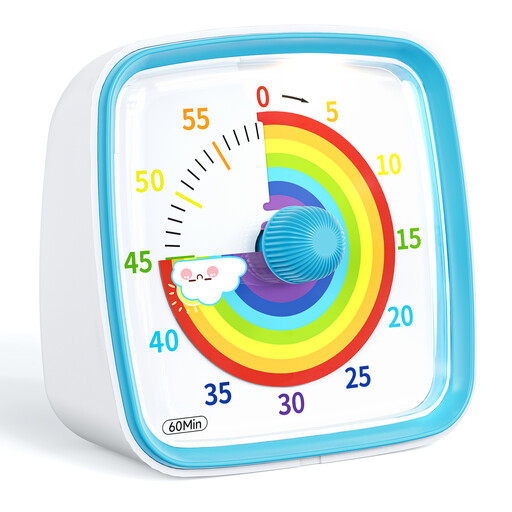
For a short proving interval, this visual countdown timer offers a way to follow remaining time without a numerical digital readout. Check its 60-minute limit and whether its alert and placement suit your shared kitchen before choosing it as an alternative to a digital timer.
 No image available
Yunbaoit Rainbow Visual Timer, 60-minute Blue Rainbow
Consider this timer if your intended interval fits within 60 minutes and you prefer a coloured disk that shows time elapsing rather than a numerical digital display.
The product description lists a twist-to-set countdown and mute-flash, low and loud alarm modes. Check how the alert modes work and where you can place the timer before relying on it to notify someone elsewhere in the kitchen.
View on Joybuy
Frequently asked questions
How long a countdown do I need for bread proving?
Choose a maximum countdown that covers your longest intended proving interval. The limits differ considerably by model: Salter specifies 19 hours, 59 minutes and 59 seconds for its Loud Digital Kitchen Timer, while Nisbets lists 99 minutes and 59 seconds for the Hygiplas DP028. Check the exact timer rather than assuming a digital display means a long range.
Is a magnetic or freestanding timer more practical in a shared kitchen?
Either can work if it keeps the active countdown visible without obstructing another user. Check for a suitable metal surface before relying on a magnet; for a stand, find a stable position away from spills and flour-heavy preparation.
How should a timer be cleaned in a shared food-business kitchen?
Include the timer in the business’s cleaning routine and follow its own care instructions. GOV.UK says food-business cleaning schedules must specify what is cleaned, how often and which products are used, and includes electronic devices among touch points requiring regular cleaning.
Does using a timer take care of allergen requirements?
No. If the shared kitchen operates as a food business, GOV.UK guidance requires allergen information and appropriate management of allergens during food preparation and sale, including measures against cross-contamination and staff training. A proving timer can organise a schedule, but it cannot replace those procedures.


