Single-cake home bakers
If you mainly follow one recipe countdown, a clear display and an end-of-bake beep may be more useful than additional cooking controls. Check that the timer’s maximum duration covers the bake.


For a single cake bake that fits within 99 minutes 59 seconds, a digital countdown timer with a readable display, audible alert and suitable placement is a sensible starting point. Consider a louder, longer-running model for extended stages or a more noticeable alert; choose a probe-equipped timer only when your recipe calls for temperature monitoring as well as timing.
If you mainly follow one recipe countdown, a clear display and an end-of-bake beep may be more useful than additional cooking controls. Check that the timer’s maximum duration covers the bake.
If you prepare icing, clean up or leave the kitchen while a cake bakes, consider where the timer will sit and how readily you will notice its alert. Loud or adjustable alarms are features to check on the exact model.
If a recipe specifies a temperature target as well as a timed stage, a timer with a food probe and temperature alarms can address both tasks. A basic elapsed-time timer cannot measure temperature.
Start with the longest interval your recipe asks you to time. Then decide how you need to see and hear the reminder, and whether the recipe calls for a temperature reading.
| Concern | What to check | Who this matters to |
|---|---|---|
| Readable countdown and alert | Look at the display, controls and stated alarm options on the exact model. | If I check the time while preparing the cake, I want to read it at a glance and notice when the bake ends. Around 42% of consumers put a readable, noticeable reminder first. |
| Simple timing and placement | Check count-up and countdown functions, the timing limit and whether a suitable stand, magnet or clip is supplied. | I need to keep one recipe timer where I can see or hear it without disrupting my work area; roughly 33% of consumers prioritise straightforward timing and placement. |
| Extended-stage timing | Compare the maximum duration with your longest task; check for adjustable volume or memory if you would use them. | When proving, resting or cooling needs a longer interval, I would rather not reset a short countdown partway through. Around 17% of consumers put extended timing first. |
| Temperature monitoring | If the recipe specifies a temperature target, check the probe, stated range and alarm functions for the exact model. | For a temperature-led step, knowing how long it has run is not enough for my recipe; about 8% of consumers primarily need temperature monitoring alongside timing. |
Salter’s Contour timer and Lakeland’s Classic Digital Kitchen Timer are specified to 99 minutes 59 seconds. That ceiling may cover an oven countdown but not a longer baking-related task.
Compare the maximum count-up or countdown duration with the longest interval you intend to track before choosing a model.
An alarm described simply as a beep does not tell you how it will suit a noisy kitchen. Salter specifies three adjustable volume levels for its Loud Digital Kitchen Timer, but that feature should not be assumed for its other models.
If missing an alert is your main concern, check the exact model’s stated alarm options and choose a placement you can use while baking.
A countdown cannot tell you a cake’s internal temperature. Thermapen’s ChefAlarm combines timing with probe-based temperature monitoring, which is a different function from a basic cake timer.
Use a time-only timer when the recipe calls for timing alone. Where it specifies a temperature target, check the probe’s suitability, stated range and care instructions.
If you start selling cakes as a food business in the UK, timing equipment does not replace registration or a food-safety management system. The Food Standards Agency says to register at least 28 days before trading or food operations start; GOV.UK says food businesses must make and follow a system for managing food safety.
Deal with those business requirements separately from your choice of kitchen timer.
Salter lists compact digital timers alongside a louder model intended for longer intervals.
The Classic Digital Kitchen Timer is a compact option for a straightforward recipe countdown.
Judge’s Kitchen Digital Kitchen Timer offers several ways to position a compact timer while working.
Its Professional Digital Kitchen Timer is aimed at shoppers who want a large display and several placement options.
ChefAlarm combines an elapsed-time timer with a food probe for recipes that call for temperature monitoring.
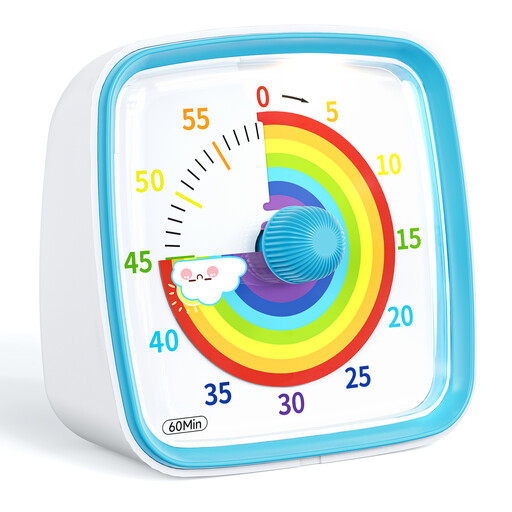
This visual countdown timer offers a different display format from the numeric digital timers discussed above. Consider it for a timed cake stage of no more than 60 minutes if a coloured disk suits the way you check progress.
 No image available
For a cake stage lasting no more than 60 minutes, the coloured disk provides a visual countdown rather than a numeric digital readout.
If you need an audible end-of-bake reminder, check the alert setting rather than using its mute mode. Confirm that the timer’s placement and setting increments suit your kitchen and recipe.
It can suit a single recipe countdown that fits within that limit. Check your longest timed stage, including any proving, resting or cooling you want to track; choose a longer-running model if that stage exceeds 99 minutes 59 seconds.
Put it where its display or alert works for you, using a placement method specified for the exact model. A stand needs worktop space, a magnet needs a suitable metal surface, and a clip is an option only when supplied.
No. A basic timer measures elapsed time, not food temperature. If your recipe specifies a temperature target, look for a suitable food probe and temperature alerts; Thermapen’s ChefAlarm combines those functions with a timer.
If you are starting a food business, the Food Standards Agency says to register with your local authority at least 28 days before trading or food operations start. GOV.UK also says food businesses must make and follow a food-safety management system; a kitchen timer does not fulfil those requirements.