Occasional solo roast cook
If you make a small beef roast infrequently and can check it near the end of cooking, an instant-read probe lets you take a manual reading without setting up continuous monitoring.


For an occasional small beef roast, a handheld instant-read probe is the straightforward choice if you only need to check the centre near the end of cooking. Choose an oven-safe leave-in probe to follow the temperature without repeated checks, or a wireless model if phone-based monitoring is worth the charging and connectivity setup.
If you make a small beef roast infrequently and can check it near the end of cooking, an instant-read probe lets you take a manual reading without setting up continuous monitoring.
If you would rather follow the roast's temperature while preparing the rest of your meal, consider a purpose-designed leave-in oven probe with a timer or alert.
If you also grill or smoke food, or want to check a roast from your phone, a wireless probe may suit those wider uses. Allow for charging, app setup and Bluetooth-range considerations.
For a one-person beef roast, decide whether you need a manual reading, continuous oven monitoring or updates on your phone. Whichever format you choose, identify the type of beef joint before deciding what temperature to aim for.
| Concern | What to check | Who this matters to |
|---|---|---|
| Manual spot checks | Check that the probe can reach the centre of your roast and that the display shows suitable cooking temperatures in °C. | If I cook a small roast only occasionally, I want to check its centre without setting up an app or leaving equipment in the oven. Around 50% of consumers put straightforward spot-checking first. |
| Oven monitoring | Look for an explicitly oven-safe probe and a timer or target-temperature alert if you want one. | When I am preparing the rest of my meal, I would rather track the roast than open the oven for repeated checks. For around 38% of consumers, oven monitoring is the primary need. |
| Remote updates | Check the connection method and stated range conditions, as well as how the probe is charged. | If I also grill or smoke food, I want to follow its temperature from my phone when I am away from the cooker. Remote access comes first for roughly 12% of consumers. |
Food Standards Scotland distinguishes a beef joint whose exterior has been properly cooked or sealed from a rolled joint, which needs cooking all the way through.
Check whether your roast is rolled before choosing a target temperature, and follow its pack instructions and applicable food-safety guidance.
An instant-read thermometer intended for a manual check is not automatically suitable for continuous oven use.
Only leave a probe in the roast if its product instructions expressly permit oven use; otherwise use it for a manual reading.
A probe that has touched raw or partly cooked meat can transfer contamination. GOV.UK advises fully cleaning a temperature probe after each use.
Clean the probe according to its care instructions before using it again.
Remote alerts help only if you intend to use them; they are not needed to take a reading beside the oven.
Compare wireless monitoring with a handheld or oven-safe leave-in probe against the way you actually cook.
Charging, pairing and managing the Bluetooth connection add steps when you want to monitor remotely.
Salter's Precision Meat Thermometer is a handheld option for manual roast checks.
Thermapen ONE is an instant-read option for cooks who want stated response-speed and accuracy specifications.
Lakeland's Digital In-Oven Kitchen Thermometer is designed to monitor meat during cooking rather than provide only a handheld spot check.
MEATER Pro is a wireless option for cooks who want phone-based monitoring across roasting and other cooking methods.
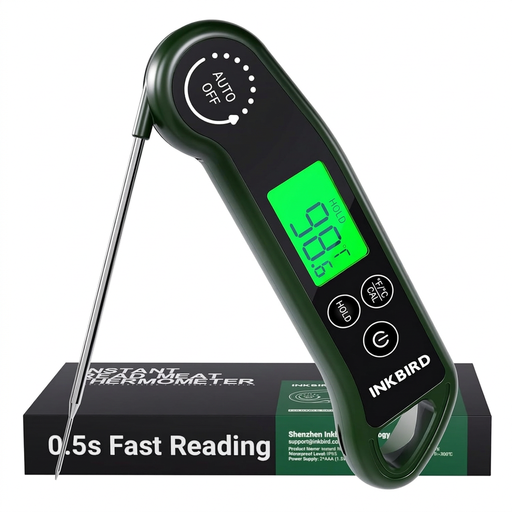
This digital meat thermometer is worth considering for a manual roast check if its probe configuration and cooking-temperature specifications meet your needs.
 No image available
Consider it for a manual check near the end of roasting only after confirming that it includes a contact probe suitable for reaching the centre of your roast.
The product title specifies an LCD screen. Check the probe length, temperature units and operating range against your intended use.
Insert a clean probe into the thickest part to check the centre rather than the surface. Food Standards Scotland advises checking more than one place when needed for a large dish.
Food Standards Scotland says a beef joint can be served rare when its outside has been properly cooked or sealed. Rolled joints are different: they need to be cooked all the way through.
Cook a rolled joint all the way through and check its core temperature. Food Standards Scotland gives 75°C or above in the thickest part as the thermometer reading for thoroughly cooked food; follow the joint's pack instructions too.
Yes. GOV.UK advises fully cleaning a cooking thermometer after each use to avoid cross-contamination and obtain an accurate reading; follow the thermometer's care instructions.