Solo cooks who want a quick check
If you usually cook one fillet, a readable display and a probe tip that reaches its thickest centre can make a brief temperature check easier.


For a single fish portion, an instant-read digital probe is usually the practical choice for a brief check at the thickest part before serving. Look for a tip that can reach the centre of the portion and a display you can read easily; consider a model with documented response time and accuracy if you check fish frequently. A leave-in alarm thermometer is more relevant when you want continuous monitoring during oven cooking.
If you usually cook one fillet, a readable display and a probe tip that reaches its thickest centre can make a brief temperature check easier.
If you rely on close temperature decisions, look for a stated accuracy tolerance and calibration information as well as a display you can read clearly.
If you cook fish infrequently, a compact probe with a clear Celsius display may meet your needs without taking up much drawer space.
For one fish portion, decide whether a quick spot-check, confidence in the reading or easy storage matters most to you.
| Concern | What to check | Who this matters to |
|---|---|---|
| Quick spot-checks | Check for an instant-read design, a stated response time and a tip that can reach the thickest centre of the portion. | When one fillet is nearly cooked, I want a reading without keeping it on the heat while I wait. Around 38% of consumers put a quick check first. |
| Confidence in the reading | Look for a stated accuracy tolerance rather than display increments alone, and check the maker’s cleaning and calibration guidance. | If a temperature decision is close, I need to trust both the probe’s specification and where I place its tip. Measurement confidence comes first for roughly 38% of consumers. |
| Compact storage | Consider a protected or foldable probe and a clear Celsius display; check whether the battery is included. | I cook fish only occasionally, so I want a probe that is simple to store and find when needed. About 24% of consumers prioritise that compact, straightforward setup. |
A display that changes in 0.1°C steps does not establish an accuracy tolerance of ±0.1°C. Electronic Temperature Instruments states both 0.1°C resolution and ±0.3°C accuracy for Thermapen ONE.
If close temperature decisions matter to you, compare published accuracy tolerances and calibration information, not just the number of digits on screen.
A reading taken away from the centre may not represent the part of the fish you need to check.
Salter’s probe instructions say to insert the tip into the centre of the thickest part. Avoid bone or other non-flesh contact, and clean the probe between uses.
A leave-in alarm adds continuous monitoring, which may offer little practical value when you only need to check a quickly cooked fillet before serving.
Choose an instant-read probe for spot-checks. Consider a dedicated leave-in model when your cooking method calls for ongoing monitoring.
An instant-read probe may not be designed to remain in the cooking environment; Salter’s instant-read instructions say not to leave that thermometer in the oven while cooking.
Check the instructions for your model. Use a dedicated leave-in thermometer if you need to monitor food throughout oven cooking.
Thermapen ONE is an instant-read option for cooks who want published speed and accuracy specifications.
The Chef’s Precision Digital Instant Read Thermometer is a home-use option with a pivoting display head.
Salter offers both a foldable instant-read probe for spot-checks and a leave-in thermometer for continuous monitoring.
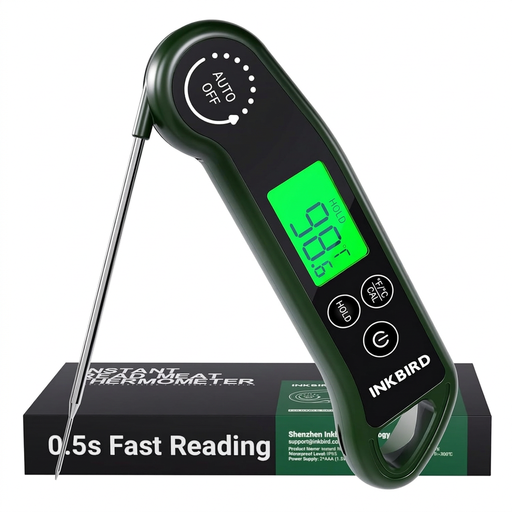
This instant-read food probe is a choice to consider for a brief cooking-temperature check. Before using it for a fish portion, confirm that its tip can reach the thickest centre and that its display shows the units you need.
 No image available
Consider this instant-read probe for a brief food-temperature check if its tip suits the thickness of your fish portion.
The product title states a 0.5-second reading and an LCD screen. Check its Celsius display, accuracy tolerance and probe shape against the way you plan to use it.
Follow the fish product’s cooking instructions where provided; one number should not replace directions specific to that product. For a general thoroughly cooked approach, Food Standards Agency MyHACCP material says normal cooking temperatures of 70°C for two minutes kill Salmonella and Campylobacter, but it is not a species-specific fish cooking guide.
Place the sensing tip in the centre of the thickest part, following Salter’s food-probe instructions. Keep it away from bone and other non-flesh material that could affect the reading, then wait for the display to settle.
Use an instant-read probe for brief checks unless its manufacturer specifically says it is suitable to remain in the cooking environment. Salter’s instant-read instructions say not to leave that model in the oven; a dedicated leave-in thermometer is designed for continuous monitoring.
Clean the probe between uses, as Salter’s instructions advise. If you suspect an inaccurate reading, National Caterers Association guidance describes checking for a reading between −1°C and 1°C in melting ice; follow your thermometer’s instructions if it needs adjustment.