Choose an instant-read probe if you mainly want a manual centre-temperature check near the end of cooking. Choose a leave-in probe for continuous oven monitoring, or a wireless model if remote alerts matter enough to justify its charging, app and connectivity requirements. Check whether your beef joint is intact or rolled before applying cooking guidance: GOV.UK distinguishes the two, and the probe must be clean when you take a centre reading.
Who each format suits
Cooks making an occasional Sunday roast
If you want a centre reading shortly before resting or serving an intact beef joint, an instant-read probe gives you a direct manual check. You will need to take each reading yourself rather than receive an oven alert.
Cooks managing the roast alongside other dishes
A leave-in probe lets you follow the roast without opening the oven for every check. If alerts away from the oven are important, consider a wireless model and check how its app and connection work in your kitchen.
Cooks checking a rolled beef joint
Identifying the joint matters before choosing a cooking target. GOV.UK food-business guidance distinguishes rolled joints, which must be cooked all the way through, from intact whole beef roasting joints; a clean probe provides a centre reading for a thorough-cooking check.
What matters when buying
Decide whether you need a spot check, continuous oven monitoring or alerts away from the oven. Then compare the features of the exact model, particularly its stated accuracy, probe-use instructions and cleaning requirements.
Instant-read probe
Choose it when: You expect to check the centre once or a few times near the end of cooking.
Trade-off: Each reading is manual; the probe will not alert you while the roast cooks.
Leave-in wired probe
Choose it when: You want to follow the roast in the oven and receive an alarm without repeated spot checks.
Trade-off: You must position the probe and cable before cooking and use a model specifically designed to remain in the oven.
Wireless smart probe
Choose it when: App alerts away from the oven are important to how you manage the cook.
Trade-off: Charging, app compatibility and connectivity become part of using the thermometer.
| Concern |
What to check |
Who this matters to |
| Roast type and a clean centre reading |
Check that the food probe can reach the centre and that its cleaning instructions are practical to follow. |
I want to know whether my joint is intact or rolled and take a clean reading where thorough cooking is required. Around 33% of consumers put this safety-focused check first. |
| Preferred doneness |
Compare stated accuracy at cooking temperatures and response time; display increments alone do not establish accuracy. |
For an intact whole joint, I want a quick reading before deciding whether to rest it or cook it longer. Roughly 27% of consumers make repeatable doneness their primary concern. |
| Monitoring during cooking |
Confirm leave-in suitability or wireless operation, alarm features and the exact probe’s temperature limits. |
While I prepare other dishes, I would rather follow the roast than open the oven for repeated checks. Around 20% of consumers prioritise unattended monitoring. |
| Straightforward occasional use |
Check the Celsius display, storage arrangement and cleaning instructions for the model you are considering. |
If I check a roast only occasionally, I want a thermometer I can store and use without setting up alerts. About 20% of consumers put simple ownership first. |
Mistakes to avoid
-
Treating a rolled joint like an intact beef roast
The distinction changes the cooking decision. GOV.UK food-business guidance says rolled joints must be cooked all the way through, whereas intact whole beef roasting joints require surface sealing.
Check the pack description or ask the butcher which type you have, then follow the relevant cooking instructions. Use a clean probe for a centre reading when checking thorough cooking.
-
Buying an instant-read probe when you need an alarm
An instant-read thermometer gives manual readings, not continuous monitoring while the roast stays in the oven.
If you need an alert while doing other tasks, look for a leave-in or wireless model and confirm its intended oven use, alarm function and probe limits.
-
Mistaking display resolution for accuracy
A display that changes in 0.1°C steps does not, by itself, tell you how close its reading is to the actual temperature.
Compare stated accuracy separately and check the temperature range to which it applies. Thermapen, for example, states ±0.3°C accuracy for Thermapen ONE within a specified range.
-
Reusing a probe without cleaning it
GOV.UK advises fully cleaning a cooking thermometer probe after each use to avoid cross-contamination. A reading you suspect is inaccurate can also mislead a cooking decision.
Follow the thermometer’s cleaning instructions after every use. If its readings seem wrong, consult the manufacturer’s checking or recalibration instructions before relying on it again.
Brands to consider for these thermometer formats
Thermapen
Thermapen ONE is a handheld instant-read option for a manual check near the end of roasting.
- Thermapen states a one-second reading and ±0.3°C accuracy within its specified range for Thermapen ONE.
- Its instant-read format does not provide unattended oven monitoring or alerts.
Salter
The cited Salter models cover both foldable instant-read checks and leave-in oven monitoring; their functions should not be treated as interchangeable.
- Salter states 2–3-second readings for its cited foldable model and continuous monitoring with alarms for its cited leave-in model.
- Check the exact model before leaving a probe in the oven; an instant-read model is not a substitute for a leave-in design.
MEATER
MEATER Pro is a wireless option for cooks who want app-linked alerts and internal and ambient temperature sensing.
- MEATER states that MEATER Pro has five internal sensors and one ambient sensor.
- Charging, app use and connectivity add considerations that a basic manual probe does not have.
Joybuy products for manual roast checks
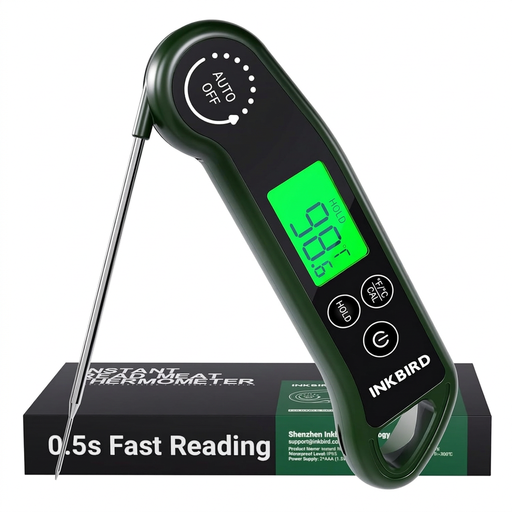
This instant-reading thermometer is relevant if you plan to check a beef roast manually. Before relying on it for a centre reading, confirm how its probe is used and cleaned, and check its stated accuracy and display units.
 No image available
INKBIRD RHT-11K K-Sensor digital meat thermometer, green
For someone planning a manual roast check, its product title describes instant reading and an LCD screen. The title claims a 0.5-second reading; check the conditions for that claim, stated accuracy, Celsius display, probe-use instructions and cleaning guidance before using it to assess the roast centre.
View on Joybuy
Questions about checking a roast
Where should I put the probe in a beef roast?
Put a clean food thermometer probe into the centre when checking whether the joint is cooked through. GOV.UK guidance uses a core reading for a thorough-cooking check; surface colour or oven temperature is not a substitute for that reading.
Do whole and rolled beef joints follow the same cooking guidance?
No. GOV.UK food-business guidance says intact whole beef roasting joints need surface sealing, while rolled joints must be cooked all the way through. Identify your joint and follow its pack or recipe instructions alongside applicable food-safety guidance.
What temperature guidance applies when a joint needs thorough cooking?
GOV.UK gives a core temperature of 70°C for 2 minutes as standard thorough-cooking advice. Do not automatically treat that as the preferred-doneness target for an intact whole beef roasting joint; first establish which type of joint you have.
Should I choose an instant-read or leave-in thermometer?
Choose instant-read for a quick manual centre check near the end of cooking; choose leave-in if you want to monitor the roast and receive an alarm while it remains in the oven. Confirm that the exact leave-in model and its probe are intended for that use.
How often should I clean the probe?
Clean it after every use. GOV.UK advises fully cleaning a cooking thermometer probe to avoid cross-contamination; follow the model’s instructions for cleaning and for checking readings that seem suspect.


