Occasional self-catering reheaters
If you mainly reheat a prepared or leftover casserole while away, a readable instant-read probe lets you check the middle before serving. Continuous cooking monitoring is unlikely to add much to that task.


For an occasional casserole check, choose an instant-read food probe that displays °C and can reach the middle of the dish. A folding, water-resistant model is more useful if you will pack it for trips or use it regularly, but a temperature reading does not replace stirring, the food’s reheating instructions or checking that it is hot throughout.
If you mainly reheat a prepared or leftover casserole while away, a readable instant-read probe lets you check the middle before serving. Continuous cooking monitoring is unlikely to add much to that task.
If the cottage microwave heats food unevenly, stir the casserole before checking it with the probe. NHS guidance on microwave reheating also advises stirring to address unevenly heated areas.
If the thermometer will also be used for other cooking at home and away, a protected folding probe, a readable display and model-specific cleaning instructions become more important than they are for one meal.
Start with a probe you can use to check the casserole’s middle and read in °C. Then decide whether easier packing, cleaning or repeated use warrants additional features.
| Concern | What to check | Who this matters to |
|---|---|---|
| Centre reading | Look for a readable °C display and a probe that reaches the middle of the portion. Follow the food’s reheating instructions when interpreting the reading. | When a casserole looks hot on top, I want to check whether its middle has heated through; around 36% of consumers would put centre checks first. |
| Microwave evenness | Choose a probe that is easy to reposition for spot checks. Stir the food before measuring rather than relying on one hot area. | If I use a microwave, I need to deal with uneven heating before serving; for roughly 29% of consumers, avoiding cold spots would be the main concern. |
| Packing and cleaning | Check for a protected or folding probe and follow the exact model’s cleaning and water-resistance instructions. | Packing for a short stay, I want a tool I can store safely and clean after use; around 21% of consumers would prioritise portable, easy-clean handling. |
| Use after the trip | If you cook regularly, compare stated response time and accuracy, guarantee terms and whether you need continuous monitoring. | I plan to use the thermometer for more cooking after the holiday, so repeated-use features matter to me; for around 14% of consumers, longer-term versatility would come first. |
A guide printed on a thermometer cover may address meat cooking rather than the directions for your particular casserole.
Follow the food label, check the middle with the probe and make sure the dish is hot throughout. NHS advice on reheating food for babies calls for food to be steaming hot all the way through.
A hot reading near the edge does not tell you whether a thick central portion has heated evenly.
Stir thoroughly, allow any standing time directed on the label, then check the thickest central area. Check another area if heating appears uneven.
Salter’s leave-in model offers food and oven monitoring with target alarms, functions intended for monitoring food as it cooks rather than checking a finished casserole before serving.
Choose continuous monitoring if you will also use it for longer cooking sessions; otherwise, focus on an instant-read probe you can position and clean easily.
Water resistance is model-specific: Electronic Temperature Instruments lists IP67 protection for Thermapen ONE, while Salter describes its folding model as waterproof.
Follow the exact thermometer’s cleaning instructions, and keep a used probe from contaminating ready-to-eat food or clean surfaces.
Its Thermapen ONE is aimed at cooks who want documented specifications for frequent spot checks.
Its range includes folding instant-read and leave-in kitchen thermometers for different checking routines.
Its Chef’s Precision instant-read model offers a large display and pivoting head for straightforward spot checks.
The Digital Meat Thermometer Probe may suit cooks who prefer a longer handle and a retained reading.
This digital cooking thermometer is a possible choice for spot checks; confirm that the exact probe and display suit a reheated casserole before buying.
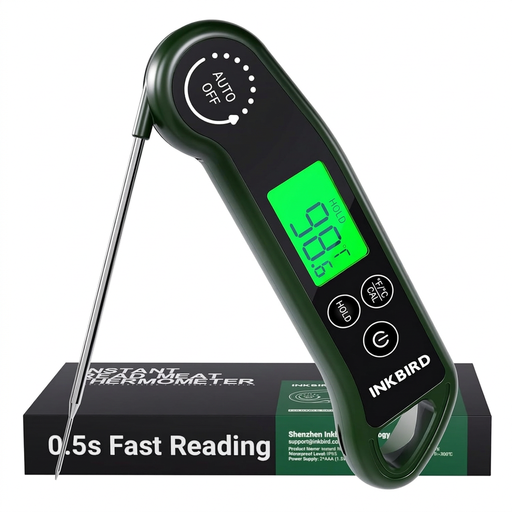 No image available
Consider this thermometer for a cooking-temperature spot check only after confirming that its probe can reach the casserole’s middle. Its product name states that it has an LCD screen and advertises a 0.5-second reading; check the display units, temperature range and cleaning instructions for this variant.
Follow the casserole’s packaging or recipe instructions and check that it is hot throughout, rather than treating one probe reading as the whole test. For people at increased risk of infection, Cambridge University Hospitals advises reheating food to at least 70°C in the middle; that advice has a specific audience and is not a universal threshold for every cottage guest.
Insert a clean probe into the thickest central part of the casserole without touching the dish. If you used a microwave, stir the food before checking; NHS microwave-reheating advice emphasises stirring to address uneven heating.
An instant-read probe is usually the simpler option when you only want to check a reheated casserole before serving. Consider a leave-in model if you also want continuous monitoring during longer cooking tasks; Salter’s dual-sensor model, for example, monitors food and oven temperatures.
No. A probe measures temperature only where you insert it; follow the food’s storage, defrosting and reheating instructions as well as checking that it is hot throughout.