What matters when choosing?
For a pork joint, establish how you will measure its centre first. Then decide whether you need a manual reading at the end or temperature updates during cooking.
| Concern |
What to check |
Who this matters to |
| Core-temperature check |
Look for a Celsius display and a food probe that reaches the joint’s centre; check the cleaning instructions. |
When the outside has browned, I still need a clean-probe reading from the centre rather than relying on appearance. Roughly 42% of consumers put core-temperature confirmation first. |
| Monitoring during roasting |
Check that the exact model is intended for leave-in use, and review its alerts, power needs and stated temperature limits. |
For a long roast or several dishes, I want to follow the joint’s temperature without repeatedly opening the oven. About 33% of consumers make ongoing monitoring their primary concern. |
| Simple final reading |
Check display legibility, Celsius units and the probe’s handling and measurement range. |
If I only take a final reading, I want to see it clearly and remove the probe after checking. Around 25% of consumers prioritise a straightforward manual check. |
Joybuy products for manual checks
This instant-read meat thermometer is relevant if you plan to take a manual reading while roasting. Before choosing it for a pork joint, check the listing and instructions for Celsius display, probe reach and cleaning.
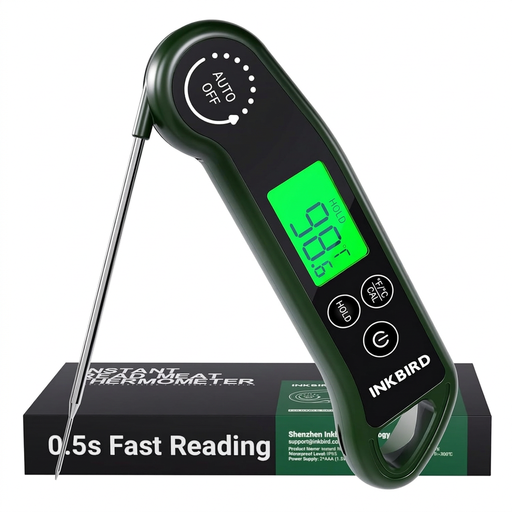 Image unavailable
INKBIRD RHT-11K K-Sensor Digital Meat Thermometer, Green
For a manual temperature check while roasting, this model is described as instant-read and has an LCD screen.
The product title claims a 0.5-second reading; treat that as a listing claim rather than an independently measured result. Confirm Celsius display, probe reach and cleaning instructions for this variant before using it to check a pork joint.
View on Joybuy
Common questions
What temperature should I check for in a pork joint?
GOV.UK food-hygiene guidance for businesses gives a core temperature of 70°C held for 2 minutes as standard cooking advice. It says to insert a thermometer with a clean probe into the centre of the food; a temperature reading alone does not replace the stated holding time.
Where should the probe go in a pork joint?
Insert a clean probe into the centre of the joint, aiming for the thickest central meat rather than treating a surface reading as the core temperature. GOV.UK’s food-hygiene guidance identifies the centre of the food as the checking point.
Should I use an instant-read or a leave-in thermometer?
Use an instant-read probe for occasional manual checks; consider a leave-in model if you want temperature updates and an alarm during roasting. OXO describes its Chef’s Precision model as instant-read, while Salter describes its leave-in model as monitoring food and oven temperatures.
Can I leave any digital food probe in the oven?
Only leave a probe in place if the exact model’s instructions permit that use. Check its stated temperature limits and setup requirements; an instant-read label alone does not establish leave-in suitability.
How should I clean a probe after checking pork?
Use a clean probe for the check and follow the cleaning instructions for your exact thermometer. Salter’s instructions for its cited leave-in model say to clean the probe thoroughly after each use, wipe it with a damp cloth and not put it in a dishwasher; those instructions should not be assumed to apply to other models.


