
24/7 Customer Support

Free returns

Same-day & Next-day Delivery

Quality Guaranteed

Unlock Your Welcome Offers: FREE Delivery | Up to 80% OFF | Free 30-day JoyPlus trial
Download the APP
For any serious mechanic or DIY enthusiast in the UK, precision is non-negotiable. When you're working on a car, motorcycle or even a high-end bicycle, applying the correct torque to a fastener isn't just good practice—it's critical for safety and performance. While a dedicated torque wrench is a workshop staple, a digital torque adapter offers a clever, space-saving and cost-effective alternative, instantly upgrading your existing breaker bars and ratchets into precision instruments.
However, the market is filled with options that look great on paper but fail in a real workshop environment. Many users find themselves with a tool that is inaccurate, fragile or simply not suited for the job. Before you invest, let's look at the common pitfalls that can lead to wasted money and compromised repairs.
To ensure you get a tool that enhances your work rather than complicates it, focus on these key specifications. These are the factors that separate a reliable car repair torque tool from a workshop liability.
The most important specification is the torque range, measured in Newton-metres (N.m). Your tasks will dictate the range you need.
bicycle torque adapter applications, engine covers and interior fittings.motorcycle maintenance tools and general automotive work, including brake calipers and some engine components.Equally important is bidirectional accuracy. While most tightening is done clockwise (CW), some components require counter-clockwise (CCW) torquing. Look for adapters that specify accuracy for both directions, typically around ±2% for CW and ±3% for CCW.
Most powerful digital torque adapters are built with a native 1/2 inch drive to handle higher forces. However, versatility is key. A quality package should include step-down adapters for 3/8 inch and 1/4 inch drives. This allows you to use the same electronic torque wrench adapter with your entire collection of sockets, from small to large, effectively turning your standard ratchet or torque adapter for breaker bar into a complete torque-measuring system.
Beyond the core numbers, practical features determine how usable the tool is day-to-day.
We've analysed the market to find digital torque adapters that balance precision, versatility and practical design. Here are our recommendations, matched to specific user needs.
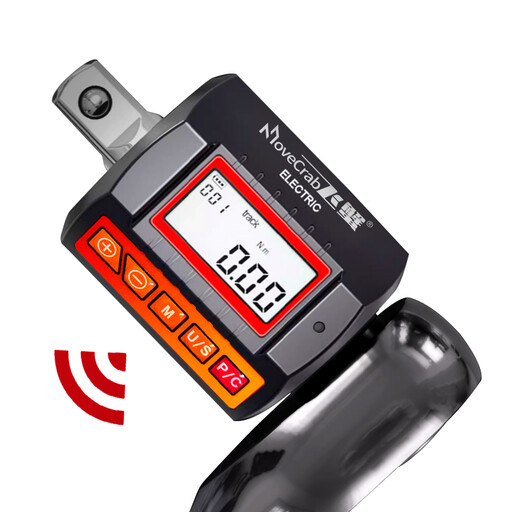
Why This Fits Their Persona: This is an ideal starting point for the home mechanic who works on their own car and motorcycle. The 4.05-135N.m range covers a wide array of common jobs, from oil changes and brake work to minor engine repairs, without being overly complex.
It avoids the "limited range" fallacy by providing a highly versatile range and including 1/4", 3/8" and 1/2" adapters, ensuring it works with almost any socket set straight out of the box.
Features sound and light alarms, multiple torque units (N.m, lbf.ft, etc.) and three working modes (real-time, peak and preset). Stores up to 1,000 data sets for review.
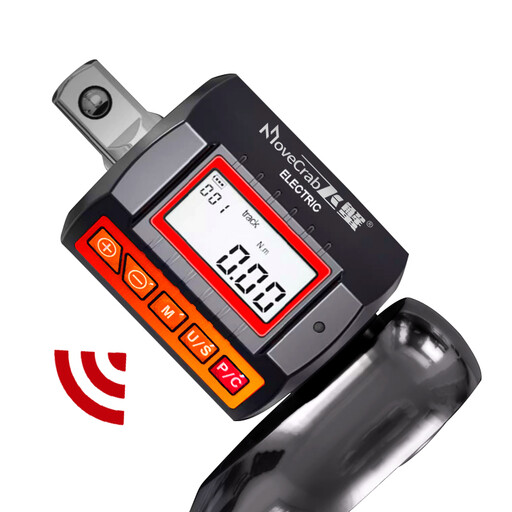
Why This Fits Their Persona: For the technician who needs more capability. The extended 200N.m range covers nearly all passenger car wheel nuts and many suspension components, making it a true workhorse for a professional garage or advanced DIYer.
It counters the "inaccuracy trap" by clearly stating its bidirectional error (±2% CW, ±2.5% CCW) and including reliable audio-visual alarms, ensuring precise application of force on critical fasteners.
The 6-200N.m range offers professional-grade versatility. It retains all the essential features like multiple modes, data storage and included 1/4" and 3/8" adapters.
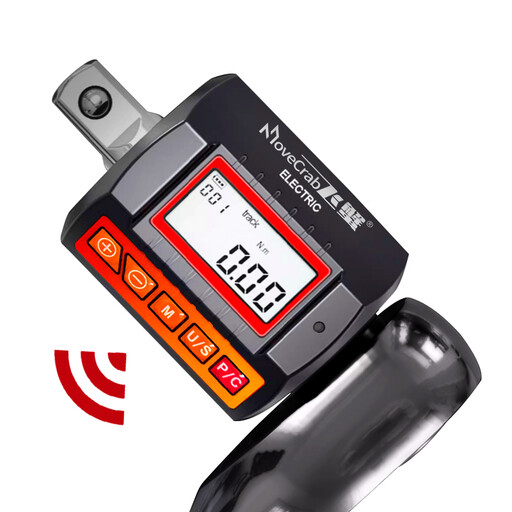
Why This Fits Their Persona: This is for the user tackling the toughest jobs. If you're working on chassis bolts, large suspension components or light commercial vehicles, the 340N.m capacity is essential. It turns a long breaker bar into a high-capacity, precision instrument.
This model is specifically designed for high-torque use, addressing the flaw of using an under-specced tool for a heavy-duty job. Its robust build is necessary to handle the forces involved, ensuring reliability where it matters most.
The massive 340N.m maximum torque capacity is its standout feature, making it suitable for jobs far beyond the scope of standard adapters. It includes all the necessary digital features and drive adapters.
We have compiled a complete, real-time list of products that fully satisfy these strict selection criteria and UK safety regulations.
Yes, this is one of the most effective ways to use the tool. Pairing an electronic torque wrench adapter with a long breaker bar gives you the leverage needed for high-torque applications while providing the precision of a digital readout. It's an excellent combination for tasks like tightening wheel nuts or suspension bolts.
For professional environments where accuracy is paramount for safety and compliance, annual calibration is the standard recommendation. For the serious home DIYer, having it checked every 2-3 years or after it has been accidentally dropped, is a sensible precaution to maintain its accuracy.
A high-quality digital torque adapter can be just as accurate as a dedicated wrench. Reputable models typically specify an accuracy of ±2% to ±3%, which is on par with many professional-grade click-type and digital wrenches. The primary benefits of the adapter are its compact size, lower cost and the versatility to upgrade all your existing ratchets and bars.