
24/7 Customer Support

Free returns

Same-day & Next-day Delivery

Quality Guaranteed

Unlock Your Welcome Offers: FREE Delivery | Up to 80% OFF | Free 30-day JoyPlus trial
Download the APP
Buying a digital torque wrench can help you apply a manufacturer-specified tightening force more consistently. However, the market includes products with very different torque ranges, drive sizes and feedback systems. Choosing by advertised “high accuracy” alone can leave you with a tool that is unsuitable for your fasteners or difficult to maintain.
This guide from the Joybuy Product Recommendation Officer explains the practical checks that matter before buying an electronic torque wrench, whether you maintain a bicycle in a home workshop, service a motorcycle or work on automotive components.
A wrench that reaches a high maximum value is not automatically suitable for low-torque work. Using a large 1/2-inch torque wrench for small bicycle fasteners can make fine adjustments difficult, while a compact 1/4-inch torque wrench may not cover wheel or suspension fasteners.
Check that your required torque sits comfortably within the stated range rather than at its extreme lower or upper limit.
Drive size describes the square connection for sockets; it does not, by itself, confirm the wrench’s usable force range. A 3/8-inch torque wrench may suit medium-duty motorcycle and automotive tasks, but always compare the actual N·m range with the vehicle or component manufacturer’s specification.
Also check whether adapters are included. A digital torque adapter can offer flexibility, but it adds another connection between the handle and socket, so each part must be fitted securely.
Vibration, sound and LED alerts make a target easier to recognise, particularly in a noisy garage or poorly lit area. They do not compensate for a loose socket, a damaged fastener, jerky force application or an incorrect setting.
A torque wrench should not be used as a breaker bar or striking tool. Follow the supplied instructions and stop applying force as soon as the target alert is reached.
Look for a range that matches your intended jobs:
Several digital models specify ±2% clockwise accuracy, while the mechanical six-piece set specifies ±3% deviation. Treat these as the manufacturer’s stated specifications and check whether calibration information or a certificate is supplied. For safety-critical work, use the vehicle or equipment manufacturer’s tightening instructions and arrange periodic calibration where appropriate.
UK workshop documentation may use N·m, while older manuals can also show lbf·ft or lbf·in. A useful electronic model should clearly display or convert between units such as N·m, lbf·ft, lbf·in and kgf·cm.
Track mode displays the torque as force is applied. Peak mode records the highest reading reached. Preset mode allows commonly used values to be stored, reducing repeated button adjustments. These features are helpful for repetitive jobs, but always confirm the selected unit before tightening.
A digital wrench contains electronic components and should be kept dry, away from direct sunlight, high humidity, dust and corrosive substances such as salt water. Do not clean it with alcohol or paint thinner unless the instructions specifically permit this.
For mechanical models, look for hardened chrome vanadium or chrome molybdenum components, a readable scale and a locking mechanism. After using a conventional click-type wrench, return the setting to the manufacturer’s recommended storage position. Store either type in its case or pouch and inspect the ratchet, socket connection and handle before use.
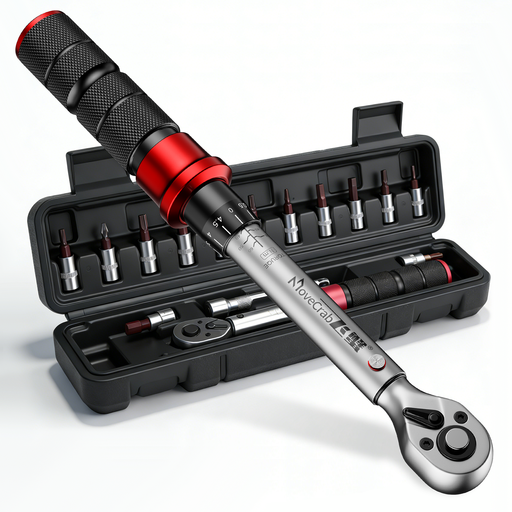
Why This Fits Their Persona: A practical starting point for UK cyclists who need controlled tightening at home without buying a separate wrench and bit collection.
Its 2–20 N·m range is aimed at lower-torque bicycle work rather than oversized automotive fastening.
Includes multiple hex, Phillips and Torx bits; dual-direction ratchet and click alert are specified.
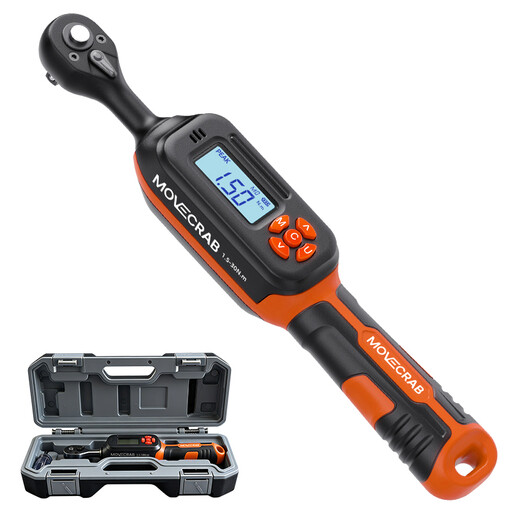
Why This Fits Their Persona: Suitable for users who want a clear electronic readout and repeatable presets for bicycle, motorcycle and detailed workshop tasks.
The listed range, ±2% clockwise accuracy specification and selectable units are stated clearly instead of relying only on promotional wording.
Vibration, audible and LED alerts; ten presets plus track and peak modes with storage for up to 500 readings.
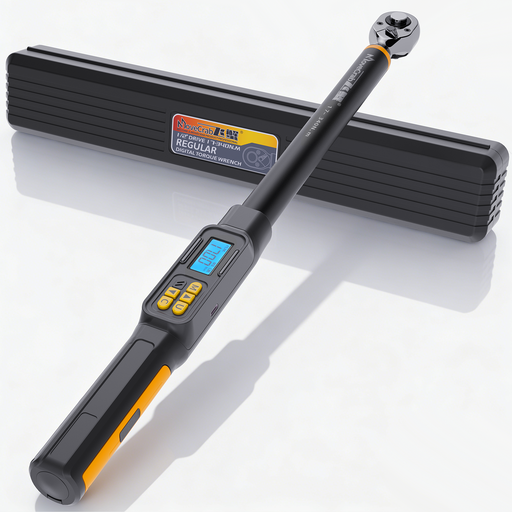
Why This Fits Their Persona: Designed around higher-torque automotive, motorcycle and industrial maintenance tasks where a broad N·m range is required.
The 17–340 N·m range is more appropriate for larger fasteners than a low-range bicycle tool. Users must still confirm the required setting before purchase.
1/2-inch drive; unit conversion, preset, track and peak modes; triple alert feedback and up to 500 stored readings.
We have compiled a complete, real-time list of products that fully satisfy these strict selection criteria and UK safety regulations.
A torque wrench is only as effective as the socket or spanner fitted to it. Consider adding:
Yes, provided its range begins low enough for the bicycle manufacturer’s specified values. A 1/4-inch model or dedicated bicycle torque wrench is generally more suitable than a high-range automotive tool. Use the correct bit and tighten gradually.
The interval depends on usage, storage and the manufacturer’s guidance. Arrange checking or calibration more frequently for heavy workshop use, repeated high-load work or safety-critical fastening. Keep records if the tool is used for professional maintenance.
Running costs are usually limited to replacement batteries and occasional calibration. Remove the battery during long-term storage where the instructions advise it, use the automatic shutdown feature and keep the wrench dry. An electronic tool with stored readings may also reduce repeated setup time for regular tasks.