
24/7 Customer Support

Free returns

Same-day & Next-day Delivery

Quality Guaranteed

Unlock Your Welcome Offers: FREE Delivery | Up to 80% OFF | Free 30-day JoyPlus trial
Download the APP
A digital torque wrench can make tightening more controlled, but choosing the wrong model may leave you with limited usable range, incompatible sockets or an alarm that is difficult to hear in a busy workshop. For UK DIY mechanics, vehicle owners and cycle enthusiasts, the key is to match the tool to the fasteners you actually work on rather than selecting the largest number on the product page.
This guide explains the specifications that matter, common buying traps and our top recommendations for automotive, motorcycle, bicycle and general mechanical use.
A tool advertised with a high maximum torque may not be suitable for small fasteners. If your regular jobs include bicycle stems, brake callipers or motorcycle controls, a large 1/2 inch torque wrench may have a lower practical resolution at the bottom of its range.
Conversely, a 1/4 inch torque wrench designed for delicate fasteners is not intended for wheel nuts or high-load suspension work. Check both the minimum and maximum torque values before buying.
A breaker bar with swivel head is designed to loosen stubborn nuts and provide leverage. It does not measure applied torque or signal when a specified setting has been reached. It can be a useful workshop companion, but it should not replace a digital or mechanical torque wrench when tightening requires a defined value.
For example, the DURATECH breaker bar listed below has a 240° rotatable head and a claimed torque capacity of up to approximately 780 N·m, but it is a leverage tool rather than a digital measuring instrument.
A torque wrench with alarm may use a beep, light, vibration or a combination of alerts. A loud workshop, gloves or poor lighting can affect how convenient each alert is, so consider where you will use it.
Also check whether the stated accuracy applies clockwise, anti-clockwise or both. The MoveCrab digital torque adapters listed here specify ±2% clockwise accuracy and ±2.5% anti-clockwise accuracy. These figures are product specifications, not a guarantee that every application will achieve the same result. Use the tool within its stated range and follow the supplied instructions.
Select a range that covers your vehicle or equipment manufacturer’s tightening specifications without operating at the extreme ends. Common applications include:
Always confirm that the adapter, socket and wrench share compatible square-drive sizes. An included adapter can improve flexibility, but it does not increase the measuring range.
UK vehicle manuals commonly specify torque in N·m, although some tools and imported components use lbf·ft, lbf·in or kgf·cm. A useful electronic torque wrench should allow straightforward switching between the units you use.
Real-time or track mode shows the torque as force is applied. Peak mode records the highest value reached, while preset mode provides an alert at a chosen target. Data storage is useful when you need to review previous readings, but it should be treated as a record-keeping feature rather than a substitute for correct installation technique.
An adjustable torque wrench or adapter should be held on its designated grip, with force applied smoothly and evenly. Avoid using a digital torque wrench as a hammer or exceeding its maximum range. The supplied product information for the MoveCrab digital wrench advises against overloads above 120% of the maximum value.
For critical vehicle work, check the manufacturer’s instructions regarding calibration intervals and storage. Some click-style tools should be returned to their lowest setting after use; digital models should be kept dry, protected from excessive heat and stored with batteries removed if they will remain unused for an extended period.
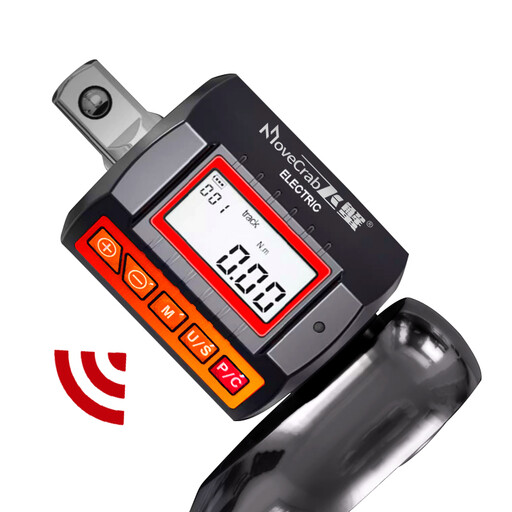
Why This Fits Their Persona: A practical starting point for home garages that already own sockets or a suitable drive tool and need one adapter for bicycle, motorcycle and car maintenance.
Its stated 6–200 N·m range is more informative than a maximum-only listing, while included 3/8-inch and 1/4-inch adapters expand socket compatibility.
Sound and light alarm, four selectable units, real-time, peak and preset modes, plus storage for up to 1,000 numerical values.
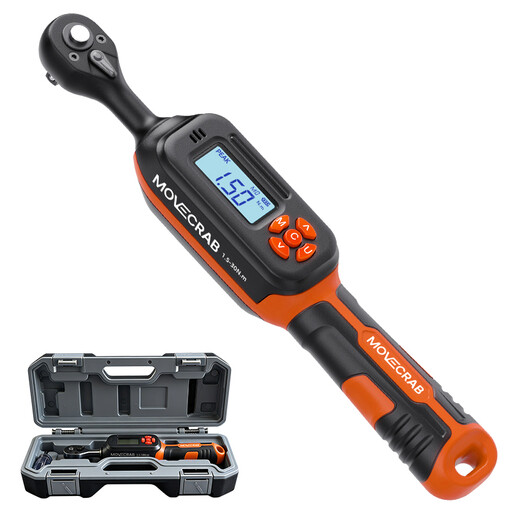
Why This Fits Their Persona: Suited to users who prioritise controlled low-torque work, including bicycle assemblies, motorcycle components and smaller automotive fasteners.
The 1–20 N·m range is clearly focused on smaller fasteners, avoiding the mismatch created by using a large-drive tool for delicate work.
Listed ±2% clockwise accuracy, LED display, vibration, sound and light alerts, 10 preset values and peak data storage for up to 500 readings.
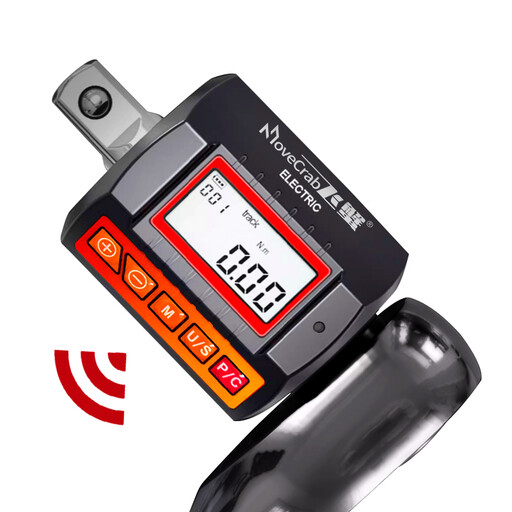
Why This Fits Their Persona: A broad-range option for car repair, motorcycle maintenance and workshop tasks involving larger fasteners, provided the required torque falls within the stated range.
The stated range makes its intended heavy-duty applications clearer, while the adapter format lets users work with existing compatible drive equipment.
1/2-inch main drive, included smaller adapters, four torque units, preset and peak modes, sound and light alerts, and 1,000-record storage.
We have compiled a complete, real-time list of products that fully satisfy these strict selection criteria and UK safety regulations.
Before starting, confirm the torque value in the vehicle, motorcycle or bicycle manufacturer’s documentation. Then:
Do not assume an adapter makes every socket or drive combination suitable. For safety-critical vehicle work, inspect the fastener, thread condition and socket fit before tightening.
It depends on the job. A digital model can display several units and provide audible, visual or vibration alerts, which may help when working in low light or wearing hearing protection. A mechanical wrench may be simpler to store and operate. Compare range, drive size and maintenance requirements rather than choosing by display type alone.
Service life depends on workload, storage, battery care and whether the tool is overloaded. Keep it dry, avoid impacts and do not use it as a striking tool. Periodic calibration is sensible for critical applications, following the manufacturer’s guidance.
Digital adapters require battery power for their display and alert functions. The product information states that the models above shut down automatically after 10 minutes of inactivity. Check the individual manual for the battery type and replacement procedure before purchase.