Family bakers using one mixing bowl
If you weigh walnuts, flour and sugar into the same bowl, a tare or add-and-weigh function lets you zero the reading between ingredients. Allow for the bowl's weight when checking capacity.


For a family cake, choose a digital scale that can zero your mixing bowl, accommodate the bowl and ingredients, and remain readable as you add walnuts. Salter and Joseph Joseph list 5 kg capacities on specific models; a display that moves out from beneath a large bowl or a design that folds away may matter more if visibility or storage is your main difficulty.
If you weigh walnuts, flour and sugar into the same bowl, a tare or add-and-weigh function lets you zero the reading between ingredients. Allow for the bowl's weight when checking capacity.
A wide or deep bowl can make a fixed display difficult to see. OXO and Joseph Joseph describe specific models with displays designed to remain visible around larger bowls.
If the scale needs to go into a drawer between family baking sessions, check its folded or stored dimensions. Joseph Joseph describes its TriScale model as folding for storage.
Start with the bowl and full recipe, then decide whether display visibility or storage will change which design you can use comfortably.
| Concern | What to check | Who this matters to |
|---|---|---|
| Whole-recipe weighing | Check tare or add-and-weigh and a capacity that accommodates the empty bowl plus ingredients. | If I add walnuts and the rest of the cake ingredients to one bowl, I want to zero the reading between additions without running out of capacity; around 50% of consumers put whole-recipe weighing first. |
| Visible reading | Check where the display sits with your usual bowl in place; some models have pull-out or sliding displays. | With a wide mixing bowl, I need to see the weight while adding walnuts rather than moving the bowl to read it; roughly 33% of consumers prioritise display visibility. |
| Storage or containment | Check stored dimensions or whether a bowl is supplied, depending on which would help you more. | When I bake occasionally, fitting the scale into a drawer or containing loose walnut pieces can shape my choice; about 17% of consumers put storage or containment first. |
A stated maximum does not tell you whether you can zero the bowl between ingredients or see the display beneath it.
Check for tare or add-and-weigh, then consider the display layout against the bowl you normally use.
Specifications vary between models, even within a brand. OXO lists 1 g metric increments for its pull-out-display model, but that figure should not be assumed for another scale.
Check the exact model's stated increment and the units your recipes use.
Some compact designs use button-cell batteries, which require particular care where children may reach the scale or spare batteries.
Check the battery type, keep spare and used batteries out of children's reach, and stop using a scale if its battery compartment cannot be secured.
A manufacturer's stated increment describes the product specification, not independently measured accuracy. Which? says its kitchen-scale testing uses calibrated weights from 1 g to 1 kg and repeated readings.
If accuracy is particularly important to your choice, look for independent results for the exact model.
Salter offers conventional digital platform scales for cooking and baking.
OXO's pull-out-display scale addresses the problem of a bowl or plate obscuring the reading.
Joseph Joseph has distinct designs for weighing into a supplied bowl, folding the scale away or keeping the display visible beside a larger bowl.
These choices include an integrated-scale food processor and kitchen scales for weighing cake ingredients. If you plan to add everything to one mixing bowl, check tare and bowl-plus-ingredient capacity on the exact product before deciding.
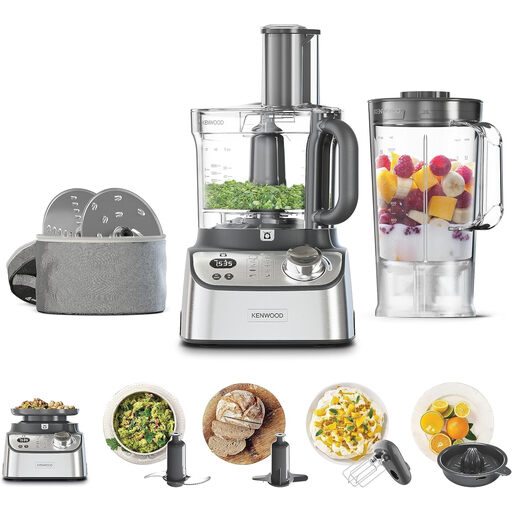 Image unavailable
Consider this if you want to weigh walnuts in a food processor rather than buy a standalone kitchen scale.
The product name specifies an integrated digital scale and a 3L capacity. Check the scale's weighing limit against your bowl and ingredients, as well as display visibility and weighing units, before choosing it for a full cake recipe.
 Image unavailable
Consider this kitchen scale for measuring walnuts and other recipe ingredients on a separate platform.
If you intend to add ingredients successively to one bowl, confirm that the exact product offers tare or add-and-weigh. Check that its display remains visible beneath your usual mixing bowl.
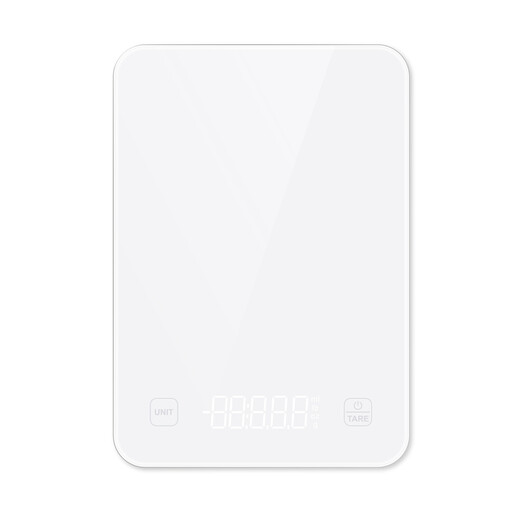 Image unavailable
Consider this platform scale if its listed capacity suits your bowl and cake ingredients.
The product name specifies a 10 kg capacity, tempered glass, app integration and a 1 g precision claim. That claim is not an independent accuracy result; confirm tare and display visibility if you will weigh several ingredients in one bowl.
Check that the scale can accommodate your bowl and ingredients and lets you zero the reading between additions. A readable display matters too, particularly if your usual mixing bowl extends over the controls.
A supplied bowl is useful if you prefer to contain loose walnut pieces while weighing them, but it is not essential if you already have a suitable bowl and the scale can tare it. Joseph Joseph describes its SwitchScale as switching between bowl and platform use.
Check the position of the display with a bowl similar in size to yours. OXO describes a pull-out display intended to avoid shadowing from bowls or plates, while Joseph Joseph describes a sliding display on its Vision model.
Follow the cleaning instructions for the exact model rather than assuming the scale is dishwasher-safe. Joseph Joseph's cited models specify wiping with a damp cloth; check separately whether any removable bowl has different cleaning instructions.