
24/7 Customer Support

Free returns

Same-day & Next-day Delivery

Quality Guaranteed

Unlock Your Welcome Offers: FREE Delivery | Up to 80% OFF | Free 30-day JoyPlus trial
Download the APP
A digital torque wrench set can make controlled fastening easier, but choosing the wrong format may leave you with an expensive tool that does not suit your work. Cyclists, DIY mechanics and vehicle owners often discover that a wrench has the wrong drive size, an unsuitable torque range or unclear calibration information only after purchase.
The main buying pitfalls are surprisingly consistent:
Torque is normally shown in N·m (Newton metres) in the UK, although some vehicle manuals use lbf·ft or lbf·in. Choose a range that places your regular jobs comfortably within the tool’s operating limits rather than selecting the largest range available.
Typical examples include:
Always consult the vehicle, bicycle or component manufacturer’s torque instructions. Do not assume that a universal tool is suitable for every bolt simply because it fits the socket.
Drive size determines which sockets and accessories can be used. A 1/2-inch drive is common for automotive work, while 1/4-inch and 3/8-inch drives are more practical for smaller fasteners.
Some digital torque adapters include 1/2-inch, 3/8-inch and 1/4-inch adapters. This can be convenient if you already own a suitable ratchet or breaker bar. However, check whether the product is an adapter rather than a complete electronic torque wrench. A torque wrench set with sockets may be more convenient if you need a ready-to-use collection of bits and sockets.
Look for clearly stated accuracy in both operating directions. For example, some digital torque adapters list ±2% clockwise accuracy and ±2.5% anticlockwise accuracy. Mechanical models may list ±3% accuracy.
A bidirectional torque wrench is useful where fasteners must be tightened clockwise and anticlockwise, although you should confirm whether the stated accuracy applies equally in both directions.
Digital models may provide:
These features can help in a busy garage or low-light workspace, but they do not remove the need to apply force smoothly and stop immediately when the target is reached.
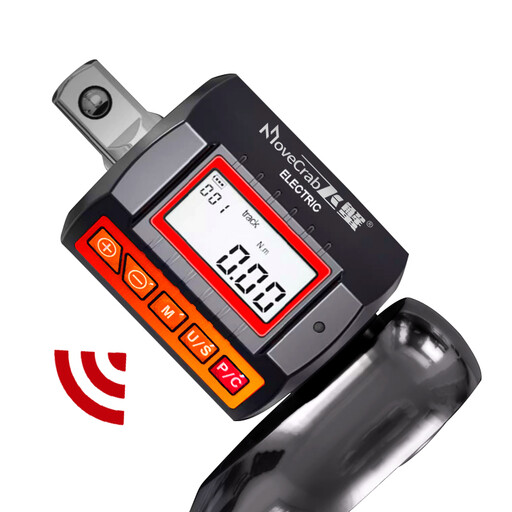
Why This Fits Their Persona: A practical entry point for home mechanics who already own compatible handles and sockets for occasional bicycle, motorcycle or car repairs.
Its 6–200N·m range and included 3/8-inch and 1/4-inch adapters are stated clearly, helping buyers check compatibility before ordering.
Lists ±2% clockwise and ±2.5% anticlockwise accuracy, four torque units, three working modes and storage for 1,000 readings.
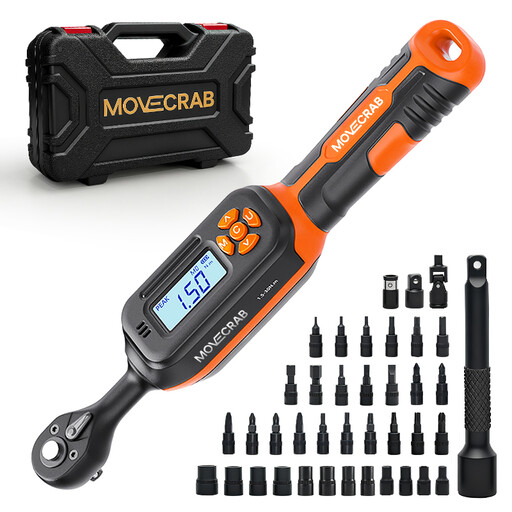
Why This Fits Their Persona: Suits cyclists and motorcycle owners wanting a complete compact kit rather than an adapter that depends on tools already in the workshop.
The 1.5–30N·m range is clearly positioned for lower-torque work, avoiding the common mistake of using a large automotive wrench for delicate fittings.
Includes a 40-piece selection, LED display, audible alert, four torque units and peak or tracking modes.
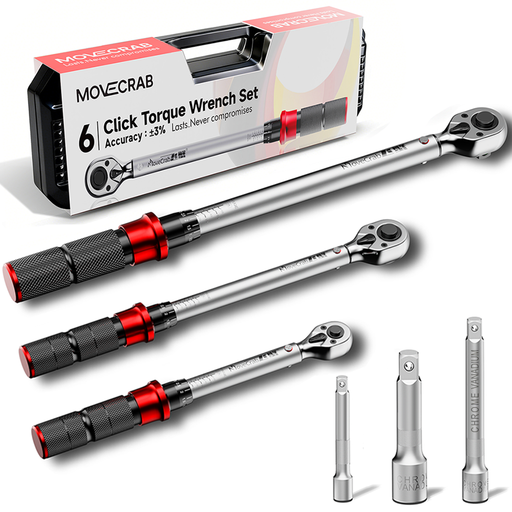
Why This Fits Their Persona: A broad mechanical option for garages, vehicle technicians and maintenance users handling both low- and higher-torque fastening jobs.
The set uses three listed wrench ranges from 5–220N·m, rather than relying on one tool to cover every application.
The listed kit includes 1/4-inch, 3/8-inch and 1/2-inch extension rods, Cr-V steel construction and a stated ±3% deviation.
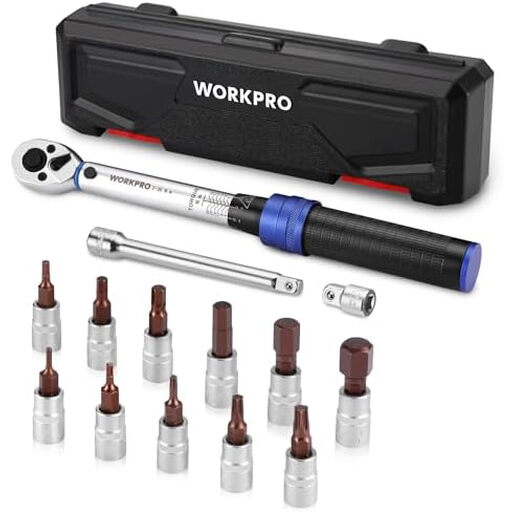
Why This Fits Their Persona: Designed around bicycle servicing, with useful hex and Torx bits for road bikes, mountain bikes and routine home maintenance.
Its listed 2–26N·m range is more appropriate for many bicycle components than a high-range 1/2-inch automotive tool.
Includes eight hex wrenches, three Torx wrenches, a 102mm extension bar, a socket adapter and a stated ±3% accuracy.
Read the supplied instructions before fitting a battery or selecting a unit. Set the required value in the same unit used by the manufacturer’s manual, then attach the correct socket or bit securely.
Apply force steadily and keep the handle or adapter aligned with the fastener. When the preset alarm sounds or the mechanical wrench clicks, stop immediately. Avoid using a torque wrench as a breaker bar unless the instructions specifically allow it.
For storage:
We have compiled a complete, real-time list of products that fully satisfy these strict selection criteria and UK safety regulations.
It can be suitable when its lower limit covers the bicycle manufacturer’s specified torque values and the adapter is used with the correct ratchet, bit or socket. For frequent bicycle work, a 1/4-inch bicycle torque wrench set may be more convenient because it combines a suitable range with commonly used hex and Torx fittings.
Not automatically. Accuracy depends on the individual product specification, condition, calibration and correct operation. The products listed above state figures such as ±2% or ±3%, but users should still follow the manufacturer’s maintenance guidance and arrange calibration checks when readings are important.