Buying priorities
Start by separating loose, robust prints from anything bound, stuck down or fragile. Then choose the capture route, storage capacity and handling process that fit the collection rather than treating every photograph in the same way.
| Priority |
What to check |
Your needs |
| Safe handling |
Check whether prints are loose, robust and safe to place under a flatbed lid or through a feeder. For albums or postal services, confirm removal, packing, tracking and return requirements before handling originals. |
I want shareable copies without putting vulnerable originals under unnecessary pressure, light, handling or transport risk. |
| Control and throughput |
Compare manual flatbed placement with feeder capacity and supported print sizes. An all-in-one can scan individual items, but check its optical resolution and workflow before relying on it for an important archive. |
I need a route that matches my collection: careful individual capture for selected prints, or faster processing for a large batch of suitable loose photographs. |
| Backup plan |
Keep scan masters on a local device and maintain a separate backup location. Check available capacity, how files will be organised and whether you can open them after transfer. |
I want to share the files without leaving the family archive dependent on one phone, drive or account. Which? and the National Cyber Security Centre both advise keeping valued data backed up in more than one place. |
| Service scope |
Confirm accepted formats and condition requirements, plus the process for packing, tracking, return, downloads, USB copies and restoration work where relevant. |
I need to know whether a service can handle my actual mix of loose prints, albums, slides or negatives before I send originals away. |
Joybuy product options
These Joybuy options focus on keeping digitised family-photo files in a separate local archive, plus one all-in-one scanner route for occasional loose-print capture.
 No image available
Samsung MU-PG4T0B 4 TB USB Type-C SSD
For keeping a sizeable local copy of scan masters separate from the capture device.
Stated 4 TB capacity, USB 3.2 Gen 2x2 connectivity, up to 2,000 MB/s transfers, AES-256 hardware encryption and password authentication.
Use it as one backup location, not the complete plan. Its highest stated transfer speed requires a compatible USB 3.2 Gen 2x2 host connection.
Joybuy
 No image available
Samsung MU-PG2T0B 2 TB USB Type-C SSD
For storing scan masters in a dedicated local location rather than only on the computer or phone used for capture.
Stated 2 TB capacity, USB 3.2 Gen 2x2 connectivity, up to 2,000 MB/s transfers, AES-256 hardware encryption and password authentication.
Check expected archive growth before choosing capacity, and maintain a second independent backup location.
Joybuy
 No image available
Samsung MU-PE1T0S 1 TB USB Type-C SSD
For creating a portable local archive copy separate from a scanner or phone.
Stated 1 TB capacity, USB 3.2 Gen 2 connectivity, up to 1,050 MB/s read and 1,000 MB/s write speeds, IP65 resistance and up to 3 m drop resistance.
Check whether 1 TB covers both high-resolution masters and edited copies, and verify encryption setup requirements before storing sensitive files.
Joybuy
 No image available
Samsung MU-PG1T0B 1 TB USB Type-C SSD
For a dedicated local photo archive that can move between common household devices.
Stated 1 TB capacity, USB 3.2 Gen 2x2 connectivity, up to 2,000 MB/s read and 1,950 MB/s write speeds, AES-256 hardware encryption, and USB-C-to-C and USB-C-to-A cables.
Estimate space for retained masters before buying. The highest stated speed depends on compatible USB 3.2 Gen 2x2 hardware.
Joybuy
 No image available
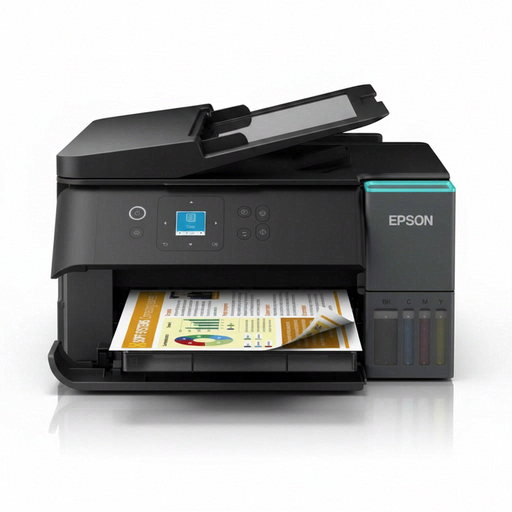
Epson EcoTank ET-2951 A4 All-in-One Printer
For occasional digitisation of individually placed loose photos in a household that also needs print and copy functions.
Stated CIS flatbed scanner, up to 1,200 × 2,400 dpi optical scan resolution, USB, Wi-Fi and Wi-Fi Direct connectivity, plus mobile-app support.
Check available scan software, output formats and colour controls before using it for a photo archive. Avoid lid pressure for fragile, cracked, stuck-down or bound photographs.
Joybuy
Frequently asked questions
Which route suits a small number of loose family photos?
A phone app is a practical starting point when convenience matters and the prints are easy to handle. Google states that PhotoScan is designed to scan printed photos with a phone; for more controlled individual capture, compare a flatbed scanner, such as the compact models described by Canon and Epson.
When is a dedicated auto-feeder photo scanner worth considering?
Consider an auto-feeder for a large batch of standard loose prints that are in good condition for feeder handling. Epson describes its FastFoto FF-680W as scanning up to 30 photos in 30 seconds and supporting prints from 9 x 13 cm to 21 x 91 cm; check that your own photographs are suitable before using that route.
Can photographs stay in an album while they are digitised?
Do not assume they can. Boots Photo says album photographs must be removed before submission, whereas PicSave advertises work with traditional, magnetic and fragile albums. If pages are brittle, stuck down, oversized or damaged, avoid forcing photographs flat or removing them without a careful handling assessment.
How should fragile photographs be handled before digitising?
Keep handling to a minimum and hold loose photographs by their edges. The National Archives advises using clean hands and nitrile or vinyl gloves for loose prints, and warns that oils, salts, abrasion and prolonged light can affect photographic layers; its conservation guidance takes priority over generic app instructions to remove photographs from sleeves.
Do I need both cloud storage and an external drive?
Keep more than one copy in separate places rather than relying on a single device or account. Which? recommends combining local, cloud and system backups for balanced protection, and the National Cyber Security Centre advises backing up data you value; retain original scan files as well as edited versions.


