
24/7 Customer Support

Free returns

Same-day & Next-day Delivery

Quality Guaranteed

Unlock Your Welcome Offers: FREE Delivery | Up to 80% OFF | Free 30-day JoyPlus trial
Download the APP
Choosing dining tables for a UK home involves more than matching a colour to your flooring. A table may look suitable online yet prove too large for a narrow kitchen, uncomfortable for everyday meals or difficult to maintain. The right choice depends on dimensions, construction, seating needs and how the room is actually used.
A dining table can fit within a room while leaving too little space for chairs. Measure the full area required, including pulled-out chairs and walking routes. As a practical guide, allow around 90cm of clearance behind occupied chairs where possible. In compact flats and kitchen diners, a smaller table with tucked-in seating may be more useful than a larger fixed design.
Terms such as “wood finish”, “woodgrain effect” and “wood look” do not mean the tabletop is made from solid timber. Solid wood dining tables usually show natural grain variation and can be heavier, while MDF, veneer and engineered boards may offer a more uniform appearance and straightforward cleaning.
Neither option is automatically suitable for every household. The important point is to check the listed material, tabletop thickness, weight capacity and care instructions rather than relying on styling photographs.
An extendable dining table may offer useful flexibility, but the extended length does not tell the whole story. Check how many chairs can fit without crowding, whether the extension is stored within the table and how much clearance is needed to open it. A compact drop-leaf design can be more practical than a long table with a separate extension panel.
For everyday use, approximate tabletop requirements are:
These are general planning figures rather than guarantees. Armchairs, wide dining chairs and table legs can reduce usable seating. Always compare the product dimensions with your room plan.
A small dining table measuring approximately 75–90cm wide can suit a breakfast corner or compact kitchen. A dining table for six usually needs more floor space, particularly if chairs remain around it throughout the day.
A round dining table can make conversation easier and avoids sharp corners, which may be useful in busy kitchens or homes with young children. Its central footprint can also work well in a square dining area, although the surrounding clearance must be measured carefully.
A square dining table suits compact, symmetrical rooms and can sit neatly in a corner when two sides are less frequently used. A rectangular dining table is often easier to position against a wall and generally provides more efficient seating for families or dinner guests.
Oak and walnut-toned finishes are popular because they work with both traditional and modern interiors. An oak dining table may have a pale, natural appearance, while a walnut dining table or dark wood finish creates stronger visual contrast. Check whether the description refers to solid hardwood, oak veneer, elm wood, MDF or a wood-effect surface.
Also consider:
The General Product Safety Regulations require consumer products supplied in the UK to be safe when used as intended. In practical terms, look for clear instructions, stable construction, secure fixings and a stated load capacity. If a product arrives damaged or does not match its description, UK consumer rights may provide remedies through the retailer.
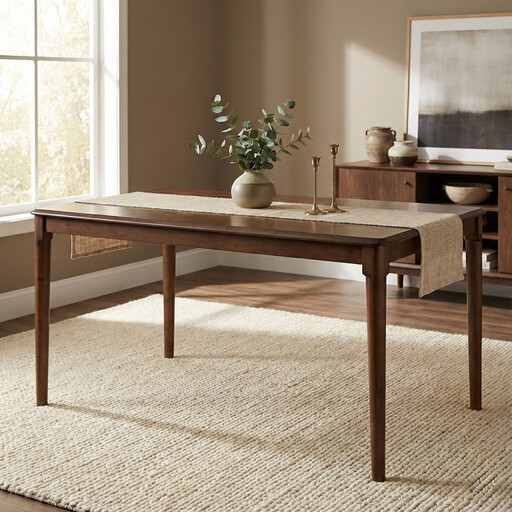
Why This Fits Their Persona: Its 150 x 90cm rectangular format is suited to households wanting a substantial table for family meals or hosting guests in a dedicated dining room.
The listing provides fixed dimensions, a 120kg weight capacity and solid hardwood construction, helping shoppers assess the table beyond its dark wood appearance.
Solid hardwood construction, rounded tabletop edges, tapered legs and a stated 120kg capacity.
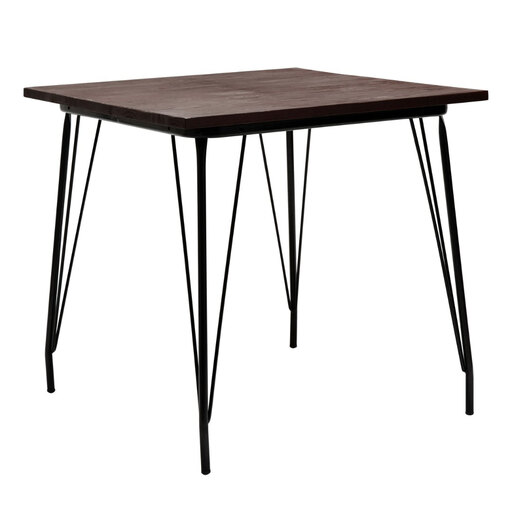
Why This Fits Their Persona: The 80 x 80cm square footprint can suit renters, couples and smaller kitchen diners needing a defined eating area without a long tabletop.
Its dimensions are clearly stated, while the elm wood top and metal base are identified separately rather than presented as an unspecified solid-wood build.
Compact square shape, stained elm wood top, black metal legs and a stated 120kg capacity.
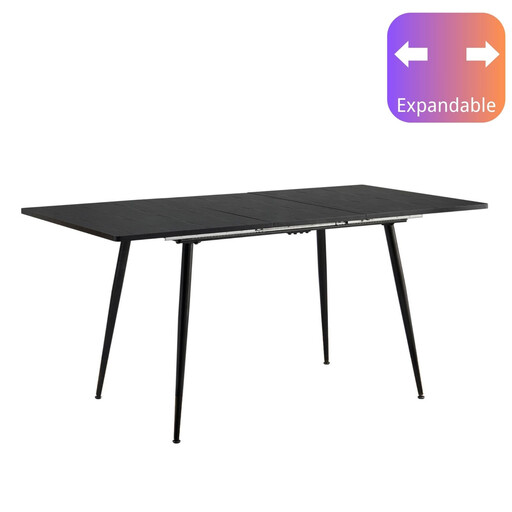
Why This Fits Their Persona: Households that need a compact daily table but occasional extra capacity can use the 120cm setting for everyday meals and extend it to 160cm for gatherings.
The product description identifies the MDF woodgrain-effect top and gives both standard and extended lengths, so shoppers can plan realistically.
Extends from 120cm to 160cm, has a 50mm tabletop and includes a 2-year guarantee.
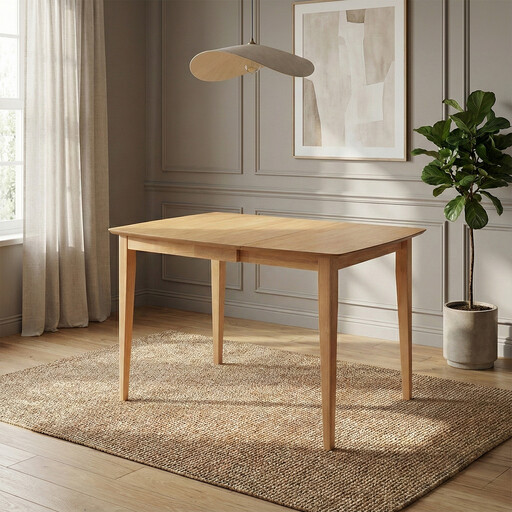
Why This Fits Their Persona: Its square-to-rectangular format is designed for small flats, kitchen diners and dining nooks where floor space changes according to the occasion.
The drop-leaf mechanism and two usable sizes are specified, reducing uncertainty about how the table works in its compact and expanded positions.
Measures 75 x 75cm when compact, extends to 120cm and has rounded corners with a 120kg stated capacity.
We have compiled a complete, real-time list of products that fully satisfy these strict selection criteria and UK safety regulations.
Aim for roughly 90cm around the table for chairs and movement, increasing this where a main walkway passes behind the seating. In a narrow room, measure with the chairs pulled out rather than using the tabletop dimensions alone.
A solid wood dining table may appeal if you value natural grain and a substantial feel. However, compare its weight, maintenance needs and price with veneer or MDF alternatives. The most suitable material depends on your room, budget and how heavily the table will be used.
A compact square or round table can work efficiently in a small kitchen, while an extendable design provides additional capacity when needed. The best fit depends on doorways, walkways, chair width and whether the table can remain fully extended.