
24/7 Customer Support

Free returns

Same-day & Next-day Delivery

Quality Guaranteed

Unlock Your Welcome Offers: FREE Delivery | Up to 80% OFF | Free 30-day JoyPlus trial
Download the APP
A dish drying rack can make washing up easier, but the wrong design may quickly become an obstacle on a crowded worktop. Small kitchens, rental properties, student flats and busy family homes all have different requirements, so choosing by appearance alone can lead to wasted money.
Before buying a dish rack or dish drainer, watch out for three common pitfalls:
The right rack should fit your available space, allow water to leave efficiently and support the types of crockery you use every day.
Start by measuring the surface where the rack will sit, allowing room to place and remove dishes. Check length, width and height, rather than relying on descriptions such as “compact” or “large”.
A sink dish rack must fit securely inside the bowl without obstructing the tap or plughole. For worktop use, check whether the rack can sit close enough to the sink for water to drain safely. Low-profile designs may be more suitable beneath wall cupboards, while taller models can offer additional space for glasses and utensils.
For example, the Addis Plate Dish Draining Rack measures 38cm long × 33.5cm wide × 5cm high, making it a relatively low-profile option for plates and smaller sink areas.
A stainless steel dish rack can suit a modern kitchen and is generally easy to wipe clean. Look for details such as coated or capped wire sections, which can help reduce direct contact between crockery and hard metal. Fingerprint-resistant finishes may also reduce visible smudges.
A plastic dish rack is often lighter and can be convenient for renters, students or anyone who wants to move the rack between the sink and worktop. However, inspect the tray and drainage design carefully. Plastic components should be easy to lift out or wash with warm, soapy water.
Material alone does not determine longevity. Follow the cleaning instructions, avoid abrasive cleaners where advised and keep the rack positioned securely to reduce the risk of tipping.
A draining rack with spout can direct water into the sink rather than allowing it to collect on the worktop. A moveable or 360-degree spout is useful when the rack may be positioned on different sides of the sink.
Also consider how your household washes up. If you regularly clean saucepans, large plates, wine glasses or several mugs at once, a narrow plate drying rack may not provide enough separation. Look for dedicated utensil compartments, stable plate slots and a holder that accommodates your most frequently used glasses.
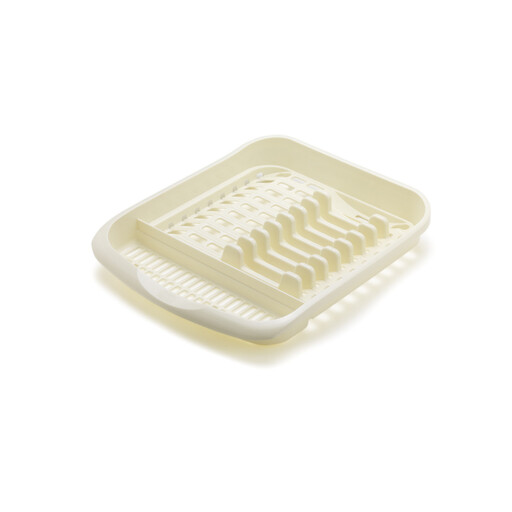
Why This Fits Their Persona: Its low 5cm profile and 38cm by 33.5cm footprint suit renters, students and smaller UK kitchens that mainly need a dedicated place for plates after washing up.
The stated dimensions make its worktop requirement clear, while the dedicated plate layout avoids relying on vague “space-saving” wording.
Plastic construction; neutral linen colour; compact plate-focused profile; straightforward to clean and maintain.
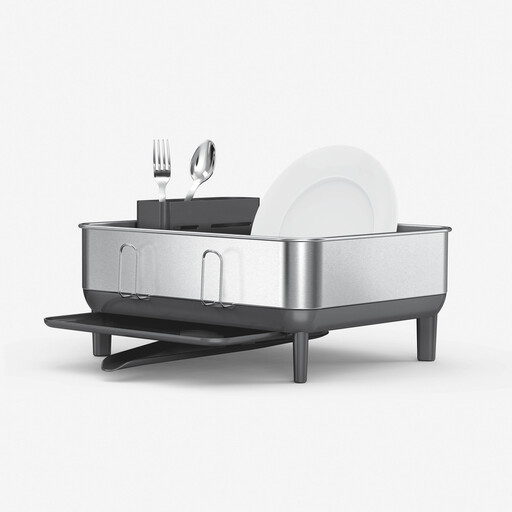
Why This Fits Their Persona: This worktop dish rack combines a smaller 39.4cm by 38cm footprint with a steel frame, making it suitable for modern kitchens where appearance and drainage both matter.
Its integrated 360-degree swivel spout directs water towards the sink, addressing the standing-water problem when positioned correctly.
Brushed stainless steel frame; anti-slip rubber feet; removable spout; fingerprint-proof finish and utensil holder.
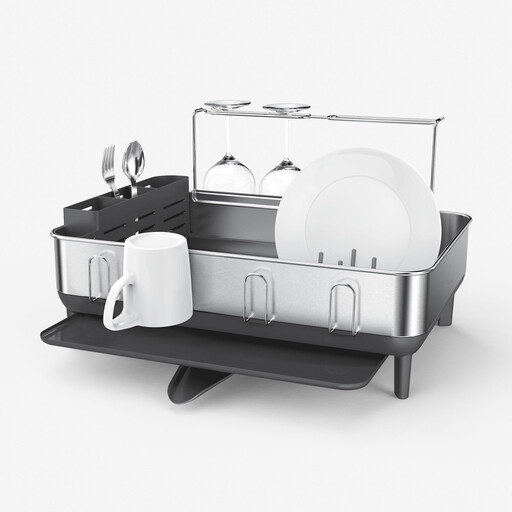
Why This Fits Their Persona: Households washing several dishes, utensils and large wine glasses may prefer its larger 56.6cm by 50.8cm dimensions and stated capacity for extra-large Bordeaux glasses.
The larger dimensions and separate utensil compartments make capacity easier to assess, while the swivel spout offers a defined drainage route.
Holds up to four extra-large Bordeaux glasses; silicone-capped wire rack; anti-slip feet; coated tray and dishwasher-safe specified components.
Place any kitchen drainer on a stable, level surface. If using a worktop dish rack with a spout, ensure the outlet points into the sink and is not blocked by the worktop edge. For a sink-based design, confirm that it does not interfere with drainage or make the sink difficult to use.
Clean trays regularly, especially around corners where food residue and limescale can collect. Warm, soapy water is suitable for many designs, but always follow the product instructions. Avoid abrasive cleaners on brushed finishes and check which components are suitable for the dishwasher.
A rack’s practical lifespan depends on moisture exposure, cleaning habits, load weight and whether it is knocked or overloaded. Replace or stop using it if the frame becomes unstable, sharp edges appear or drainage components no longer fit securely.
We have compiled a complete, real-time list of products that fully satisfy these strict selection criteria and UK safety regulations.
A sink dish rack saves worktop space and keeps water closer to the plughole, but it can reduce usable sink area. A worktop model offers easier access and may hold more dishes. Choose according to your sink dimensions, worktop depth and drainage arrangement.
Wipe the tray and rack frequently, particularly if water collects beneath dishes. A deeper clean is sensible when you notice residue, odour or visible limescale. Removable trays and dishwasher-safe parts can make this routine easier.
No. A swivel spout simply channels water into the sink; it does not connect to the household plumbing. Position the rack securely and check that the spout reaches the sink without dripping onto the worktop.