Solo users who build a daily load
If your breakfast bowl is joined by cups, cutlery and later dishes, a six-place tabletop dishwasher may suit your routine. Check whether its programmes accommodate the loads you actually expect to wash.


A six-place tabletop dishwasher makes more sense if you collect cups, cutlery and later dishes alongside your breakfast bowl; if you want to wash just one bowl straight away, hand washing may be simpler. Before buying, check the exact model’s small-load options, worktop fit, water connection and drainage. A short programme alone does not establish whether it suits your usual load.
If your breakfast bowl is joined by cups, cutlery and later dishes, a six-place tabletop dishwasher may suit your routine. Check whether its programmes accommodate the loads you actually expect to wash.
A tabletop model avoids the need for an integrated dishwasher bay, but it still needs adequate worktop space, a suitable water supply and somewhere to drain.
If you rarely have other dishes to add, a six-place machine may be more appliance than the task calls for. Consider whether a suitable small-load programme would change how you use it; otherwise, washing the bowl by hand may remain simpler.
Start with your usual load, then establish whether a dishwasher will fit and connect in your kitchen. Compare its running information only on a like-for-like programme basis.
| Concern | What to check | Who this matters to |
|---|---|---|
| Small-load flexibility | Check place-setting capacity and whether the exact model has a half-load option. Check the intended use of any quick programme. | If I add cups and cutlery during the day, I want to wash them without waiting for a full rack. Around 39% of consumers put small-load flexibility first. |
| Space and connections | Measure the usable worktop and hose clearance; confirm the model’s water inlet and where its drain hose can discharge. | In a compact kitchen, I need the machine to fit and have a workable route to the tap or water tank and sink. For around 38% of consumers, fitting and connecting it is the primary concern. |
| Energy, water and noise | Compare exact-model energy and water figures on the same programme basis, and check the stated noise level. | If I expect to run small loads regularly, I want to understand the resources each cycle uses and how much noise the appliance makes. Around 23% of consumers put this information first. |
A place setting covers more than a bowl. A dishwasher guide includes plates, a glass, bowl, cup and saucer, so six-place capacity says little about the practicality of washing one bowl immediately.
Think through what else you would load that day. If you will not build a load, check for a suitable half-load option or consider washing the bowl by hand.
Cookology says its CTTD6WH connects to a kitchen tap or fixed mains supply; only some models in its wider tabletop range have built-in tanks. A tank-based model still needs filling and drainage.
Check the exact model’s inlet method, dimensions and drain-hose instructions against your kitchen before ordering.
An appliance rated A++ on an older scale could be rated F on the newer one. The letters alone do not provide a like-for-like comparison across those scales.
Use each exact model’s current energy label and product information sheet, comparing figures stated on the same basis.
Joybuy’s listing for the three-place-setting GORGENOX DW5-D40A says that product is no longer available, so it is useful as a capacity reference rather than a current buying option.
Check availability on the product-detail page of any model you intend to buy.
A reference for buyers considering a six-place tabletop machine with a stated half-load feature.
A reference for comparing tabletop dimensions and water-connection arrangements.
A reference for compact-dishwasher features, rather than a current purchase option for the evidenced Series 4 SKS62E32EU.
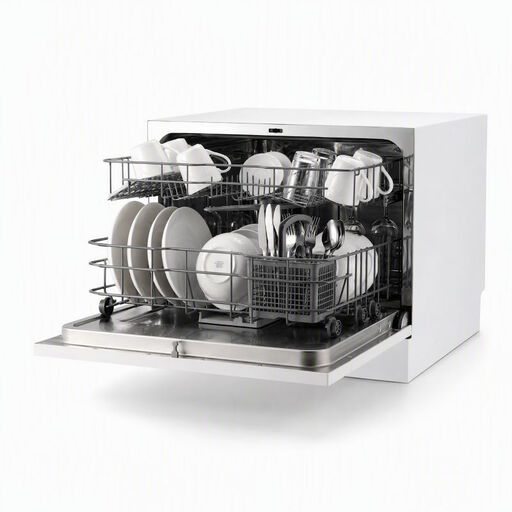
This tabletop option is relevant if you plan to combine breakfast bowls with other dishes. Check whether its programmes and installation arrangements suit your routine before choosing it for very small loads.
 No image available
Consider this freestanding tabletop model if you can load your breakfast bowl with other dishes rather than washing one item at a time.
It is larger than the immediate one-bowl task, but it may suit you if cups, cutlery and later dishes join the load. A place setting is described as including several types of crockery and glassware; for smaller loads, check the exact machine’s programme options rather than relying on its capacity alone.
The water-supply arrangement depends on the model, and every option still needs suitable drainage. Cookology says its CTTD6WH connects to a standard kitchen tap or fixed mains supply, while some models in its wider tabletop range have a built-in tank. Confirm the chosen model’s inlet and drain-hose instructions.
Measure the usable worktop space and allow room for the door, hoses and access to the sink. Cookology states that the CTTD6WH measures W550 x D500 x H438 mm; use the dimensions of your chosen model rather than applying those measurements to another dishwasher.
Compare the current energy label and product information for each exact model on the same programme basis, alongside its water-use figure. For products within scope in Great Britain, guidance from the Department for Energy Security and Net Zero and the Office for Product Safety and Standards requires an accurate energy label; an older rating letter should not be compared directly with a current one.