
24/7 Customer Support

Free returns

Same-day & Next-day Delivery

Quality Guaranteed

Unlock Your Welcome Offers: FREE Delivery | Up to 80% OFF | Free 30-day JoyPlus trial
Download the APP
As a Joybuy Product Recommendation Officer, my role is to help you navigate the crowded market of DIY tools. Choosing a new tool set can be a frustrating experience. You are often faced with impressive-looking cases filled with hundreds of pieces, only to find the tools rust, break or simply aren't right for the job. Before you invest your hard-earned money, it is crucial to understand the common pitfalls that lead to buyer's remorse.
Here are three frequent traps to watch out for:
To select a reliable and long-lasting DIY tool set, you need to look past the marketing hype and focus on a few core specifications. These are the non-negotiable factors that determine a tool's performance and durability.
The type of steel used is perhaps the single most important factor. Look for tools made from specific alloys designed for durability:
If your kit includes a ratchet, check its tooth count. A 72-tooth mechanism is a significant upgrade over older 48-tooth designs. Each click of a 72-tooth ratchet moves the handle by only 5 degrees, whereas a 48-tooth ratchet requires a 7.5-degree arc. This smaller swing arc is incredibly useful when working in the tight, confined spaces of a car engine bay or behind appliances, making it a key feature in any good mechanics tool set.
Not all tool sets are created equal. A complete tool set for home will have a broad mix of tools for general repairs, like a hammer, pliers and a variety of screwdrivers. In contrast, a car tool kit will focus heavily on a comprehensive socket set in both metric and imperial sizes, along with extension bars and universal joints. For delicate work on laptops or phones, a dedicated electric screwdriver set or precision screwdriver kit with adjustable torque is essential to avoid damaging sensitive components.
Based on these practical criteria, we have matched several products to specific user needs. This approach helps ensure you get the right tool for your projects without paying for features you do not need.
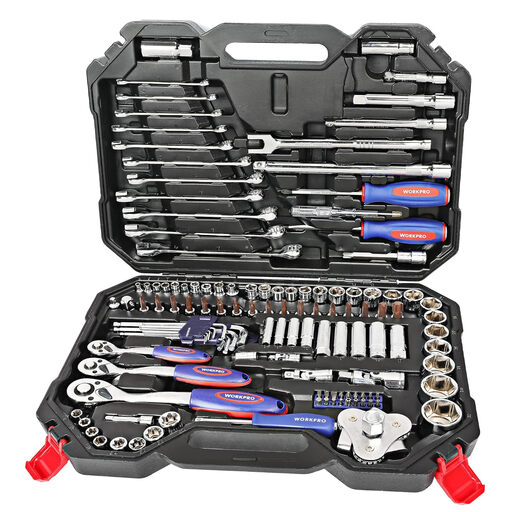
Why This Fits Their Persona: This is an ideal starter kit for anyone moving into a new home. It covers a wide range of general tasks, from assembling flat-pack furniture and hanging pictures to basic car maintenance, without being overwhelming.
It avoids the "piece count illusion" by providing a genuinely useful selection of sockets, spanners and hex keys. The durable blow-moulded case is designed for longevity, preventing tool loss and disorganisation.
The tools are made from heat-treated, chrome-plated steel for rust protection. The kit includes 1/4", 3/8" and 1/2" drive sockets, offering great versatility for a home repair tool kit.
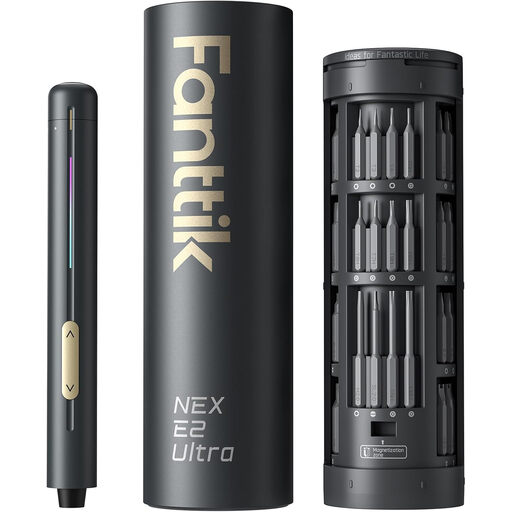
Why This Fits Their Persona: Perfect for those who build PCs, repair laptops, cameras or other small electronics. This precision screwdriver kit provides the control needed to work with delicate components without causing damage.
This is a specialised tool, not a general-purpose one. It avoids the trap of using oversized, clumsy tools on small screws. The 50 high-strength S2 steel bits are genuinely useful for electronics, not just filler.
Features 5 adjustable torque settings (from 0.05N.m to 0.6N.m) for precise control. The magnetic aluminium alloy case with a pop-up mechanism keeps all 50 bits organised and secure.
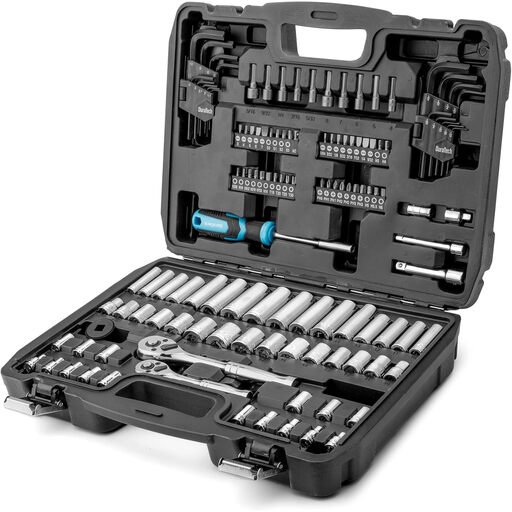
Why This Fits Their Persona: This car tool kit is built for automotive work. It includes a comprehensive range of metric and imperial sockets, extension bars and the high-torque ratchets needed for engine and chassis maintenance.
It avoids the poor material trap by using heat-treated Cr-V steel for high hardness and durability. The sockets have high-visibility size markings to prevent confusion between metric and SAE sizes.
Includes both 1/4" and 3/8" drive 72-tooth ratchets, which are essential for working in tight spaces. The set also comes with a versatile magnetic screwdriver and 40 interchangeable bits.
We have compiled a complete, real-time list of products that fully satisfy these strict selection criteria and UK safety regulations.
1. What is the real difference between Cr-V and S2 steel in a tool set?
Think of it in terms of toughness versus hardness. Cr-V (Chrome Vanadium) is tough and resilient, making it ideal for tools that need to withstand high twisting forces without cracking, like sockets and spanners. S2 steel is harder, which means it resists wear and deformation better. This makes it the superior choice for screwdriver and hex bits, as it is less likely to strip the head of a screw. A good kit often uses both materials for their respective applications.
2. How many pieces do I really need in a home repair tool kit?
Quality over quantity is key. A well-curated 100-piece set with useful tools made from quality materials is far better than a 250-piece set filled with redundant, low-grade bits. For a general home repair tool kit, look for a core selection: a hammer, a tape measure, pliers, a set of screwdrivers (or a driver with interchangeable bits), an adjustable spanner and a basic socket set. Anything from 80 to 130 quality pieces is typically more than sufficient for most household tasks.
3. Can I use a mechanics tool set for general home repairs?
Yes, absolutely. A mechanics tool set is often an excellent foundation for a home toolkit because it is built to a higher durability standard. The sockets, ratchets and spanners are perfect for assembling furniture, tightening bolts on appliances and other common tasks. You may just need to supplement it with a few home-specific tools like a hammer, a spirit level and a set of pliers to create a truly complete tool set for home.