
24/7 Customer Support

Free returns

Same-day & Next-day Delivery

Quality Guaranteed

Unlock Your Welcome Offers: FREE Delivery | Up to 80% OFF | Free 30-day JoyPlus trial
Download the APP
Navigating the world of DJI drones can feel overwhelming. With a lineup spanning from pocket-sized flyers to professional cinematography tools, choosing the right model for your needs and budget is a significant decision. Whether you're a holidaymaker wanting to capture family memories, a content creator aiming for cinematic shots or a commercial pilot requiring top-tier performance, the key is to match the drone's capabilities to your specific goals.
As the Joybuy Product Recommendation Officer, my role is to help you cut through the marketing clutter. This guide provides a straightforward look at the key factors to consider when buying a DJI camera drone in the UK and highlights a few standout models for different types of users.
Before diving into specific models, let's cover a few essential points. Focusing on these will help you narrow down your options and make a more informed choice.
In the UK, a drone's weight is a critical factor that determines the rules you must follow. Drones weighing under 250g fall into the C0 category, which has the fewest restrictions—you generally don't need to complete the CAA's Flyer ID test to fly one. For heavier drones, such as the DJI Air 3S or DJI Mavic 4 Pro, you will need to register as a drone operator with the CAA and display your Operator ID on the drone. Always check the latest guidance from the CAA before you fly.
While nearly all modern DJI drones offer excellent image quality, the hardware can vary significantly. A 4K drone UK model is a great starting point for crisp, detailed video. However, for those serious about videography, sensor size is paramount. A larger sensor, like the 1-inch CMOS on the Air 3S, captures more light and detail, performing much better at sunrise, sunset or in overcast conditions. For ultimate image fidelity, a flagship professional drone with camera featuring a 4/3 CMOS sensor, like the Mavic 4 Pro, delivers unparalleled dynamic range and colour depth.
A long flight time drone means more time in the air capturing shots and less time on the ground swapping batteries. Many models are available in a Fly More Combo, which typically includes extra batteries and a multi-battery charging hub. This is often a cost-effective choice for anyone planning to fly for more than 20-30 minutes at a time. Additionally, consider the controller. While standard controllers that use your smartphone are effective, a drone with screen controller (like the DJI RC 2) offers a brighter, dedicated display that is easier to see in direct sunlight and frees up your phone.
Here are our recommendations, selected to suit a range of pilots from beginners to seasoned professionals.
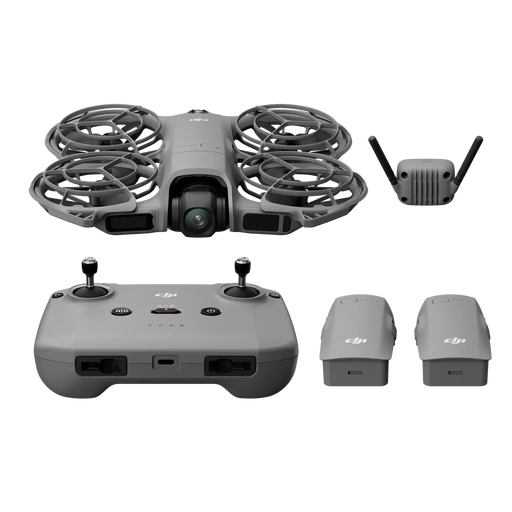
Why It Stands Out The DJI Neo 2 is an excellent drone for beginners. Weighing just 151 grams, it falls into the least restrictive flight category in the UK. Its intuitive features, such as Palm Takeoff and Gesture Control, make flying accessible and fun, even for those with no prior experience. Despite its small size, it includes omnidirectional obstacle sensing for enhanced safety and captures high-quality 4K video, making it a powerful yet user-friendly package.
Pros
Who is it for? This drone is ideal for first-time pilots, families and travellers who want a simple, safe and highly portable drone to capture casual photos and videos without a steep learning curve.
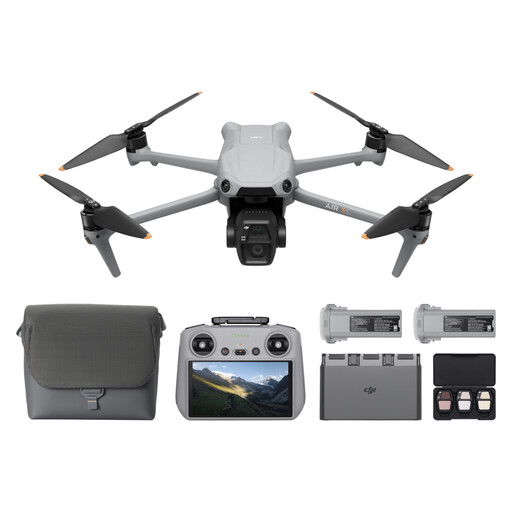
Why It Stands Out The DJI Air 3S represents a significant step up in image quality and flight performance. Its dual-camera system features a wide-angle camera with a large 1-inch CMOS sensor for outstanding low-light performance and a medium telephoto camera for creative compression and subject isolation. With a long flight time of up to 45 minutes and the included DJI RC 2 drone with screen controller, it provides a premium flying experience for serious creators. Omnidirectional sensing and an advanced return-to-home system add layers of safety and confidence.
Pros
Who is it for? This is a superb choice for ambitious hobbyists, content creators and semi-professionals who need advanced imaging capabilities, extended flight time and the convenience of an integrated screen controller.
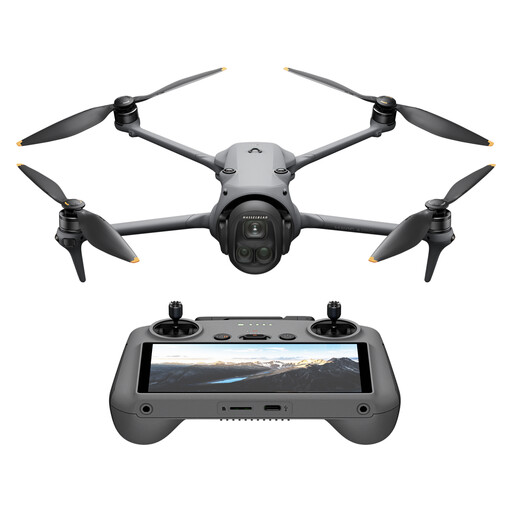
Why It Stands Out The DJI Mavic 4 Pro is a flagship professional drone with camera, engineered for demanding cinematographers. Its centrepiece is the tri-camera system, led by a massive 4/3 CMOS Hasselblad camera capable of capturing 100MP stills and 6K video. This system provides unmatched image quality and focal length versatility. With a class-leading 51-minute maximum flight time, 30km transmission range and advanced obstacle sensing that works even in low light, the Mavic 4 Pro is built for uncompromising professional workflows.
Pros
Who is it for? This drone is designed for professional filmmakers, commercial drone operators and production houses that require the highest level of image fidelity, reliability and creative control available in a portable platform.
These three models cover a wide spectrum of users, but DJI's lineup is extensive. If you're looking for different features or a model that fits a specific budget, explore our full range of video camera drone options to find the perfect match for your aerial adventures.
For drones weighing under 250g, like the DJI Neo 2, you do not need to pass the CAA's Flyer ID test, though you still need an Operator ID if the drone has a camera. For any drone weighing 250g or more, such as the DJI Air 3S and Mavic 4 Pro, the pilot must register with the CAA to get an Operator ID (which must be displayed on the drone) and pass the free online Flyer ID theory test. We strongly advise checking the official CAA website for the most current regulations before flying.
A Fly More Combo is a bundle offered by DJI that includes the drone plus several key accessories. It typically contains two extra Intelligent Flight Batteries, a multi-battery charging hub, spare propellers and a carrying bag or case. For most users, the combo offers significant value. The extra batteries are essential for extending your time in the field, effectively tripling your potential flight time in a single outing.
It is not recommended to fly most consumer DJI drones, including the models listed here, in the rain. These drones are not waterproof, and moisture can damage the sensitive electronic components, motors and battery systems, potentially leading to a critical failure. Always fly in clear weather conditions and avoid high winds for the safest and most reliable performance.