
24/7 Customer Support

Free returns

Same-day & Next-day Delivery

Quality Guaranteed

Unlock Your Welcome Offers: FREE Delivery | Up to 80% OFF | Free 30-day JoyPlus trial
Download the APP
Buying dog beds can seem straightforward until a new mattress loses its shape, slides across the floor or becomes difficult to clean. For UK households, the right choice needs to suit your dog’s sleeping position, available space and daily routine—not just match the room’s décor.
Marketing language can also make comparison difficult. A “plush dog bed” may feel soft but offer little structure, while a “supportive dog mattress” may be too firm or thin for a dog that prefers to curl up. Before choosing, look beyond appearance and check the construction, measurements and cleaning instructions.
Fluffy fabric creates an appealing first impression, but surface softness does not necessarily indicate useful cushioning underneath. A dog bed with a thin or uneven filling may flatten quickly, particularly when used every day.
Look for the actual filling material and construction. Egg-crate foam, quilted fibre or a properly filled base can provide more consistent support than loose, unstructured padding. Raised edges may also suit dogs that like to rest their head against a bolster.
There is no universal size for a medium dog bed. One manufacturer’s medium may measure 62cm by 60cm, while another may offer a longer mattress intended for stretching out.
Measure your dog from nose to the base of the tail, then add room for movement. If your dog sleeps curled up, a more compact bed may work. Dogs that lie on their side usually need additional length and width. Always compare the listed dimensions with the floor space, crate or furniture where the bed will sit.
A bed that cannot be cleaned conveniently may become impractical in homes affected by muddy walks, wet coats or shedding. Check whether the cover is removable, whether it is machine washable and how the inner filling should be treated.
For safety and stability, inspect the underside too. An anti-slip base can help limit movement on smooth flooring, but the bed should still be placed on a flat, stable surface. No pet bed should be treated as indestructible: replace it if the filling becomes exposed or the fabric is badly damaged.
For small to medium dogs, compare the usable sleeping area rather than the external measurement alone. Bolsters and raised edges take up some of the available space. A dog sofa bed with a surrounding edge can feel secure, but a flat mattress may provide more room for stretching.
Useful measurements include:
A supportive dog mattress should have filling that remains reasonably even during regular use. Quilted construction can help distribute polyester fibre across the surface, while foam designs provide a different type of cushioning.
For colder rooms, a fleece dog mattress or Sherpa-style surface can add warmth. A plush or jumbo cord cover may feel inviting, but inspect seams and the base if your dog tends to scratch or chew.
A washable dog bed is useful for routine hygiene, but “washable” can mean different things. Confirm whether only the cover can go in the washing machine and follow the stated care instructions. If the product is spot-clean only, allow it to air dry fully before use.
An anti-slip cloth base is useful on hard floors, while a mattress designed for crates or direct floor use offers greater flexibility. Keep any pet bedding away from open flames and direct heat sources, and check the product label for full care and safety guidance.
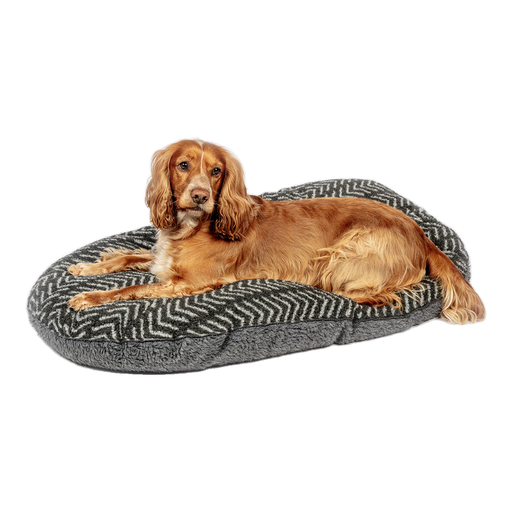
Why This Fits Their Persona: Its 27-inch medium format suits small to medium dogs and can be placed on the floor, in a crate or inside a suitable bed frame.
The listed dimensions, knitted Sherpa fleece and quilted construction make its size and build easier to assess than relying on vague “medium” or “cosy” wording.
Soft knitted fleece surface; supersoft polyester fibre filling; tonal charcoal arrow pattern.

Why This Fits Their Persona: This sofa-style pet mat suits owners who want a generous, decorative resting space for a dog that likes a soft surface and a supported head position.
The 85 × 72 × 14cm dimensions are stated clearly, while the removable machine-washable cover addresses the cleaning issue. The anti-slip cloth base helps reduce movement on suitable floors.
Egg-crate foam; elevated headrest; plush faux-fur surface; removable cover.
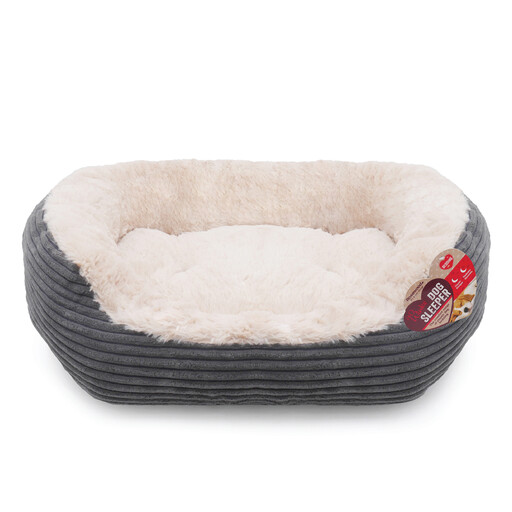
Why This Fits Their Persona: A practical option for homes needing a defined, compact sleeping area for a dog that enjoys curling up against raised sides.
Its 62 × 60cm measurements and stated spot-cleaning instructions make the space and maintenance commitment clear before purchase.
Jumbo cord fabric; raised edges; polyester filling; anti-slip base material.
We have compiled a complete, real-time list of products that fully satisfy these strict selection criteria and UK safety regulations.
Place the bed away from radiators, heaters and open flames. Vacuum loose hair regularly and follow the manufacturer’s washing instructions rather than assuming the inner mattress is machine safe. For spot-clean-only designs, use a mild detergent sparingly and allow the fabric to dry completely.
Inspect the seams, base and filling every few weeks. Active dogs may cause faster wear through scratching, chewing or repeated jumping, so durability depends on both construction and how the bed is used. A replacement is sensible when damage creates exposed filling, loose threads or unstable cushioning.
Measure your dog while lying in its usual position, then allow extra space for turning and stretching. Compare those measurements with the bed’s internal sleeping area, not only its external dimensions. A 27-inch mattress is approximately 68.6cm long, while a 62 × 60cm bed offers a more compact, square sleeping space.
They can reduce cleaning effort, particularly for dogs that return from wet or muddy walks. However, check whether the entire bed or only the cover is washable. A removable cover may be easier to manage than a fully machine-washable large mattress, but both options still require correct drying and regular inspection.
Yes, if the filling, seams and base match your dog’s habits and the bed can be maintained properly. Plush fabric offers a soft surface, while foam or evenly distributed fibre can add structure. Dogs that chew or scratch heavily may need a simpler, more durable design and closer checks for damage.