
24/7 Customer Support

Free returns

Same-day & Next-day Delivery

Quality Guaranteed

Unlock Your Welcome Offers: FREE Delivery | Up to 80% OFF | Free 30-day JoyPlus trial
Download the APP
Choosing dog collars in the UK is not simply a matter of picking a colour and adding it to your basket. The right collar needs to match your dog’s neck measurement, walking habits, coat and stage of life. A collar that looks suitable online may loosen, rub, become difficult to clean or fail to provide enough control outdoors.
As the Joybuy Product Recommendation Officer, I filter product information into practical shopping advice, helping you compare features without relying on inflated marketing language.
A “small dog collar” is not automatically suitable for every small breed, while a “large dog collar” may still be too narrow or short for a particular dog. Neck sizes vary considerably, even between dogs of similar weight.
Check the product’s stated adjustment range and measure around your dog’s neck. Once fitted, you should generally be able to place two fingers between the collar and your dog’s neck. Recheck the fit regularly, particularly for puppies and dogs whose weight or coat changes.
A nylon dog collar can be practical for wet UK weather, but durability also depends on the stitching, buckle, holes and D-ring. Leather can feel supple and well-finished, yet it is porous and may require care after exposure to rain.
Look beyond phrases such as “strong” or “premium”. Check the actual construction: webbing type, bonded stitching, buckle design, D-ring attachment and care instructions.
A check chain collar or dog training collar is not a substitute for gradual, reward-based training. It should never be left on an unattended dog, used with harsh pulling or fitted so tightly that it affects breathing or comfort.
For dogs that pull, a no-pull dog headcollar can provide directional guidance, but it must be introduced gradually and fitted correctly. Watch your dog’s behaviour and stop if they show signs of distress or discomfort.
Measure your dog’s neck with a flexible tape, keeping it close to the fur without compressing the throat. Compare the measurement with the collar’s full range rather than relying on a size label alone.
Useful examples include:
For growing puppies, an adjustable dog collar can provide room for gradual growth. However, do not leave excess length hanging where it could catch on objects.
A nylon dog collar is usually easy to wipe clean and practical for everyday walks, particularly in changeable weather. Soft-weave nylon may be preferable for delicate puppy necks.
A leather dog collar can offer a traditional appearance and a supple feel. The Ancol Timberwolf Leather Collar Sable 35cm uses top-grain bridle leather, bonded nylon stitching and an antique gold-tone buckle and D-ring. Its care guidance states that it should be air-dried naturally and protected from excessive soaking.
A collar should have a secure fastening system and a clearly specified lead attachment point. A dog collar with D-ring allows the lead to be clipped to a dedicated metal ring rather than relying on the buckle.
Inspect the buckle, D-ring and stitching before every walk. Replace the collar if the webbing frays, the buckle cracks, the leather splits or the D-ring becomes loose. Never use a collar for unsupervised tethering unless the product instructions specifically support that use.
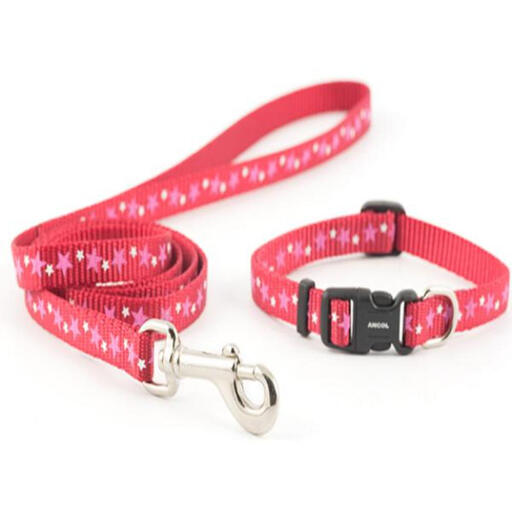
Why This Fits Their Persona: A practical starter option for new puppy owners who need a collar and lead together for initial walks and daily use.
The fully adjustable collar helps accommodate growth, while the product is specifically described for puppies and small dogs rather than relying only on a generic size label.
Includes a matching lead, soft-weave fabric and weather-proof nylon weave. Recheck the fit as your puppy grows.
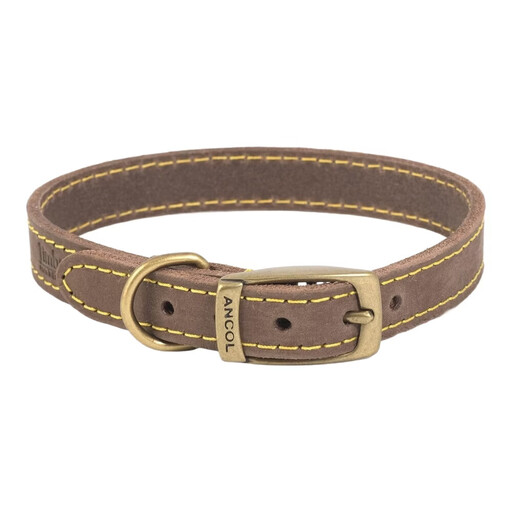
Why This Fits Their Persona: Suitable for owners who prefer a traditional leather finish and are prepared to follow the care instructions.
The description specifies top-grain bridle leather, double-sided bonded nylon stitching and a stated 35cm size, making the construction easier to assess.
Features a buckle and D-ring, with leather protector treatment. Keep it away from excessive soaking and condition it as directed.
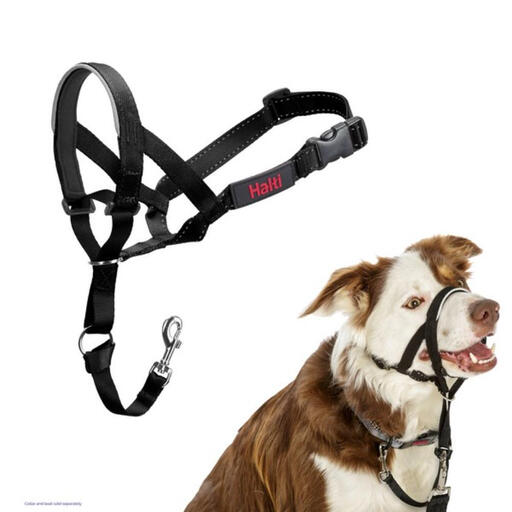
Why This Fits Their Persona: Designed for owners seeking directional guidance for dogs that pull, with gradual introduction and supervised use required.
The instructions require measuring both neck and nose circumference, introducing it with treats and checking the noseband position rather than putting it on for immediate unrestricted use.
Includes a padded neoprene nose band, reflective accents and a safety link for connection to the dog’s regular collar.
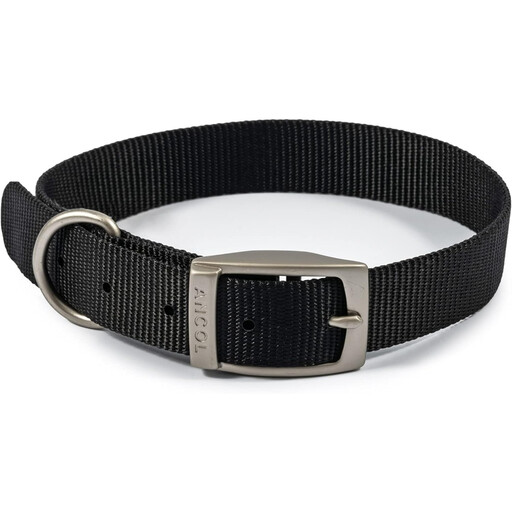
Why This Fits Their Persona: A straightforward everyday collar for medium to large dogs needing a wipe-clean nylon design and quick-release fastening.
The listed 35–43cm adjustment range makes fit checking more transparent, while the product warning advises removal when the dog is unsupervised or in a cage.
Uses soft nylon webbing, a quick-release buckle and a metal D-ring. Check the buckle and stitching routinely.
We have compiled a complete, real-time list of products that fully satisfy these strict selection criteria and UK safety regulations.
It should sit securely without restricting breathing or causing rubbing. A practical starting point is leaving room for two fingers between the collar and your dog’s neck. Check the fit while your dog is standing, and inspect it again after grooming or changes in coat thickness.
There is no universal replacement schedule. Inspect the collar before walks and replace it when you see fraying, cracked hardware, damaged stitching, stretched holes or weakened leather. Puppies may also need a new collar as their neck grows.
A headcollar is intended for controlled walking and training, not continuous wear. Measure carefully, introduce it gradually and supervise your dog. If your dog resists persistently or appears uncomfortable, reassess the fit and seek suitable behavioural guidance.