
24/7 Customer Support

Free returns

Same-day & Next-day Delivery

Quality Guaranteed

Unlock Your Welcome Offers: FREE Delivery | Up to 80% OFF | Free 30-day JoyPlus trial
Download the APP
Dog dental chews can make daily oral care easier, particularly for dogs that resist tooth brushing. However, not every chew marketed for “dental health” is designed for the same purpose. The right choice depends on your dog’s weight, age, chewing style, ingredients and feeding routine.
This guide explains the practical details to check before buying, highlights common marketing traps and matches several options to different UK dog-owner needs.
Many dog dental treats are soft, meaty or bite-sized. They may be suitable as rewards, but they do not necessarily provide the texture, ridges or chewing time associated with dental care. Products such as training cubes, Jumbone-style treats and chewy braids can be enjoyable, yet they should not automatically be treated as dog plaque control chews.
Look for a product specifically labelled for daily dental care, with information about its texture, shape and intended dog size.
“Small”, “medium” and “large” are not universal categories. A small terrier and a larger spaniel may need different chew sizes, even if both are described as small or medium breeds.
Check the product’s stated weight range. For example, some small dog dental chews are intended for dogs weighing around 5–10kg or 7–12kg, while medium products may be suitable for 10–25kg dogs. A chew that is too small can be swallowed quickly; one that is too large may be difficult to manage.
Terms such as “fresh breath”, “deep clean” and “tartar removal” describe intended use or user-perceivable benefits, not a guarantee that existing dental disease will be resolved. According to some brands’ own research or product information, daily chewing may help reduce plaque or tartar build-up, but results vary with chewing behaviour and the dog’s existing oral condition.
Dog dental chews should complement, not replace, brushing and veterinary dental checks. If your dog has bleeding gums, loose teeth, facial swelling, pain or persistent bad breath, seek veterinary advice.
Puppies need products designed for developing teeth and gums. Several adult dental sticks are not suitable for puppies under four months, while puppy-specific products may have different feeding instructions and softer textures.
Before buying, confirm:
This is particularly important when comparing small dog dental chews, medium dog dental chews and large dog dental chews.
A porous, ridged or abrasive texture may encourage longer chewing and contact around the teeth and gumline. X-shaped dental sticks, for example, are designed to create multiple chewing surfaces. Other products use a porous stick structure or fibrous composition.
Do not judge texture from the photograph alone. Read the product description and feeding guidance. A very hard chew may not suit every dog, while a soft treat may be consumed too quickly to offer much mechanical cleaning.
Dental treats still contribute to daily calorie intake. If your dog is prone to weight gain, compare the fat content, energy information and recommended serving size. Low-fat dog treats can be useful, but “low fat” does not mean unlimited.
Also check for:
A complementary treat should be fed alongside a complete diet, with the main meal adjusted where necessary.

Why This Fits Their Persona: A compact pack offers a straightforward way to introduce daily dental chews for dogs weighing within the small-dog range.
The listing identifies it as a small-dog dental chew and describes its chewy, porous texture rather than presenting it as an ordinary snack.
The stated fat content is 2.5%; the product includes ridges and lists calcium and vitamin D among its nutritional additives.

Why This Fits Their Persona: The large 56-stick pack suits owners who want a clearly structured daily routine for a medium-sized dog.
The stated 10–25kg range helps prevent guesswork, while the feeding guide specifies one stick daily for the intended size.
The product uses an X-shaped design, lists 1.3% fat content and contains no added sugar according to the supplied product information.
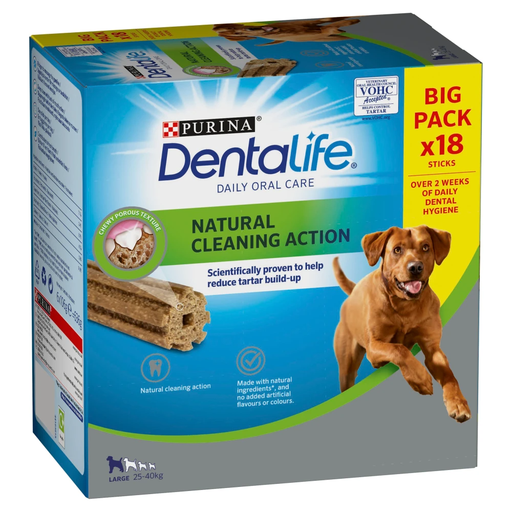
Why This Fits Their Persona: Designed for large dogs weighing 25–40kg, this larger format is suitable for owners managing a regular chew routine for a bigger, stronger dog.
Its stated weight range and one-stick-per-day guidance are clearer than selecting a chew solely by breed label or pack appearance.
The pack contains 18 sticks, with a porous texture, ridges and 2.4% stated fat content.
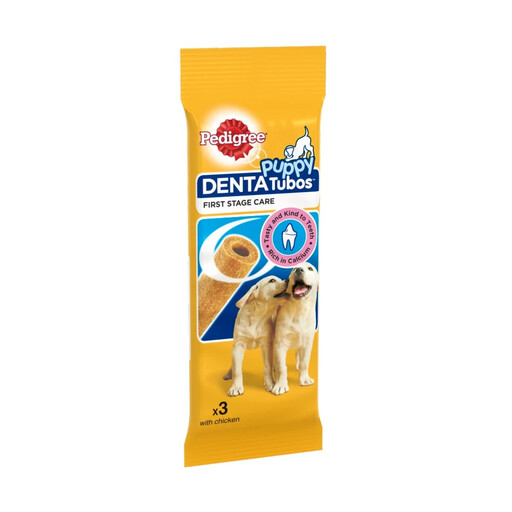
Why This Fits Their Persona: A puppy-specific option for dogs aged 4–12 months, with feeding guidance divided by small, medium and large puppy size.
It is labelled for puppies rather than adapting an adult chew, and the supplied information states that it is not suitable below four months or for puppies under 5kg.
The product has a softer texture, lists 2.0% crude fat and provides age- and size-related feeding instructions.
We have compiled a complete, real-time list of products that fully satisfy these strict selection criteria and UK safety regulations.
Daily dental chews can support a consistent oral-care routine when the product is correctly sized and your dog chews it rather than swallowing it quickly. They are complementary treats, not a replacement for brushing or professional dental care.
Some can, but only if the product is specifically labelled for puppies and matches the puppy’s age and weight. Adult dental sticks may be unsuitable for developing teeth. Always check the minimum age and supervise feeding.
Calculate the pack price by the number of recommended daily chews. A larger pack may reduce the cost per serving, but only if your dog can use the product before its recommended freshness period and the chew is appropriate for their size. Also include the calories in your dog’s daily food allowance.