
24/7 Customer Support

Free returns

Same-day & Next-day Delivery

Quality Guaranteed

Unlock Your Welcome Offers: FREE Delivery | Up to 80% OFF | Free 30-day JoyPlus trial
Download the APP
As a nation of dog lovers, we want what’s right for our four-legged family members, and that includes their dental health. Navigating the world of dog dental chews can be confusing. Shelves are filled with options, all promising fresher breath and cleaner teeth. Yet, many UK dog owners find themselves with products that are either gone in a flash or, worse, unsuitable for their pet.
Before you make your next purchase, it’s worth understanding a few common pitfalls that can lead to wasted money and disappointment.
To make a more informed choice, focus on a few core parameters. These are the non-negotiable details that separate a worthwhile purchase from a poor one.
Always read the label. A quality dental chew should have a clear, understandable list of ingredients. Many modern vegetarian dog chews are built on a base of ingredients like potato starch, which provides a chewy texture, and glycerin, which helps maintain moisture. Powdered cellulose is often added as a source of dietary fibre. Look for products free from artificial colours, flavours and preservatives. The simpler the formula, the easier it is to know exactly what you are giving your dog.
The primary function of dog teeth cleaning chews is to mechanically scrape away plaque and tartar through the act of chewing. This requires a specific texture—one that is firm enough to create friction against the tooth surface but pliable enough not to cause damage. Look for unique shapes with ridges, nubs or grooves. These features are not just for show; they are designed to reach the awkward spaces between teeth and along the gumline, enhancing the cleaning action as your dog chews.
Size is a critical safety factor. A chew that is too small for a large dog is a serious choking hazard, while one that is too large will be unmanageable for a small breed. Reputable brands offer their dental sticks for dogs in various sizes tailored to different weight categories. Always choose the size recommended for your dog’s weight and breed to ensure both safety and effectiveness.
Instead of a one-size-fits-all approach, we've matched some options to the specific needs of different dogs and their owners.
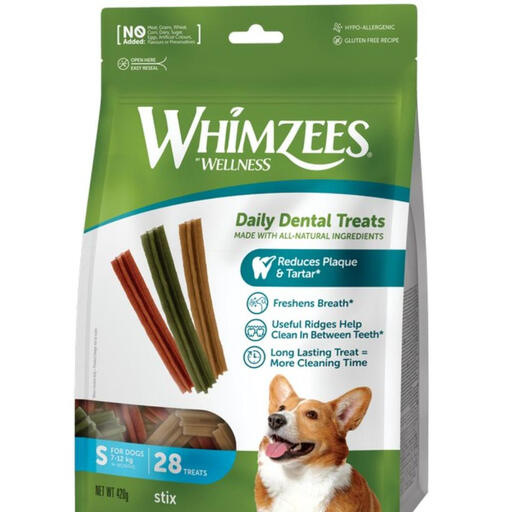
Why This Fits Their Persona: Perfectly sized for small breeds like Terriers, Dachshunds or Pugs. This chew provides a safe, daily dental care routine without the risk of being a choking hazard, which is a primary concern for owners of smaller dogs.
It directly addresses the durability dilemma for small jaws. The texture is firm enough to last, providing adequate cleaning time, rather than being devoured instantly.
Features a limited-ingredient, vegetarian formula. It is a high-fibre, low-calorie option suitable for daily treating without contributing to weight gain.
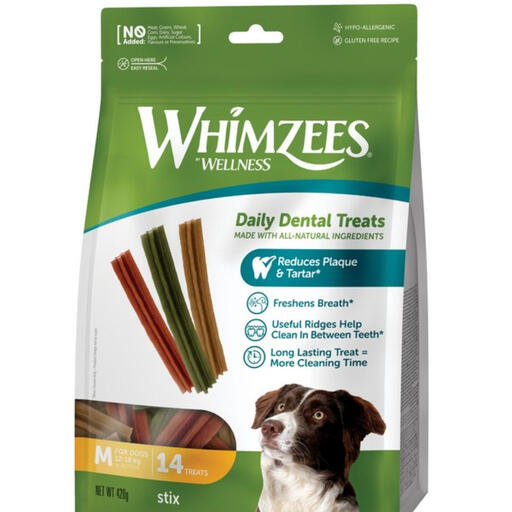
Why This Fits Their Persona: An ideal choice for a wide range of popular UK breeds like Cocker Spaniels, Beagles and Border Collies. It provides a substantial daily chew that helps keep them occupied while supporting their oral hygiene.
It counters the "All-Natural" illusion with a transparent, six-ingredient vegetarian list. There are no artificial additives, colours or vague flavourings to worry about.
The unique grooved shape and firm texture are specifically engineered to help reduce plaque and tartar buildup as the dog chews, reaching more tooth surface area.
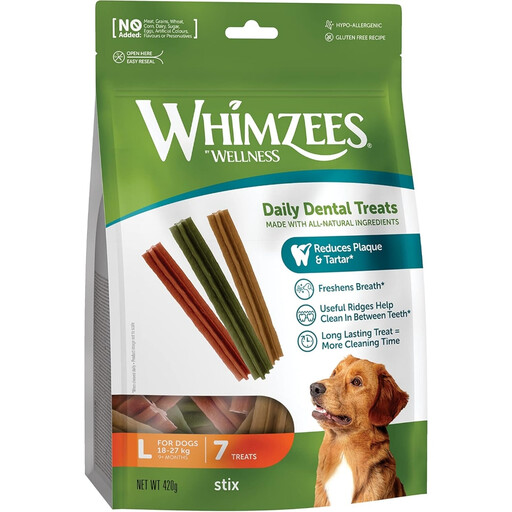
Why This Fits Their Persona: Designed for the powerful jaws of Labradors, German Shepherds and other large breeds. Its substantial size provides a long-lasting challenge, helping to reduce boredom and satisfy their natural urge to chew.
This chew solves the critical safety issue of size appropriateness. It is large and robust enough that a big dog is unlikely to swallow it whole, preventing a common choking hazard.
The all-natural, grain-free composition is gentle on the digestive system. Its high-fibre content also helps to promote digestive regularity in larger dogs.
We have compiled a complete, real-time list of products that fully satisfy these strict selection criteria and UK safety regulations.
Generally, one chew per day is the standard recommendation from many manufacturers, but it is important to read and follow the specific product's guidelines. Always remember to account for the chew's calories as part of your dog's total daily food intake to maintain a healthy weight.
The effectiveness of a dental chew is primarily determined by its physical properties—its texture, shape and hardness—which create the mechanical abrasion needed to clean teeth. A well-designed vegetarian dog chew can be just as effective at helping to reduce plaque and tartar. They also serve as an excellent alternative for dogs that have sensitivities or allergies to common meat proteins.
This can vary significantly between brands. Some chews are formulated to be suitable for puppies from as young as three months old, whereas others are recommended only after six months, once a puppy's adult teeth have fully emerged. Always check the product packaging for specific age and weight recommendations and be sure to supervise your puppy closely whenever they have a chew.