
24/7 Customer Support

Free returns

Same-day & Next-day Delivery

Quality Guaranteed

Unlock Your Welcome Offers: FREE Delivery | Up to 80% OFF | Free 30-day JoyPlus trial
Download the APP
As a dog owner in the UK, you want to do everything you can to keep your companion happy and healthy, and that includes their dental health. The market for dog dental chews is vast, with countless options all promising a simple solution to a complex problem. However, navigating the marketing claims can be tricky, and it's easy to choose a product that's ineffective or, worse, unsuitable for your pet.
Before you buy, it's important to be aware of a few common pitfalls that lead to wasted money and disappointment:
To make an informed choice, focus on a few core parameters that directly impact safety and effectiveness. This will help you find a product that genuinely contributes to your dog's oral hygiene.
The physical properties of a chew are its primary mechanism for cleaning.
Beyond the physical shape, the ingredients list tells you a lot about a chew's purpose.
To help you match a product to your dog's specific needs, we've identified a few options from our catalogue that align with different owner profiles and priorities.
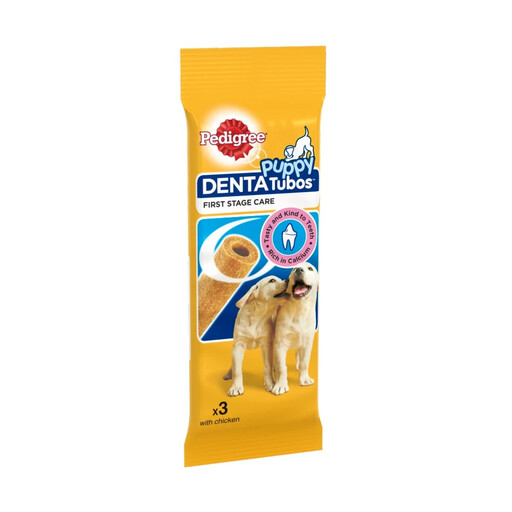
Why This Fits Their Persona: You're raising a puppy and want to start good habits early without risking their delicate developing teeth. This chew is designed specifically for the needs of a growing dog.
It directly counters the "one-size-fits-all" pitfall by offering a softer texture and specific formulation for puppies aged 4-12 months, avoiding the hardness of adult chews.
Rich in calcium to support healthy tooth and bone development. The gentle texture is appropriate for a puppy's mouth.

Why This Fits Their Persona: You prioritise simple, high-quality ingredients and avoid grains, gluten and artificial additives. You want a chew that is both a satisfying treat and a functional dental aid.
This product sidesteps the "natural" marketing trap by being genuinely simple: it's made from 100% natural buffalo hide, is high in protein, low in fat and free from fillers.
A long-lasting chew that satisfies a dog's natural instinct to gnaw. Infused with salmon oil, which is a source of Omega-3 for skin and coat health.

Why This Fits Their Persona: You own a small dog and are looking for a reliable, easy and effective daily treat to support their oral health. Safety and a product designed for their size are your top priorities.
This chew is explicitly designed for small dogs, eliminating the guesswork and risk associated with inappropriately sized treats. It's a purpose-built solution.
The chewy, porous texture is designed to clean hard-to-reach back teeth. According to the brand's own research, it is scientifically proven to help reduce tartar build-up.
We have compiled a complete, real-time list of products that fully satisfy these strict selection criteria and UK safety regulations.
Most dental chews are designed to be given as a daily dental treat for dogs. This consistency is key to helping manage plaque and tartar build-up. However, always read the feeding guide on the specific product packaging, as recommendations can vary. Remember to account for the calories in the treat by slightly adjusting your dog's main meal to maintain a healthy weight.
No, dental chews are a supplementary tool, not a replacement for brushing. The gold standard for canine dental health remains regular brushing with a dog-specific toothpaste. Dental chews work by providing a daily mechanical cleaning action that helps reduce the rate at which plaque and tartar accumulate between brushings or professional cleanings.
This is a critical safety question. Most standard dental chews are not suitable for puppies under 4-6 months of age, as their jaws and teeth are still developing. It is essential to choose a product specifically labelled as a puppy dental chew. These are made with a softer, more forgiving texture. Always check the product's age recommendation before giving it to your puppy.