
24/7 Customer Support

Free returns

Same-day & Next-day Delivery

Quality Guaranteed

Unlock Your Welcome Offers: FREE Delivery | Up to 80% OFF | Free 30-day JoyPlus trial
Download the APP
Dog dental chews can make oral care easier, particularly when your dog resists tooth brushing. However, not every dental stick offers the same size guidance, texture or nutritional profile. The right choice should suit your dog’s weight, chewing style, age and diet—not simply the product with the strongest-looking claim on the packet.
This guide explains the practical checks UK dog owners should make before buying dog dental chews, followed by selected options for different households.
Dental chews are designed to support daily oral hygiene through chewing action, texture and, in some products, functional ingredients. They may help reduce plaque accumulation or tartar build-up as part of a regular routine, but they should not be treated as a replacement for veterinary dental care or professional cleaning.
Claims such as “reduces tartar by up to 80%” should be understood in context. This is a brand or product research claim, dependent on feeding frequency and the conditions of the relevant study. It does not guarantee the same result for every dog.
A “small”, “medium” or “large” label is only useful when it matches the stated weight range. A small dog may chew a large stick too forcefully or struggle to break it down, while a large dog could swallow a smaller stick quickly with limited cleaning action.
Always check the pack’s feeding guide. For example, some medium dog dental chews are intended for dogs weighing 10–25 kg, while selected large options are labelled for dogs from 25 kg upwards.
A sugar-free recipe can be useful for owners limiting added sugar, but it does not automatically indicate low calories, suitable ingredients or an appropriate texture. Some products described as natural or vegetarian may still contain cereals, oils or humectants.
Read the full composition and analytical constituents. Check for ingredients that may be unsuitable for your dog, including peanut-based recipes if your pet has a known sensitivity.
The product must be suitable for your dog’s weight and life stage. Many daily dental sticks are intended for dogs aged over four months, while some specialist options are designed for dogs aged 16 weeks and older.
Look for clear wording such as:
If your dog gulps treats, has difficulty chewing or has existing dental problems, speak to your vet before introducing a firm chew. Supervision is advisable whenever your dog eats a dental treat.
Shape is not just a visual feature. X-shaped, ridged, star-shaped and porous designs can create contact with different areas of the mouth as the dog chews. A chewy or gently abrasive texture may help work against soft plaque deposits.
However, the texture must be appropriate for the dog’s chewing habits. A dental chew that is finished in seconds may be less suitable for your intended routine than one that encourages sustained chewing. Never offer a damaged, damp or spoiled treat.
Daily dental chews are complementary pet food, so they should be included within your dog’s overall food intake. Compare:
Fresh water should always be available. Follow the label’s feeding instructions instead of giving multiple dental chews as ordinary snacks.
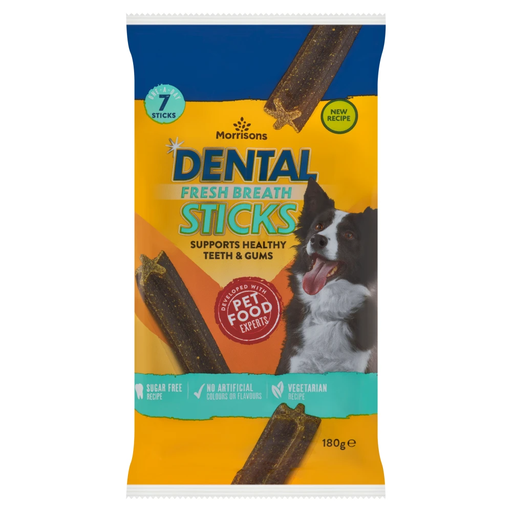
Why This Fits Their Persona: A straightforward starting option for owners who want a one-a-day dental treat without selecting a large multipack immediately.
The listing specifies use for dogs over four months and recommends supervision, helping owners avoid treating the stick as suitable for every age or chewing style.
Star-shaped design; sugar-free vegetarian recipe with no artificial colours or flavours.

Why This Fits Their Persona: Suitable for owners seeking a vegan, grain-free and gluten-free option with clearly defined medium-dog sizing.
The product is labelled for medium dogs weighing 10–20 kg and aged 16 weeks or older, rather than relying on a vague breed description.
Peanut butter, peppermint, parsley and activated charcoal; approximately 70 kcal per chew.

Why This Fits Their Persona: A practical bulk-pack choice for households that want to maintain a consistent daily dental-chew routine.
The stated 10–25 kg range, one-stick-per-day guidance and resealable pack information make ongoing usage easier to plan.
X-shaped texture; listed fat content of 1.3% and no added sugar.
For a small adult dog, the Pedigree DENTASTIX Fresh Daily Dental Chews Small Dog Treat 7 Sticks 110g is labelled for daily feeding and lists a 1.3% fat content with no added sugar. For a large dog, Dentalife Large Dog Dental Chews, 18 Sticks, 636g is labelled for dogs weighing 25–40 kg, with a porous texture and ridges.
Owners comparing familiar Pedigree Dentastix with Dentalife dog chews should compare the actual weight range, pack quantity, ingredients and feeding instructions. The largest pack is not automatically the most economical if your dog does not enjoy the texture or cannot safely finish the chew.
We have compiled a complete, real-time list of products that fully satisfy these strict selection criteria and UK safety regulations.
No. Dental chews can complement brushing and routine veterinary care, but they do not replace either. If your dog has persistent bad breath, bleeding gums, loose teeth or visible heavy tartar, arrange a veterinary assessment.
Many products are designed for one chew per day, but follow the individual label. Adjust meals or other treats to account for the chew’s calories, and provide fresh drinking water.
The duration depends on the chew’s size, texture and your dog’s eating habits. A suitable chew should encourage controlled chewing rather than immediate swallowing. Supervise your dog, remove any small remaining pieces and store opened packs as directed.