
24/7 Customer Support

Free returns

Same-day & Next-day Delivery

Quality Guaranteed

Unlock Your Welcome Offers: FREE Delivery | Up to 80% OFF | Free 30-day JoyPlus trial
Download the APP
For many UK dog owners, dog dental treats for fresh breath are an easier starting point than brushing every tooth. They can fit into a morning routine, training session or evening reward, but not every product labelled “dental” is suitable for every dog.
The main buying risks are usually hidden in the detail:
A sensible choice starts with the product label, the dog’s age and size and the role the treat will play in your daily dental care routine.
Check the minimum age first. Some dog dental sticks are intended only for dogs over four months, while puppy products may be suitable from two months. Puppies also need softer textures and appropriately sized items as their mouths develop.
Consider how your dog eats. A fast eater may bite off and swallow large pieces, so supervision is important. For smaller dogs and puppies, soft treats can often be broken into smaller portions, but the packaging should confirm how the product is intended to be used.
A ridged, star-shaped or multi-sided design may create more contact with the teeth and gum line than a plain, smooth biscuit. However, this does not guarantee that all plaque or tartar will be removed.
Look for practical details such as:
Dental treats should complement, rather than replace, regular brushing or veterinary care where needed.
Read the composition and analytical constituents. A sugar-free recipe may be preferable for owners trying to limit unnecessary ingredients, while a product with parsley or peppermint oil may appeal to shoppers specifically seeking a natural dog breath freshener.
“Natural” does not automatically mean suitable for every dog. Check for known sensitivities and introduce a new treat gradually. Forthglade, for example, states that its fresh breath soft bites contain dried parsley and peppermint oil, while also advising owners to limit treats to 10% of daily calorie intake.
For dog plaque and tartar control, look for clearly stated product features rather than relying on broad promises. The Morrisons dental sticks list sodium phosphates as an active additive and describe their star-shaped design as helping clean between teeth and along the gum line. These are product details, not a guarantee of a particular dental result.
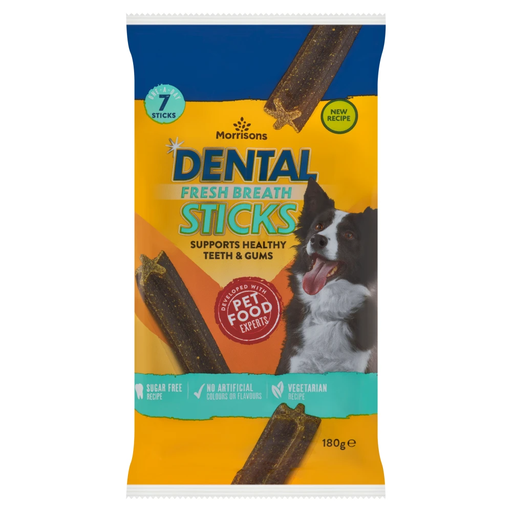
Why This Fits Their Persona: A straightforward option for owners who want a daily dental treat with clear age guidance and a one-piece-per-day feeding direction.
The label states that it is sugar-free, contains no artificial colours or flavours and is suitable for dogs older than four months. This makes the product details easier to check before purchase.
Star-shaped design; sodium phosphates listed in the composition; clear supervision and water instructions.
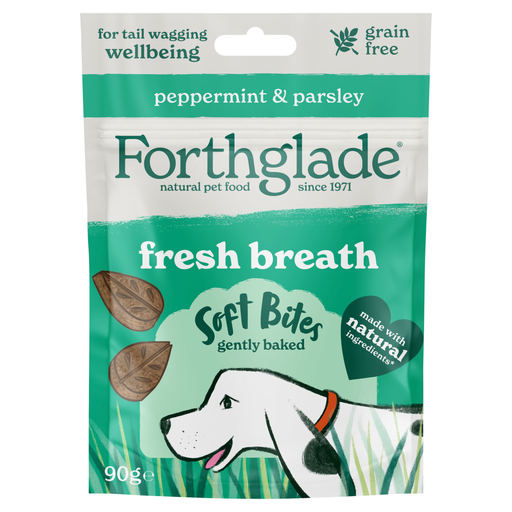
Why This Fits Their Persona: Suitable for owners who prefer small, soft bites that can work as a reward during training or as part of a controlled daily routine.
The feeding guidance addresses calorie control and recommends breaking treats in half for small dogs and puppies, helping reduce the risk of overfeeding.
Contains dried parsley and peppermint oil; suitable from two months; resealable pouch and 28-day guidance after opening.
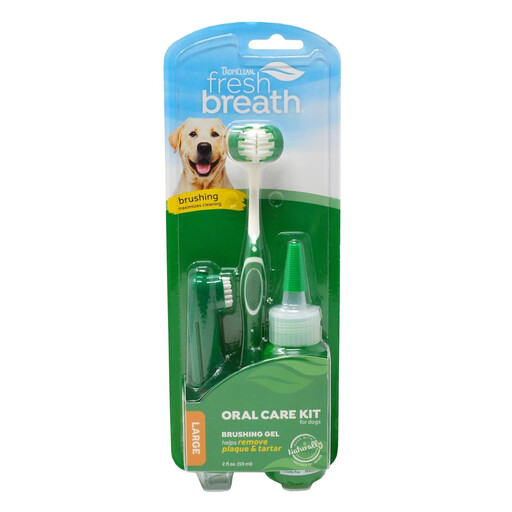
Why This Fits Their Persona: A practical choice for puppy owners who want to establish brushing habits rather than rely only on dental treats.
It includes application tools and gives a daily-use method, so owners can see how the product fits into a repeatable puppy oral care routine.
Includes a triple flex brush and finger brush; gel contains green tea leaf extract, honey and natural mint; designed for puppies.
Choose one routine that you can maintain consistently:
For puppy owners, a puppy oral care kit can help make handling the mouth familiar. For adult dogs, dental sticks or soft dog fresh breath treats may be easier to introduce as part of an existing reward routine.
We have compiled a complete, real-time list of products that fully satisfy these strict selection criteria and UK safety regulations.
No. Treats may freshen breath or provide chewing contact, but they do not necessarily clean every tooth surface. Daily brushing with a pet-appropriate product remains a useful part of oral hygiene where your dog accepts it.
Follow the product’s feeding guide. Some dental sticks specify one piece per day according to age and size. Soft treats may need to be limited to a proportion of daily calories, with the Forthglade label advising no more than 10% of daily calorie intake.
Some are, but the minimum age varies. The TropiClean kit is described for puppies, while the Morrisons dental sticks are labelled for dogs older than four months. Always check the package, choose a suitable size and supervise your puppy while eating or brushing.