
24/7 Customer Support

Free returns

Same-day & Next-day Delivery

Quality Guaranteed

Unlock Your Welcome Offers: FREE Delivery | Up to 80% OFF | Free 30-day JoyPlus trial
Download the APP
For UK dog owners, dog poo bags are a daily essential. Yet choosing a suitable pack involves more than comparing the number printed on the front. A low-priced roll may tear when you need it most, while an “eco” label may not explain how the material breaks down or how it should be disposed of.
This guide covers the main buying pitfalls, the specifications worth checking and suitable options for different walking routines.
These terms are not interchangeable. Degradable dog waste bags may be designed to break down under particular conditions, but the product description may not provide a clear timeframe or composting route. Compostable dog poo bags should state the relevant standard, such as EN 13432 or ASTM D6400, where applicable.
Even certified compostable bags should not automatically go into a household food-waste caddy or garden compost. Many UK councils do not accept pet waste in standard composting collections. Check local guidance, and never use pet-waste compost for edible crops unless the relevant process specifically permits it.
Scented dog poo bags can make a walk more comfortable, but fragrance does not replace secure closure. Similarly, an antibacterial claim describes a product feature; it should not be treated as a guarantee of complete germ removal or odour prevention.
Tie handles, a reliable knot and a bag with enough material around the opening are more practical considerations. If you prefer a scented option, check whether the fragrance is suitable for your household and whether the bag can be opened easily with one hand.
A pack of 600 bags may appear economical, but the saving is limited if each bag is too narrow for your dog or difficult to separate. Large dog poo bags should offer sufficient width and length to turn safely inside out, collect waste and tie without stretching the material excessively.
For multi-dog households, calculate the cost per bag rather than the cost per roll. For occasional walkers, a smaller pack may avoid storing rolls for longer than recommended.
Look for clear material details rather than relying only on front-of-pack terms such as “green” or “eco-friendly dog poo bags”.
Bag size is usually listed in centimetres. A 15 × 30cm bag may suit many everyday clean-ups, while bags around 23 × 33cm provide more coverage for larger breeds or messier collections.
Thickness can also be relevant. For example, the Adios Plastic bags are listed as 20 microns thick, while Benevo bags are listed at 17μm. These figures help with comparison, but handling technique, seams and storage also affect performance. Keep rolls away from heat, moisture and direct sunlight, as some degradable or compostable materials can be affected by storage conditions.
No bag should be described as entirely immune to punctures. Avoid contact with sharp sticks, stones or long claws, and inspect the bag before use.
Dog waste bags with handles are convenient when you need to tie the bag quickly. Loose-packed bags can be useful for one-handed access, while tear-off rolls are compact and compatible with many dispensers.
A dog poo bag dispenser can be clipped to a lead, belt or backpack, helping you avoid searching through pockets during a walk. Check whether the dispenser accepts standard-sized rolls before buying dog poo bag refills. A refill that is too wide or tightly wound may not feed smoothly.

Why This Fits Their Persona: A straightforward 100-bag pack for owners who want an everyday roll supply without committing to a larger bundle.
The stated 15 × 30cm size gives a useful reference point before purchase, while the tear-off design avoids relying on vague quantity claims alone.
100 bags, degradable material, antibacterial-labelled construction and easy tear-off dispensing.
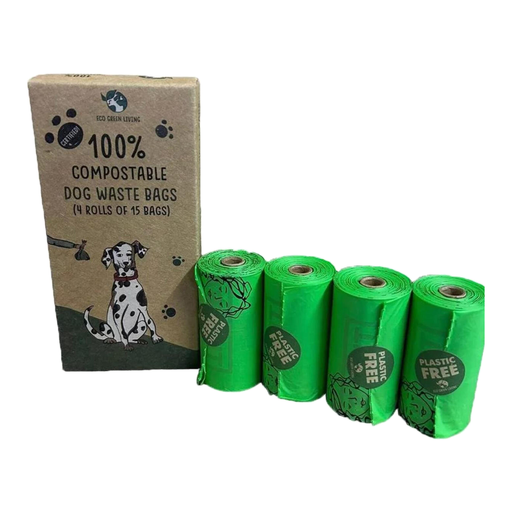
Why This Fits Their Persona: Suitable for environmentally conscious owners who want stated compostability standards and larger bags for regular walks.
The listing identifies EN 13432, EN 7P2045 and ASTM D6400 standards, making the compostability claim more specific than generic “biodegradable” wording.
23 × 33cm bags, water-resistant and leakproof features stated, with 60 bags per pack.
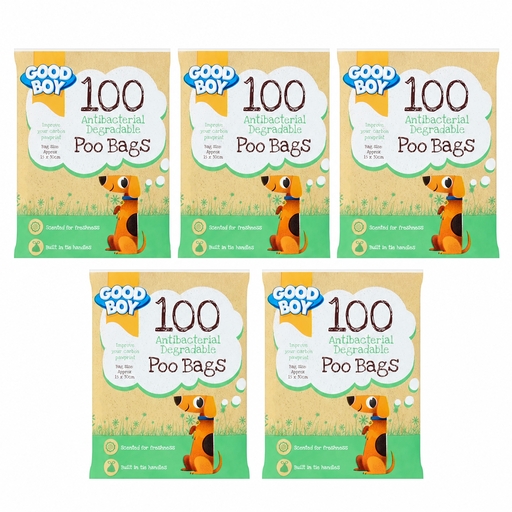
Why This Fits Their Persona: The 500-bag bundle suits multi-dog homes, frequent walkers and owners who prefer to buy supplies less often.
The pack states both total quantity and individual bag dimensions, so value can be assessed against usage rather than the headline pack size.
500 bags, built-in tie handles, fresh scent and degradable antibacterial-labelled material.
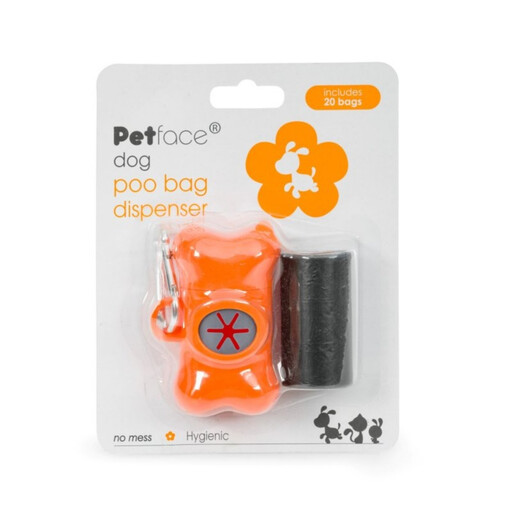
Why This Fits Their Persona: A practical choice for owners who want bags attached to a lead, backpack or belt rather than loose in a pocket.
The reusable PP dispenser includes a snap clip and arrives loaded with 20 LDPE bags, while replacement rolls are available separately.
Compact clip-on design, 20 included bags and reusable construction; the pack contains 10 dispensers.
We have compiled a complete, real-time list of products that fully satisfy these strict selection criteria and UK safety regulations.
Only where the packaging and local guidance permit it. Certification such as EN 13432 relates to specified composting conditions, and pet waste may not be suitable for compost used around edible plants. Check your council’s instructions before disposal.
The usable storage period varies by material and manufacturer. Degradable and compostable bags can be more sensitive to moisture, heat and sunlight, so follow the product label and keep rolls sealed in a cool, dry cupboard.
They can help mask unpleasant odours while the bag is being carried, but scent is a personal preference rather than a substitute for thickness or secure handles. If leak resistance is your priority, compare bag dimensions, material information and closure design first.