
24/7 Customer Support

Free returns

Same-day & Next-day Delivery

Quality Guaranteed

Unlock Your Welcome Offers: FREE Delivery | Up to 80% OFF | Free 30-day JoyPlus trial
Download the APP
Choosing suitable dog toys is not simply a matter of picking the most colourful or heavily advertised option. A toy needs to match your dog’s size, chewing strength, play style and environment. The right choice can support exercise, enrichment and owner-pet interaction, while the wrong one may be ignored, damaged quickly or become unsafe.
Marketing descriptions often use phrases such as “tough”, “bite-resistant” or “long-lasting”. These terms do not mean a toy cannot be damaged. A strong chewer may split seams, remove pieces or expose a squeaker within minutes.
Every toy should be treated as a consumable item. Supervise play, inspect it before and after use and replace it when cracks, loose threads, sharp edges or detached parts appear.
Labels such as “for all breeds” can be useful, but they do not replace checking the actual dimensions and your dog’s behaviour. A 15 cm ball may be manageable for one dog but too small for another that tends to swallow toys. Similarly, a small puppy may struggle with a large, rigid chew.
Look for clear measurements and consider the dog’s mouth size, bite strength and tendency to carry or ingest objects.
Textured chew toys may help rub against teeth and gums during play, but they are not a substitute for brushing or professional veterinary care. Be cautious of claims suggesting that a toy alone controls plaque, freshens breath or guarantees dental improvement. Select a toy for its construction and suitability, not unsupported health promises.
For durable dog chew toys, check whether the product uses rubber, TPR, nylon, cowhide, latex, fabric or a combination of materials. Each has a different purpose:
A double-layer design does not make a product indestructible. It simply describes how the toy is assembled and may help you compare construction more objectively.
For dog toys for small and large breeds, size is a safety consideration rather than a cosmetic preference. A toy should be large enough that your dog cannot swallow it whole, but not so large that it cannot be carried or gripped comfortably.
Check the listed dimensions. For example, a compact 10.7 × 4 cm rubber toy is positioned for small dogs, while a 24 × 6 cm natural rubber and nylon toy is designed for medium and large dogs. Always follow the product guidance and observe your dog during first use.
Match the toy to the activity:

Why This Fits Their Persona: A practical option for owners wanting one toy for indoor interaction, garden play and park visits. Its inflatable format can be deflated for storage or travel.
The 15 cm diameter is clearly stated, making it easier to compare size instead of relying on broad breed claims. It is also clearly described as a supervised play toy.
Lightweight woven outer structure; suitable for throwing, kicking, chasing and compact storage when deflated.
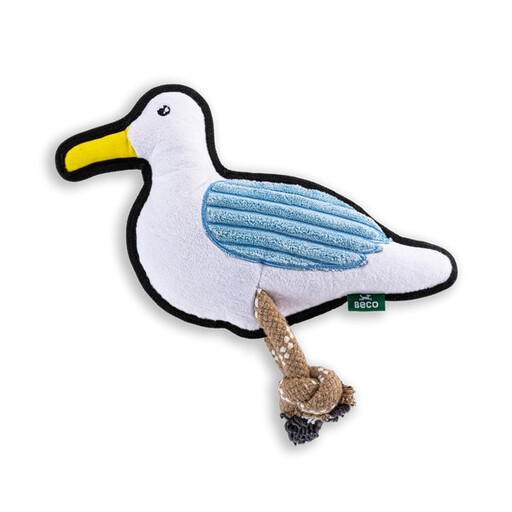
Why This Fits Their Persona: Suitable for owners who value recycled materials alongside energetic play, light cuddling and water-based activities in the garden, park or on holiday.
Its construction details are specified: recycled materials, double stitching, an internal squeaker and a floating design. It is still not presented as indestructible and requires supervision.
Double stitching; built-in squeaker; floats in water; made from recycled materials.
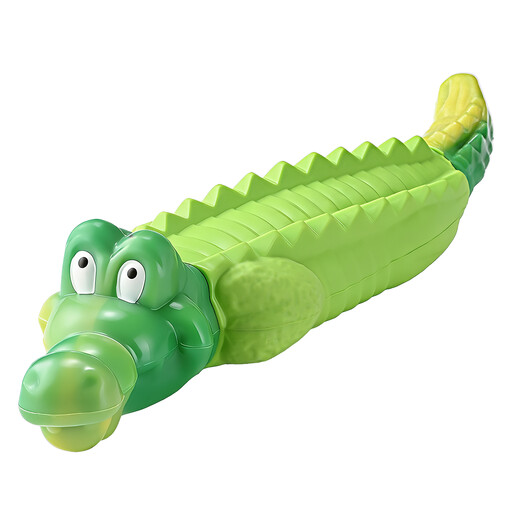
Why This Fits Their Persona: Designed for medium and large dogs that need a larger toy for chewing, fetch training, tugging and outdoor play.
The product states its 24 × 6 cm dimensions and medium-to-large breed focus, reducing the risk of choosing a toy that is too small for a powerful chewer.
Natural rubber exterior with nylon core; textured crocodile shape; suitable for fetch, tugging and outdoor interaction.
We have compiled a complete, real-time list of products that fully satisfy these strict selection criteria and UK safety regulations.
There is no universal lifespan for dog toys. A gentle fetch toy may last much longer than a chew toy used daily by a powerful dog. Rotate several toys to reduce constant wear, clean them according to the label and keep fabric toys dry after outdoor use.
For puppies, introduce puppy teething toys while watching how they chew. For squeaky toys, remove the item if the squeaker or filling becomes accessible. Do not allow your dog to consume pieces of rubber, nylon, fabric, cowhide or edible inserts. If ingestion occurs or your dog appears unwell, contact a veterinary professional promptly.
Choose a product with a suitable size and a robust construction, such as layered rubber and nylon or a clearly specified nylon chew. No toy is guaranteed to withstand every dog, so inspect it frequently and avoid leaving a strong chewer unattended with a damaged item.
Replace a toy as soon as it develops cracks, loose parts, torn stitching, sharp edges or exposed sound components. The replacement interval depends on your dog’s chewing strength, how often the toy is used and the material.
Squeaky dog toys can be suitable for supervised play when intact and correctly sized. They should not be used if your dog tries to remove and swallow the squeaker and they should be discarded once the sound unit or internal filling is exposed.