
24/7 Customer Support

Free returns

Same-day & Next-day Delivery

Quality Guaranteed

Unlock Your Welcome Offers: FREE Delivery | Up to 80% OFF | Free 30-day JoyPlus trial
Download the APP
Choosing dog toys can seem straightforward until a squeaker stops working, a rope begins to fray or a supposedly durable toy proves too small for your dog. For UK households, the right choice depends less on colourful packaging and more on your dog’s size, bite strength, preferred activity and where the toy will be used.
This guide explains the common buying traps, the specifications worth checking and a selection of dog toys matched to different lifestyles.
Many toys are described as tough, but no dog toy is indestructible. A plush toy may handle gentle carrying and supervised fetch but fail quickly when used as a chew toy. Similarly, a rope toy can be suitable for tugging yet become unsafe when its fibres start to unravel.
Look for clear usage guidance. If a product is labelled “not a chew toy” or “not suitable for aggressive chewers”, treat that as an important limitation rather than a minor disclaimer.
A large dog may swallow or break a toy designed for small breeds, while a small dog could struggle to carry an oversized product. Check the stated measurements and consider the toy’s shape, weight and any detachable components.
For dog toys for medium and large dogs, robust materials and a size that cannot be easily swallowed are particularly important. However, size alone does not make a product suitable for unsupervised chewing.
Squeaky dog toys can attract attention and encourage chasing, biting or carrying. However, a squeaker does not automatically provide meaningful mental stimulation. Some dogs lose interest once the sound disappears, while others may try to remove the squeaker.
Interactive dog toys work more effectively when they match a clear activity, such as fetch, tugging, scent exploration or problem-solving. Consider how you will play with the toy rather than buying solely for a sound or novelty design.
The material should match the intended activity:
Look for reinforced stitching, securely attached parts and a construction that is easy for you to inspect. Avoid assuming that a soft outer layer or thick appearance guarantees long-term durability.
Measure your dog’s existing toys and compare them with the product dimensions. A toy should be easy for your dog to pick up without fitting entirely inside the mouth. Avoid products with small loose parts for dogs that tend to swallow objects.
Curved edges, handles and textured surfaces can make fetch and tug toys for dogs easier to grip. For outdoor dog toys, buoyant or brightly visible materials may be useful in parks, gardens and near water, but always check the area for hazards before play.
Select the toy according to your dog’s routine:
Introduce a new toy gradually, especially if it has an unfamiliar texture or sound. Rotating several toys can help maintain interest without leaving every item available all day.
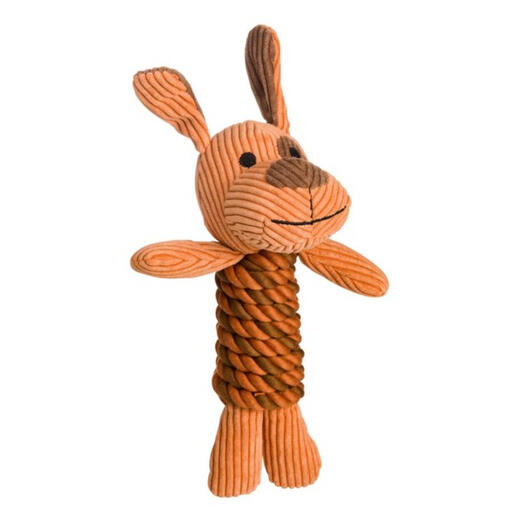
Why This Fits Their Persona: A practical option for households wanting one toy for supervised fetch, light tugging and everyday indoor play.
Its product information identifies the toy as unsuitable for aggressive or heavy chewers, helping buyers avoid using a plush-and-rope design beyond its intended purpose.
Soft plush fabric, twisted rope body and a built-in squeaker support several supervised play styles.
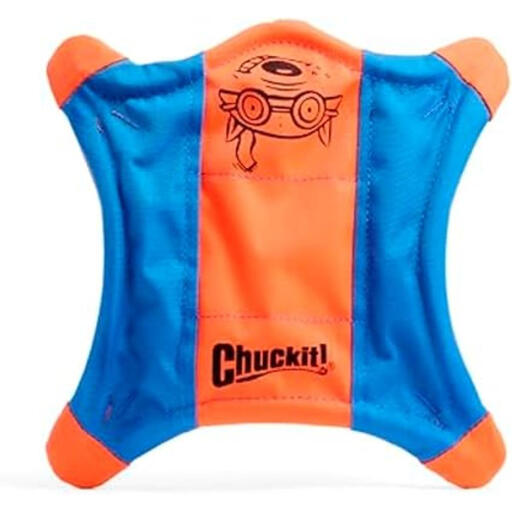
Why This Fits Their Persona: Designed for owners who prioritise structured outdoor fetch in a garden, park or other open space.
It is clearly described as a fetch toy rather than a chew toy, so its aerodynamic design is matched to its intended use.
Lightweight, buoyant construction, curved retrieval sides and a glow-in-the-dark feature for lower-light play.
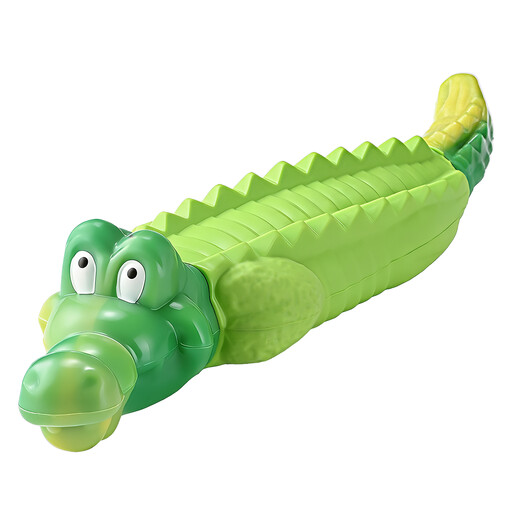
Why This Fits Their Persona: Intended for medium and large dogs that need a firmer option for supervised chewing, fetch training and outdoor activity.
The stated 24 × 6 cm size and medium-to-large-dog positioning make the intended audience clearer than generic “all dogs” wording.
Natural rubber outer layer, nylon core and textured crocodile shape for gripping, chewing and retrieving.
We have compiled a complete, real-time list of products that fully satisfy these strict selection criteria and UK safety regulations.
Use toys in a space suitable for the activity. A garden may be enough for short fetch sessions, while energetic dogs may need a secure, open area away from roads and obstacles. Avoid throwing toys towards glass, parked cars or other animals.
Inspect each toy before and after use. Look for:
Replace a toy as soon as damage creates a swallowing or choking risk. Supervision is particularly important for puppies, dogs that chew forcefully and pets that try to ingest fabric or rope.
There is no fixed lifespan. A plush toy used occasionally for gentle carrying may last longer than a rubber toy used daily by a strong chewer. Inspecting toys regularly is more useful than relying on a promised duration. Rotation and appropriate storage can also reduce unnecessary wear.
They can be suitable for supervised play if the toy is an appropriate size and has no loose components. Puppies may quickly bite through plush fabric or try to remove the squeaker, so inspect the toy frequently and remove it if damaged.
Choose a product specifically described for chewing and matched to your dog’s size. Natural rubber and nylon designs may suit some moderate chewers, while plush, rope and squeaky toys are generally better for supervised interaction. No toy should be treated as indestructible or left with a dog that damages it rapidly.