Who is choosing the machine?

Bake-sale batch planners

If you need dough for several pizzas, work backwards from the quantity you intend to make. Compare the machine’s documented dough function with its capacity information, then allow enough time for repeat cycles rather than treating a loaf-size rating as a pizza yield.

Time-constrained home bakers

If you will be preparing toppings, packaging or other sale items alongside the dough, a documented dough programme can take care of mixing and kneading. Check its cycle length and controls before building the rest of your schedule around it.

Allergen-conscious event organisers

If you are making pizzas for people with different dietary needs, choose an appliance you can clean and manage alongside separate ingredients and equipment. A gluten-free programme does not establish that the finished food is suitable for someone with an allergy; event food-handling and allergen-information duties need their own plan.

What matters when buying?

Bread maker with a dough programme

Choose it when: You want pizza dough and the option to make loaves or use other documented programmes.

Allow for: The chosen recipe may require successive cycles; a stated loaf size is not a guaranteed pizza-dough yield.

Dedicated dough maker

Choose it when: Your priority is preparing a larger dough batch and you will bake the pizzas separately.

Allow for: A dough maker does not replace a bread maker’s loaf-baking functions; shaping space and oven capacity still matter.

Concern What to check Who this matters to
Batch capacity Confirm a dough-only function and the applicable recipe limit. Test your recipe rather than converting a loaf rating into a pizza count. If I need several pizzas for the sale, I want to know how many batches fit before preparation time runs out. Around 42% of consumers put batch throughput first.
Hands-off timing Check the dough-cycle duration and controls; a rapid-bake setting for loaves does not establish the dough-cycle time. When toppings and packaging also need attention, I want the machine to handle dough preparation while I do those jobs. For around 33% of consumers, reducing hands-on time is the primary need.
Allergen management Consider how shared parts will be cleaned and ingredients kept separate. Check the information required for your event and food format. If I am serving people with different dietary needs, I need a reliable way to manage ingredients and communicate allergens, regardless of programme names. That responsibility comes first for around 25% of consumers.

What could disrupt your plans?

  • Treating loaf size as a pizza count

    Panasonic’s range guide and Morphy Richards’ product information describe loaf capacities, which do not tell you how many pizza bases your recipe will produce. Too few planned cycles could leave you short of dough.

    Make a trial batch with your intended recipe, record the dough portions it yields and schedule any repeat cycles alongside shaping and baking.

  • Applying a fast-bake claim to pizza dough

    Morphy Richards describes Fastbake in relation to baked loaves and directs pizza preparation to the dough setting. Those are different functions, so the loaf claim should not set your pizza-dough timetable.

    Check the dough-cycle duration in the manual, then allow time to divide, shape and prove the dough as your recipe requires.

  • Relying on a gluten-free programme for allergen control

    A programme name cannot establish that shared equipment or ingredients are suitable for someone with an allergy. Food Standards Scotland advises managing allergens through practices including cleaning, separation and accurate information; cooking does not remove allergens.

    Check every ingredient, clean and separate equipment appropriately, and give consumers accurate allergen information for the pizzas you prepare.

  • Assuming every bake sale has the same food-business duties

    For England, Wales and Northern Ireland, the Food Standards Agency says a local authority may decide that registration is unnecessary for very limited, infrequent food activity. The event’s organisation and frequency matter, while the food format affects allergen-information requirements.

    Ask the relevant local authority about your event before planning a recurring operation, and establish whether the pizzas will be sold non-prepacked, prepacked or prepacked for direct sale. Check the applicable guidance in Scotland if the event is held there.

Relevant brands to consider

Panasonic

Panasonic’s SD-YR2550 and SD-R2530 are bread-maker options for buyers who want pizza-dough programmes alongside other bread-making functions.

  • Panasonic documents pizza-dough programmes and manual kneading and rising controls for these models.
  • The 640 g–1.1 kg sizes in Panasonic’s range guide refer to loaves, not a stated pizza-dough yield.

Morphy Richards

The Fastbake Breadmaker offers a documented dough setting for pizza preparation alongside its loaf programmes.

  • Morphy Richards directs pizza-dough preparation to the machine’s dough setting.
  • Its Fastbake claim concerns baked loaves, not dough-cycle speed; the pan, measuring cup and kneading blades are hand-wash only.

Russell Hobbs

Russell Hobbs describes pizza-dough use for its Classics Breadmaker, a route for buyers also considering cleaning and scheduling features.

  • Russell Hobbs describes a 13-hour delay function and dishwasher-safe loaf tin and kneading paddle parts.
  • Check the manual’s recipe limit and whether delayed operation suits your chosen ingredients before planning bake-sale batches.

Lakeland

Lakeland’s bread-maker range includes compact and larger models, so the model and its documented functions matter more than the range name.

  • Lakeland describes pizza-dough capability for its larger touchscreen bread maker.
  • Do not assume every machine in the range has the same dough function or pizza-dough batch limit; check the particular model.

Joybuy dough-making products

This dedicated dough maker is an option if you intend to prepare pizza dough in a larger batch and bake the pizzas separately, rather than use the appliance to bake loaves.
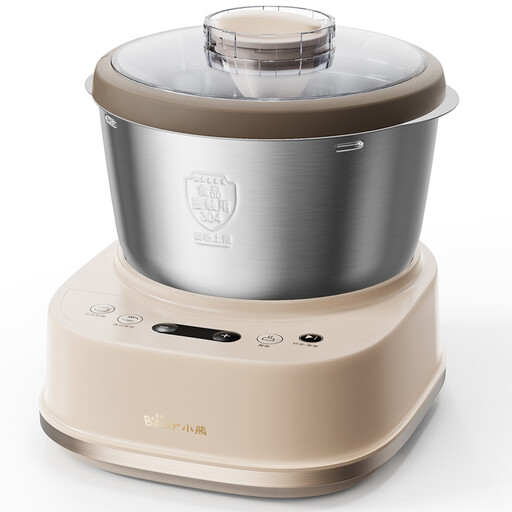
Bear HMJ-A50N1 Intelligent Dough Maker

Bear HMJ-A50N1 Intelligent Dough Maker, 5 L

Consider this dough-only machine if a larger kneading batch is more useful to you than a bread maker’s loaf-baking functions.

The listing states a 5 L bowl, dough weight up to 2.5 kg, automatic kneading and fermentation, and separate knead-only and ferment-only modes. Check the recipe limits and full cycle time before setting your bake-sale quantity; the stated dough weight does not establish how many pizza bases you will make.

Joybuy

Bake-sale pizza dough questions

Can I calculate pizza quantities from a bread maker’s loaf capacity?

No: a loaf-size figure is not a count of pizza bases. The yield depends on your recipe and portion size, so run a trial batch and use its result to schedule any repeat dough cycles.

Do I need to register to sell pizza at a bake sale?

Registration depends on the event’s circumstances, rather than on the use of a bread maker. For England, Wales and Northern Ireland, the Food Standards Agency says a local authority may decide registration is unnecessary for very limited, infrequent activity; ask the relevant local authority about your event. For an event in Scotland, check the applicable Food Standards Scotland guidance and confirm the position locally.

What allergen information should I prepare for pizzas sold at the event?

Start with an accurate ingredient record for every pizza, then establish the requirements for your food-business status and how the food will be sold. The Food Standards Agency says food businesses in England, Wales and Northern Ireland must provide information on applicable mandated allergens for non-prepacked food, while prepacked and prepacked-for-direct-sale food have different labelling requirements. Food Standards Scotland also provides allergen guidance for food businesses in Scotland.

Does a gluten-free programme make the pizza safe for someone with a wheat allergy?

No safety conclusion follows from the programme name alone. Ingredients, shared equipment and cross-contact all need attention; Food Standards Scotland advises cleaning and separation when managing allergens and notes that cooking does not remove them.

How should I handle pizza ingredients at a community event?

Plan for cleaning, chilling, cooking and avoiding cross-contamination throughout preparation and service. Food Standards Scotland advises keeping foods that normally need refrigeration cool and not leaving food put out for a party for more than four hours; check the guidance that applies to your event and ingredients.