
24/7 Customer Support

Free returns

Same-day & Next-day Delivery

Quality Guaranteed

Unlock Your Welcome Offers: FREE Delivery | Up to 80% OFF | Free 30-day JoyPlus trial
Download the APP
A tidy drawer can make everyday tasks easier, but choosing the wrong drawer organisers may create a different kind of clutter. Compartments that are too shallow can spill their contents, oversized trays can waste usable space, and lightweight designs may slide around every time the drawer opens.
There are also several common shopping traps:
Before comparing colours or piece counts, measure the drawer and consider how you use it.
Measure the internal length, width and height, rather than relying on the external drawer size. Check for hinges, runners, sloped sides and any internal obstructions.
For a practical fit:
This is especially important when buying a kitchen drawer organiser or cutlery drawer organiser, where drawer runners and handles can reduce the available space.
A multi-compartment drawer organiser is useful when you need to separate different categories, such as knives, forks, teaspoons and cooking utensils. However, too many fixed sections may limit flexibility.
For mixed household storage, sets of different-sized containers can be more adaptable. They can be arranged around bottles, cables, stationery or unusually shaped items. For make-up and toiletries, smaller compartments may help separate brushes, palettes and everyday products without requiring a deep container.
Think about the items you reach for most often. Frequently used objects should sit towards the front of the drawer, while occasional-use items can go further back.
Plastic drawer storage containers are easy to wipe, but the finish and construction still matter. Look for:
Clear plastic drawer organisers make it easier to identify contents at a glance, while a neutral-coloured organiser may blend more discreetly into a kitchen or office. If storing food-contact items such as cutlery, check the product information for suitability rather than assuming that every plastic organiser is intended for direct food contact.
For an anti-slip drawer organiser, follow the care instructions. The ADDIS product information advises placing it on a clean, dry and flat surface, avoiding excessive loads, heat sources and harsh cleaning products.

Why This Fits Their Persona: This assorted set suits renters, students and households organising one or two drawers without committing to a single fixed layout. Four sizes allow contents to be grouped across bathroom, vanity or kitchen storage.
The four-size format helps avoid buying several identical trays that leave awkward gaps. Measure first, as the supplied information does not provide exact individual dimensions.
Clear plastic construction supports quick identification; 11 pieces provide flexible arrangements for smaller household items.
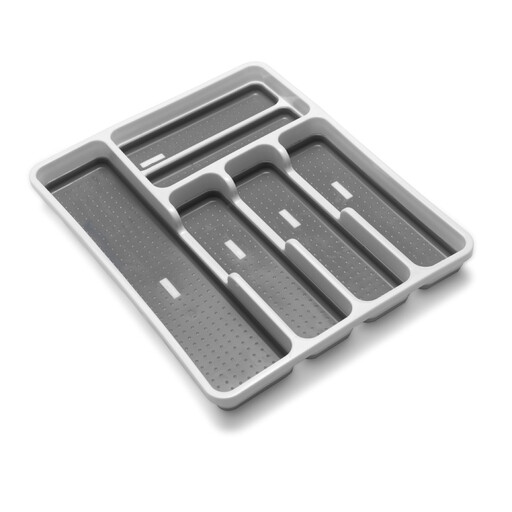
Why This Fits Their Persona: A suitable choice for households wanting a defined layout for everyday kitchen cutlery, stationery or craft materials. Its neutral white/grey finish can sit discreetly in different rooms.
Its integrated anti-slip base is designed to reduce unwanted movement, addressing the common problem of trays sliding during drawer use. It still needs a clean, dry, flat surface.
Six separate compartments; smooth, wipe-clean plastic surfaces and a compact design listed for use beyond the kitchen.
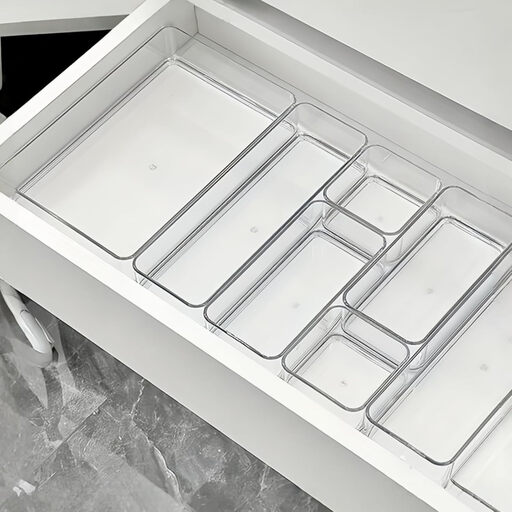
Why This Fits Their Persona: The larger assortment is suited to busy families or people organising several drawers across the kitchen, bathroom, vanity, office and utility room.
The range of container sizes makes it easier to use available drawer space rather than forcing every item into one standard compartment.
25 pieces across four sizes; clear containers can support visual sorting of make-up, toiletries, utensils and small household supplies.
Start with one drawer and remove everything before arranging the containers. Group similar items, discard duplicates and place the most frequently used pieces at the front.
For a make-up drawer organiser or bathroom drawer organiser, keep powders, brushes and toiletries separated to make cleaning simpler. A vanity organiser should leave enough room to remove products without knocking over adjacent items.
In a kitchen, avoid packing compartments so tightly that cutlery catches when lifted. Sharp tools should be stored safely, with blades pointing downwards or in a suitable section. Do not overload plastic containers with heavy items, as this can make a drawer difficult to open and place stress on the organiser.
If you need a dedicated solution for cooking tools and cutlery, browse the wider utensils drawer organiser range.
We have compiled a complete, real-time list of products that fully satisfy these strict selection criteria and UK safety regulations.
They can be useful because most designs require no permanent installation. Choose lightweight containers or adjustable sets that can be repositioned when moving. Measure each drawer first, particularly in older UK kitchens where internal dimensions may vary.
Choose a design with an integrated anti-slip base, then place it on a clean, dry and flat surface. Avoid overloading compartments and check whether the drawer itself is level. Loose liners may also affect stability, so follow the organiser’s care instructions.
The frequency depends on the room and contents. Kitchen and bathroom organisers may need regular wiping, while office storage can usually be cleaned less often. Use a soft damp cloth where specified, and avoid abrasive pads or harsh chemicals that may scratch or degrade plastic surfaces.