Choose a screenless pen tablet if you can write on a pad while viewing your notes on a connected computer; choose a pen display if writing directly on the visible document matters more than desk space and connection simplicity. For either format, check your computer, note-taking software and available desk space before deciding. Wireless pen tablets can reduce cable clutter, but the tablet itself still needs power.
Who each setup suits
Laptop users with limited desk space
If you make meeting notes or annotate documents beside a laptop, a screenless pen tablet gives you a separate writing surface without adding another display. You must be comfortable watching the laptop screen as you write.
People who annotate on-screen
If you regularly mark PDFs or sketch over shared material, a pen display lets you place the pen on the visible document. Allow space for the display and check its connection requirements.
Hot-desk and meeting-room users
If the device moves between desks or rooms, consider its carrying size, cable arrangement and reconnection method. A wireless pen tablet may reduce attached cables, provided it works with your computer.
What matters when choosing
For shared-office notes, settle the writing format first: a separate pad viewed through a computer screen, or a pen display you can write on directly. Then check how the device fits your desk and work computer.
| Concern |
What to check |
Who this matters to |
| Writing workflow |
Try to establish whether you can write on a separate pad while watching your computer screen, or need to write directly on the displayed document. Check your note or annotation app. |
When I mark shared PDFs, seeing the pen tip on the document may matter more than keeping the desk clear; around 31% of consumers would put writing workflow first. |
| Desk and connections |
Measure the space beside your keyboard and check available ports. For a one-cable Wacom One 14 setup, Wacom specifies Thunderbolt 3 or later or DisplayPort Alt Mode. |
If my workspace changes during the day, I need a device and cables I can place without disrupting the desk; roughly 31% of consumers would make setup simplicity their primary concern. |
| Portability |
Compare size, weight and storage needs. For a wireless model, confirm computer compatibility, tablet charging needs and any wired connection you expect to use. |
Moving from my desk to a meeting room makes carrying and reconnecting the tablet important; about 23% of consumers would prioritise that flexibility. |
| Shortcut controls |
Check whether controls can be mapped in the driver to commands in your actual note-taking app, and whether their placement works for your writing hand. |
When I repeatedly change tools or undo marks, reachable controls could save trips to the keyboard; around 15% of consumers would put shortcut access first. |
Buying pitfalls
-
Assuming any USB-C laptop can run a one-cable pen display
The connector alone does not confirm that a laptop can send the video signal a pen display needs.
For the Wacom One 14, check the laptop for Thunderbolt 3 or later or DisplayPort Alt Mode before planning a one-cable setup.
Wacom specifies a separately sold converter kit for a PC without DisplayPort Alt Mode.
-
Expecting a screenless pen tablet to store notes on its own
A screenless pen tablet is an input device for a compatible host, not a notebook with its own display and note storage.
Decide whether you need an accessory for your work computer or a standalone digital notebook, then check the device and app combination.
-
Choosing by pressure levels alone
A pressure-level figure does not settle whether the writing position, desk fit or connection suits office notes.
Choose the writing format and check computer and software compatibility before comparing pen or shortcut specifications.
-
Assuming a battery-free pen means a wireless tablet needs no charging
XPPen lists a battery-free stylus for the Deco mini7W V2, while the wireless tablet has its own battery.
Check charging arrangements for the tablet separately from those for the pen, and confirm the wired connection you could use when needed.
Brands to consider for these formats
Wacom
Wacom One includes computer-connected pen tablets and pen displays for note-taking and annotation.
- Wacom lists PC, Mac, Chromebook and compatible Android connections for Wacom One pen tablets; Windows and macOS require a driver download.
- The Wacom One 14 pen display needs a computer with suitable video output for its one-cable USB-C setup. Check the exact computer before choosing it.
Huion
Huion's Inspiroy 2 range offers screenless pen tablets in different sizes, including models with physical controls.
- Huion lists a battery-free pen, configurable keys and a scroller for the Inspiroy 2 L.
- The cited L model measures 353 × 209 mm. Check whether that size fits your shared desk and whether the particular variant supports your host device.
XPPen
XPPen offers both compact wireless and larger wired screenless tablets in the cited Deco models.
- XPPen lists Bluetooth 5.0, USB-C and a 336 g body for the Deco mini7W V2.
- The cited Deco 01 V3 has a 10 × 6.25-inch active area but is wired; check the exact model if wireless use is important.
A Joybuy option for standalone notes
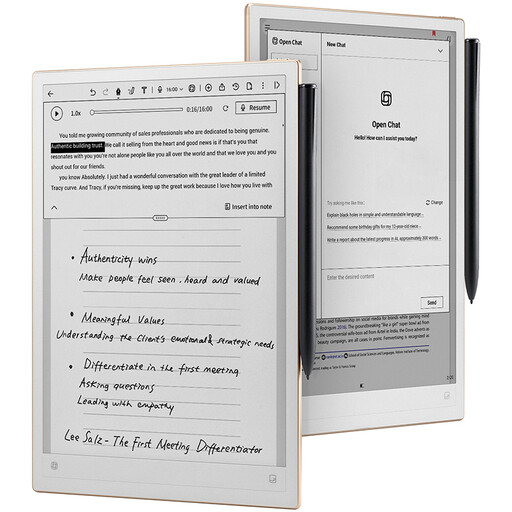
This digital notebook is an alternative if you want to write on a device's own screen rather than use a drawing tablet connected to a separate computer. Check whether its note apps work with your office devices if cross-device access matters.
 No image available
iFLYTEK AINOTE 2 10.65-inch E Ink tablet with protective case
Consider this standalone digital notebook if you want to handwrite notes on the device rather than watch ink appear on a connected laptop.
The listing names a 10.65-inch E Ink screen and a 4.2 mm thickness. Its voice-to-text feature requires an internet connection; check note-app compatibility with your work devices before relying on cross-device access.
View on Joybuy
Common questions
Can a screenless drawing tablet take notes without a computer?
A screenless pen tablet needs a compatible host on which to view and save your notes. Wacom describes its Wacom One pen tablets as connecting to a PC, Mac, Chromebook or compatible Android device; check the exact tablet, operating system and note-taking app together.
Will one USB-C cable connect a pen display to my work laptop?
For the Wacom One 14, one-cable operation requires a laptop with Thunderbolt 3 or later or DisplayPort Alt Mode, according to Wacom. Check your laptop specification rather than relying on the presence of a USB-C socket; connection requirements differ between pen displays.
Does a battery-free pen eliminate charging and upkeep?
A battery-free pen does not mean that every part of the setup is maintenance-free. A wireless tablet may still need charging, while the pen may need replacement nibs; check those requirements and driver support for the model you choose.


