What matters when choosing
Decide first whether you need to work without a computer, draw directly on an image, or keep your existing desktop workflow. Then check the connection and charging requirements of the route you prefer.
| Concern |
What to check |
Who this matters to |
| Sketching without a connection |
Confirm standalone operation, suitable Android drawing apps and a workable way to transfer files. Battery capacity alone does not establish session length. |
I need to capture concepts away from my computer and cannot rely on a free socket while I draw; around 40% of consumers put independent sketching first. |
| Drawing directly on screen |
Match the pen display’s video, data and power requirements to your laptop’s exact USB-C port and the required cable. |
Seeing a stroke beneath my pen matters more to me than working untethered; roughly 30% of consumers prioritise direct on-screen drawing with one cable. |
| Using desktop software wirelessly |
Check the wireless connection, operating-system support and charging arrangements; expect to draw on a surface separate from the computer screen. |
I want to keep using my computer-based tools without a tablet cable across the desk. Around 20% of consumers make wireless, off-screen input their primary need. |
| Simple USB input |
Confirm an available computer USB port, driver support and whether off-screen drawing feels workable for you. |
I already have a computer display and can accept a USB connection if it avoids a separate display setup; about 10% of consumers put straightforward wired input first. |
Relevant brands for reference
These brands illustrate different ways to sketch with limited access to plug sockets; compare the requirements of a particular model rather than assuming the same setup applies across a range.
Wacom
Its cited models offer a choice between drawing on a connected display and using an off-screen USB pen tablet.
- Wacom says one USB-C cable carries power, video and data for Wacom One DTC141 with a qualifying computer connection.
- That setup requires Thunderbolt 3 or later or DisplayPort Alt Mode. Wacom Intuos instead uses your computer screen and connects by USB.
Huion
Kamvas 13 is a computer-connected pen-display option for buyers considering a USB-C laptop setup.
- Huion says a capable laptop can power Kamvas 13 directly through USB-C.
- For the relevant one-cable connection, Huion specifies USB 3.1 Gen 1 data and DisplayPort 1.2 support; Android use requires extra power.
XPPen
Its cited products show the distinction between a standalone Android drawing tablet and a computer-connected pen display.
- XPPen describes the Magic Drawing Pad as a standalone Android tablet with an 8000 mAh battery that can also connect to a PC or Mac through USB-C.
- Independent use means working with suitable Android apps. For the separate Artist 13.3 Pro V2 display, XPPen says a power adaptor is not included.
Xencelabs
Its Pen Tablet Medium series is relevant if you want wireless input while continuing to use a computer display.
- Xencelabs states that the series uses a private Bluetooth 5.0 connection and offers up to 16 hours of wireless creation on a charge.
- It remains an off-screen tablet and needs recharging; the stated maximum runtime should not be treated as a fixed session length.
Joybuy product choices
This Android tablet is a choice to consider if sketching away from a computer is your priority. Check pen inclusion, app compatibility and your expected time between charges before deciding whether it fits your concept-sketching workflow.
 No image available
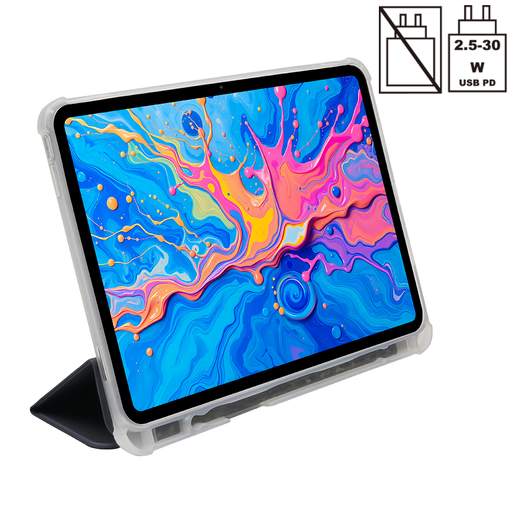
TECLAST ArtPad Pro 12.7-inch 2K tablet, 256GB, 4G LTE + 5G WiFi
For sketching away from a computer, this Android tablet has a 10,000mAh battery; check that your required drawing apps and file-transfer workflow work on Android.
Its 12.7-inch 2K display is listed as T-Pen compatible with 4096-level pressure support. Check whether a T-Pen is included before planning to draw straight away.
The listed configuration has a Helio G99 processor, 20GB RAM described as 8GB plus 12GB virtual memory, and an included protective case. Battery capacity does not establish how long it will run during your drawing sessions.
View on Joybuy
Common questions
Can one USB-C cable run a drawing display without a wall adaptor?
It can when the display and computer support the required connection. Wacom says Wacom One DTC141 carries power, video and data over one USB-C cable with a computer that supports Thunderbolt 3 or later or DisplayPort Alt Mode. Huion specifies USB 3.1 Gen 1 data and DisplayPort 1.2 support for the relevant Kamvas 13 connection. Check your laptop’s port specification rather than relying on its connector shape.
What can I use if there is no spare plug socket while I sketch?
A standalone battery-powered drawing tablet lets you sketch without a computer connection during the session, provided its apps suit your work and it has charge remaining. XPPen describes the Magic Drawing Pad as a standalone Android tablet. A wireless pen tablet can also remove the tablet cable while you draw, but it still relies on a separate computer display.
What should I check as soon as a drawing tablet arrives?
Test the exact setup you intend to use, including the laptop port, supplied cables, driver and pen operation. If you bought online in the UK and want to cancel a change-of-mind purchase, GOV.UK says to tell the seller within 14 days of receiving the item. Follow the applicable return instructions; an item that is faulty, damaged or misdescribed raises a different question from a change-of-mind return.
What should I do with an old drawing tablet?
Look for an appropriate electrical-equipment recycling or take-back option rather than treating the tablet as ordinary household rubbish. GOV.UK identifies the UK Waste Electrical and Electronic Equipment Regulations 2013, as amended, as the framework supporting recovery, reuse and recycling of electrical products and components.


