
24/7 Customer Support

Free returns

Same-day & Next-day Delivery

Quality Guaranteed

Unlock Your Welcome Offers: FREE Delivery | Up to 80% OFF | Free 30-day JoyPlus trial
Download the APP
Choosing everyday rewards for a cat can seem simple until the packaging starts making broad promises about taste, nutrition and value. UK owners shopping for Dreamies cat treats often want a reliable reward for training, bonding or encouraging a fussy eater, but several buying traps can lead to wasted money or unsuitable feeding habits.
The main issue is that treats are not a replacement for a complete cat food. They should be used as complementary food for cats, with the main meal adjusted to account for extra calories.
A cat treats mega pack 200g can be convenient, but pack size alone does not tell you whether the treats suit your cat. Check the feeding guide, calorie information, resealable packaging and your cat’s flavour preferences before buying in quantity. A large bag may not be practical if your cat refuses the flavour or the treats lose freshness after opening.
Fussy cats may reject a treat because of its mouthfeel rather than its flavour. Some prefer a firm biscuit, while others respond to dual-texture cat treats with a crunchy outside and softer centre. Texture is particularly useful to consider when introducing a new reward or switching from another type of cat treat.
Some Dreamies varieties contain added vitamins and minerals, but this does not make them a substitute for a balanced daily diet. Read the ingredients, analytical constituents and feeding guidance on the product label. Also check age restrictions, especially if buying for kittens.
Popular options include salmon cat treats, tuna cat treats and cheese cat treats. Salmon-flavour Dreamies list fish and fish derivatives, including 4% salmon, while the cheese variety lists dried cheese powder at 2.1%, equivalent to 4% cheese. The tuna product provides a tuna flavour, but its ingredient list should still be checked if your cat has known sensitivities.
Flavour descriptions should not be confused with a high proportion of the named ingredient. Always check the composition on the packaging, particularly if your cat has dietary restrictions.
Dreamies cat treat biscuits are described as crunchy on the outside and soft inside. This dual texture can make them suitable for cats that enjoy a contrast between a biscuit-like coating and a softer centre.
The listed guidance for these products is:
The product description states that each treat contains less than 2 kcal, but the recommended daily amount should still be treated as a limit rather than a target. Cats with weight-management needs may require individual feeding advice from a vet.
The tuna and cheese varieties list an energy value of 416 kcal per 100g, alongside protein, fat, crude fibre and inorganic matter figures. They also list vitamins and minerals, including vitamins A, B-group, D3 and E, plus zinc and manganese.
Look for a resealable bag or keep an opened pack sealed in a cool, dry place. This helps preserve texture and reduces the chance of the treats becoming stale. Check the best-before information on the physical label, as shelf-life details can vary by batch.
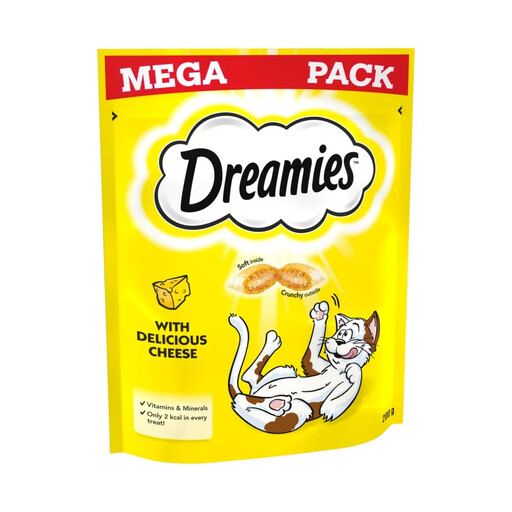
Why This Fits Their Persona: A practical starting point for owners who want a 200g everyday reward in a familiar cheese flavour, with clearly stated kitten and adult feeding limits.
The pack information states less than 2 kcal per treat and provides daily limits, making portion planning more straightforward than relying on the pack size alone.
Crunchy-and-soft texture; resealable 200g packaging; includes listed vitamins and minerals.
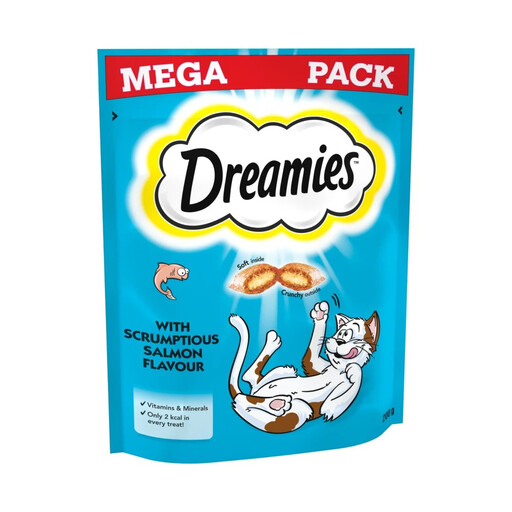
Why This Fits Their Persona: Suits owners who want a fish-flavoured reward and prefer to see a named salmon percentage in the composition rather than choosing from flavour wording alone.
The product information identifies 4% salmon and states that it has no artificial flavours, giving buyers specific details to compare with general taste-led claims.
Salmon flavour with 4% salmon listed; less than 2 kcal per treat; dual-texture format.
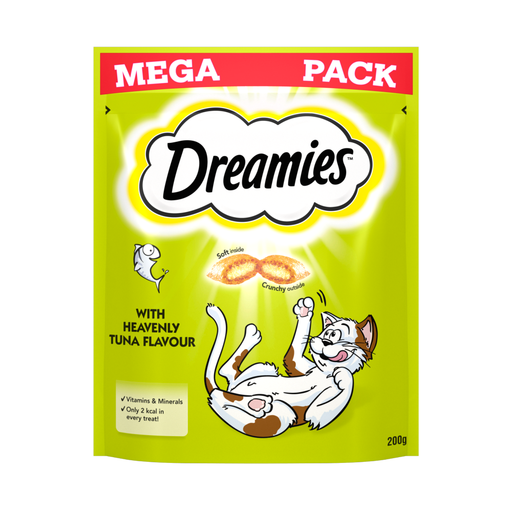
Why This Fits Their Persona: A suitable format for owners giving small rewards regularly, provided the daily allowance is measured and the main meal is reduced when necessary.
The product provides a clear maximum of 20 pieces for adults and 6 for kittens over 8 weeks, rather than suggesting unlimited rewarding.
Tuna flavour; dual-texture pieces; listed vitamins and minerals; storage guidance to keep the bag sealed.
Before adding Dreamies cat treats to your basket, consider:
We have compiled a complete, real-time list of products that fully satisfy these strict selection criteria and UK safety regulations.
The listed products are not suitable for kittens under 8 weeks old. For kittens aged 8 weeks and above, the guidance states up to 6 pieces per day. Treats should be introduced carefully and used alongside an appropriate complete kitten food.
The product guidance states up to 20 pieces per day for adult cats. This is a maximum listed amount, not a requirement. Adjust the cat’s main meal to account for the treats and provide fresh water.
The product descriptions state that each treat contains less than 2 kcal. Even so, total intake matters. Measuring the daily portion is especially important for indoor cats, less active cats or cats already receiving other rewards.