What matters when choosing?
Decide when the child will eat it before comparing dried-fruit packs; then check the label for the child’s particular dietary needs.
A snack between school and dinner
Choose this route: Look for a suitable fresh-fruit or savoury option if the child will eat before the evening meal.
Consider: Check any alternative against the child’s allergy or intolerance needs too.
Dried fruit with a meal
Choose this route: Consider dried fruit when it will be served as part of a meal or dessert and its current label suits the child.
Consider: A simple recipe or portioned pack does not remove the need for an individual allergen check.
| Priority |
What to check |
Your needs |
| Eating occasion |
Will the fruit be eaten with a meal or between meals? The NHS and the Office for Health Improvement and Disparities advise keeping dried fruit to mealtimes to reduce tooth-decay risk. |
For the gap between school and dinner, I need a suitable alternative to a routine dried-fruit snack. |
| Allergen information |
Read the current pack’s ingredients, allergen declaration and any precautionary wording. UK Food Standards Agency guidance covers declaration of 14 regulated allergens when they are ingredients; check for other ingredients the child must avoid as well. |
I need to match the actual pack to my child’s allergy or intolerance, rather than rely on a “natural” or “free from” impression. |
| Recipe and sugars |
Compare ingredients and the nutrition panel on the same serving basis. Whitworths lists 9.3 g sugars per 14 g Sunny Raisins box; Tesco lists 8.4 g per 14 g Seedless Raisins box. Those figures are total sugars, not evidence of added sugar. |
If I’m comparing raisin packs, I want to know both what else is in each recipe and how much the stated portion contains. |
| Pack format |
Check the stated pack and portion sizes against how you will use the fruit. A 14 g box provides a defined serving; a larger bag can be measured out for meals or baking. |
For a meal ingredient, I may prefer a larger bag; for a packed meal, a portioned box may be easier to carry. |
Relevant brand references
These product examples show why the particular pack matters more than a brand-wide assumption about ingredients or allergens.
Whitworths
Whitworths sells Sunny Raisins in 14 g boxes.
- Whitworths lists raisins (99%) and sunflower oil as ingredients, and 9.3 g sugars per box.
- The small-box format does not change UK guidance to keep dried fruit to mealtimes.
Tesco
Tesco lists both 14 g seedless-raisin boxes in a multipack and a larger 1 kg raisin bag.
- Tesco lists 8.4 g sugars per 14 g box; its 1 kg raisin product lists raisins and sunflower oil.
- Tesco warns that ingredients and allergen information may change, so check the physical pack.
Sunsweet
A Tesco listing for Sunsweet Stoned Prunes 500 g provides a prune option rather than a raisin-box format.
- The listing specifies California pitted prunes and potassium sorbate (E202).
- Its safety information says an occasional pit or partial pit may remain after mechanical pitting.
M&S
M&S lists a mixed dried-fruit product containing sultanas, raisins, currants and sunflower oil.
- The listed fruit types make it possible to check each component against the child’s needs.
- M&S says product ingredients and allergen information may change; read the current label.
Joybuy dried fruit for mealtimes
These 500 g raisin and sultana bags are options to consider for use with meals or in baking, rather than as routine between-meal after-school snacks.
 No image available
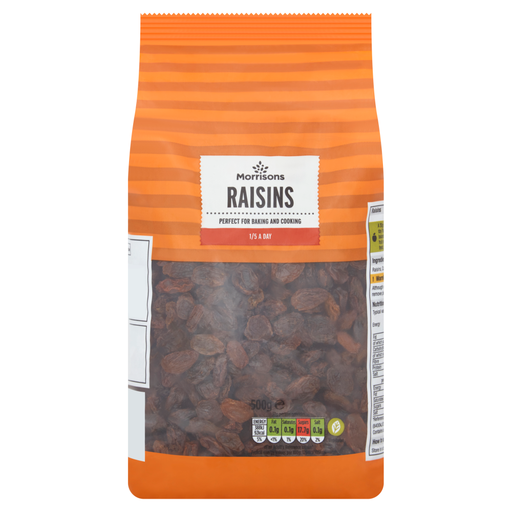
Morrisons Raisins 500g
Consider these raisins for adding to a meal or for baking, rather than as a routine snack between meals.
The pack is 500 g. Check its current ingredients and allergen information before serving it to a child with specific dietary needs.
View on Joybuy
 No image available
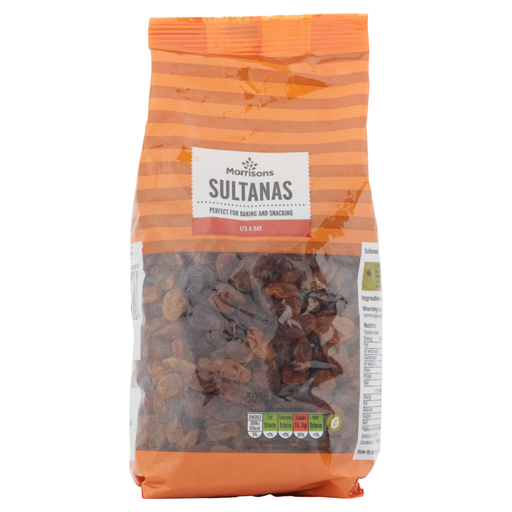
Morrisons Sultanas 500g
Consider these sultanas as a meal ingredient or for baking, rather than as a routine snack between meals.
The pack is 500 g. Check its current ingredients and allergen information against the child’s specific needs.
View on Joybuy
Frequently asked questions
Is dried fruit suitable as an everyday snack straight after school?
Not when it is routinely eaten between meals. The NHS and the Office for Health Improvement and Disparities advise having dried fruit at mealtimes to reduce the risk of tooth decay. For the gap before dinner, choose another snack that suits the child’s dietary needs.
Does a short ingredient list mean dried fruit is allergen-free?
No. It identifies listed ingredients but does not guarantee freedom from every allergen or cross-contact. Check the current pack’s ingredients and any precautionary wording against the child’s specific allergy or intolerance.
What should I check on the pack for a child with an allergy?
Read the current ingredient list, allergen declaration and any “may contain” wording relevant to the child. UK Food Standards Agency guidance requires information about the 14 regulated allergens when they are ingredients, but other ingredients can matter to an individual child too.
Are sulphites relevant to dried-fruit labels?
Yes, when they are relevant to the child’s needs. Food Standards Agency guidance includes sulphur dioxide and sulphites among the regulated allergens at concentrations above 10 parts per million. Check the particular product label rather than assuming that all dried fruit has the same ingredients.
Can I use a retailer webpage for an allergy check?
Use it to compare products, but confirm the actual pack before serving. Tesco and M&S both warn that product ingredients and allergen information can change.


