People who portion lunch at home
A large bag works if you regularly take dried fruit to work and are willing to put a serving into a separate container. Check the pack’s storage instructions once it is open.


Choose a large bag if you regularly include dried fruit with lunch and can portion it yourself; choose mini packs if a ready-to-carry serving matters more. Fruit-and-nut mixes offer a different combination, but check their ingredients and allergen statements rather than treating them as plain dried fruit. The NHS says 30g of dried fruit counts as one 5 A Day portion and advises eating it at mealtimes.
A large bag works if you regularly take dried fruit to work and are willing to put a serving into a separate container. Check the pack’s storage instructions once it is open.
Individual boxes or sachets remove the step of measuring fruit into a container. Check the weight of each one: a small box may contain less than the amount you planned to pack.
Plain fruit, mixed fruit and fruit-and-nut products can have different ingredient and allergen statements. Read the current pack, particularly when avoiding sulphites, peanuts, other nuts or sesame.
Start with how you will carry and portion the fruit for lunch, then compare the ingredients and pack information for the exact product you intend to buy.
| Priority | What to check | Your needs |
|---|---|---|
| Pack format | Compare total weight, the number of separate packs and the weight in each. Tesco Groceries lists a 1kg raisin bag and a separate 12 × 14g box format. | I can portion a large bag before work, or I need something ready to put straight into my lunch bag. |
| Lunch portion | Check the amount in one box or the portion you put into a container. The NHS says 30g of dried fruit counts as one 5 A Day portion and advises eating dried fruit at mealtimes. | A 14g box is easy to carry, but I would not mistake it for the NHS’s 30g dried-fruit portion. |
| Ingredients | Read the ingredients and nutrition information for the exact product. Marks & Spencer lists sweetened or juice-infused fruit in some of its mixes. | If I want a straightforward fruit pack, I will check the ingredients rather than rely on the picture or product name. |
| Allergens | Read the ingredient, allergen and precautionary statements on the current pack. The Food Standards Agency notes that sulphites are often used in dried fruit; the listed Whitworths 1DERS mix contains peanuts. | I need to check whether a fruit mix or fruit-and-nut pack is suitable for the ingredients I avoid. |
Separate portions describe the format, not the total quantity. Tesco Groceries lists its 12-box raisin pack as 168g in total, alongside a separate 1kg bag.
Compare the total pack weight and the amount in each box before deciding which format fits your lunches.
The NHS says 30g of dried fruit counts as one 5 A Day portion and advises eating dried fruit at mealtimes rather than between meals.
Put the amount you want with lunch into a container instead of keeping the whole bag open on your desk.
The listed Whitworths 1DERS mix contains peanuts and sweetened cranberries, while listed M&S fruit mixes include sweetened or juice-infused ingredients.
Check the ingredients and allergen statements when switching between plain fruit, mixed fruit and fruit-and-nut packs.
Ingredients and allergen information can change, so an earlier description may not describe the pack in hand.
Check the physical label before eating, especially if you need to avoid a particular ingredient or allergen.
These examples show different pack formats and ingredients; a brand name alone does not tell you what is in a particular pack.
Tesco Groceries lists seedless raisins in both a 1kg bag and a 12 × 14g box format.
Whitworths lists its 1DERS fruit-and-nut mix in multipacks.
Marks & Spencer lists larger dried-fruit packs as well as mixed-fruit and fruit-and-nut products.
These options include larger packs to portion yourself and individually packed fruit for a desk lunch. Compare their pack formats and current labels against the way you prepare lunch.
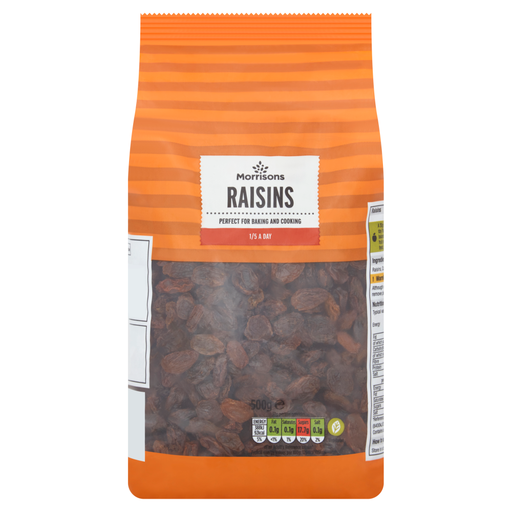 No image available
A 500g raisin pack for lunches you portion yourself. Check the pack’s ingredients and storage instructions before using it across several lunches.
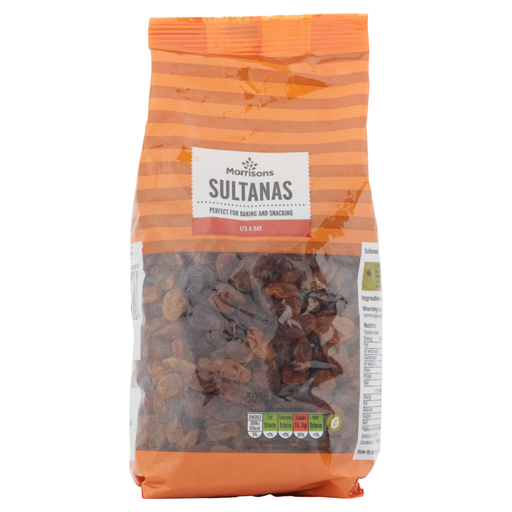 No image available
A 500g sultana pack for people who prefer to prepare their own lunch portions. It is not a set of individual servings, so bring a separate container if needed.
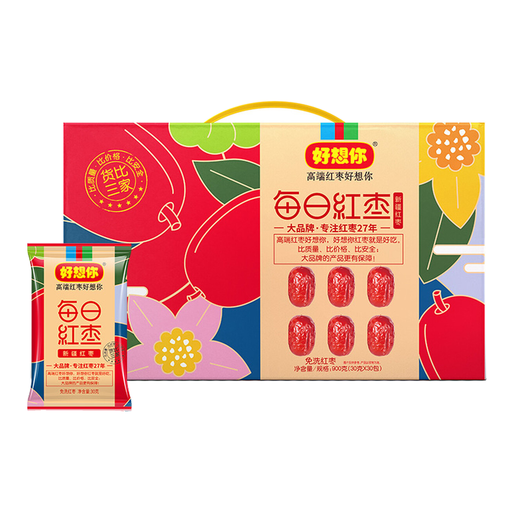 No image available
Thirty separate 30g sachets provide a ready-packed format for lunch. The dates have stones, so take care when eating them.
 No image available
Twelve individual 14g boxes are easy to add to a packed lunch. One box is below the NHS’s 30g reference for a dried-fruit 5 A Day portion.
 No image available
Individually wrapped prunes offer a different carrying format within a 500g pack. Check the current ingredient list if you need to avoid isomaltose.
The NHS says 30g of dried fruit counts as one portion. Use the weight on an individual pack, or measure from a larger bag, if you want to compare your lunch portion with that reference.
The NHS advises eating dried fruit at mealtimes rather than between meals. For a desk lunch, pack the amount you plan to eat with that meal instead of leaving an open bag out for repeated snacking.
Mini packs give you separate, ready-to-carry amounts; a large bag lets you decide how much to put into each lunch. Check both the total weight and the weight of one mini pack: Tesco Groceries lists 12 × 14g raisin boxes separately from its 1kg raisin bag.
Read the current pack’s ingredients, allergen declaration and precautionary statements. The Food Standards Agency notes that sulphites are often used in dried fruit, while the listed Whitworths 1DERS fruit-and-nut mix contains peanuts and carries a may-contain statement for nuts and sesame.
Not necessarily. Marks & Spencer lists sweetened or juice-infused fruit in some mixes, and its Super Fruit Medley includes sulphites. Check the ingredients of the particular pack rather than assuming all dried-fruit formats have the same composition.