Runners with a diagnosed food allergy
Start with the allergen you need to avoid. Check the exact product’s ingredients and precautionary warnings before considering it for a training run.


Choose dried fruit by checking the exact allergen you need to avoid against the current pack, then consider whether its carbohydrate content and portion fit a session you have practised in training. A short ingredient list does not establish allergy suitability: check precautionary warnings too. The UK Sports Institute identifies dried fruit as one compact carbohydrate option, while World Athletics advises practising fuelling strategies in training.
Start with the allergen you need to avoid. Check the exact product’s ingredients and precautionary warnings before considering it for a training run.
Check each dried-fruit variety rather than assuming fruit is sulphite-free. M&S product information lists sulphur dioxide or sulphites in its orchard fruit medley, dried pineapple and soft apricots.
Compare portions and carbohydrate information, then try the chosen format during training. World Athletics advises practising competition eating rather than relying on an unfamiliar approach for an event.
Check allergy requirements first; then compare the portion, carbohydrate information and practicality of eating the fruit during a run.
| Priority | What to check | Your needs |
|---|---|---|
| Named allergen | Read the current pack’s ingredients and allergen declarations. Check any ‘may contain’ or ‘not suitable for’ warning against the allergen you avoid; the Food Standards Agency describes precautionary labelling as a warning about possible unintended allergen presence. | I need to assess the exact product for my allergy, not rely on a general ‘free from’ description. |
| Sulphites | Check each variety for sulphur dioxide or sulphites. M&S lists them in its orchard fruit medley, dried pineapple and soft apricots. | If I avoid sulphites, the fruit type or a short ingredient list cannot replace reading the label. |
| Carbohydrate portion | Compare carbohydrate per 100g with the amount you would carry and eat. World Athletics gives event-duration guidance of 30–60g carbohydrate per hour for 1–2.5 hours and up to 90g per hour for events over 2.5 hours; these are not figures for a particular dried-fruit product. | I want to understand what my chosen portion contributes to a longer session alongside my fluid plan. |
| Format and ingredients | Compare the ingredient list, pack size and texture of the exact product. Practise the portion and timing during training, as World Athletics advises for competition eating. | A portion has to be practical for me to carry and eat while running, not just look suitable on the nutrition panel. |
A named allergen may be absent from the ingredients while a precautionary warning still identifies a possible cross-contact risk. The Food Standards Agency explains that wording such as ‘may contain’ communicates possible unintended allergen presence.
Identify your allergen, then read both the ingredients and any precautionary wording on the current pack.
M&S lists sulphur dioxide or sulphites in its orchard fruit medley, dried pineapple and soft apricots. One fruit variety cannot establish the ingredients of another.
If you avoid sulphites, check the declaration on every product and variant you are considering.
A dried-fruit portion needs to fit the run’s carbohydrate and fluid plan as well as be practical to eat. World Athletics advises practising competition eating in training.
Use the pack’s carbohydrate information to work out the contribution of your chosen portion, and try its timing and format during training.
M&S product information provides examples of how ingredients and allergen wording differ between dried fruits.
Whitworths is a dried-fruit, nut and seed brand to consider when comparing fruit formats.
Sunsweet UK focuses on prunes and prune juice, offering a different fruit format to consider.
These raisins, red dates and figs are options to compare for a marathon-training session. None is presented as suitable for every ‘free from’ requirement: check the current pack against the allergen you need to avoid.
 No image available
The 12 x 14g format lets you consider individual packs when planning what to carry. Check the current ingredients and allergen warnings before use.
 No image available
This 500g pack offers red dates as an alternative fruit format to portion for training. Check its carbohydrate information, ingredients and allergen warnings on the current pack.
 No image available
These figs come in a 200g pack. If considering them for a run, check the current pack’s carbohydrate information and allergen wording, and try your chosen portion in training.
 No image available
The 100g pack is a raisin option for comparing portions. Read its current ingredients and precautionary allergen information before deciding whether it fits your requirements.
 No image available
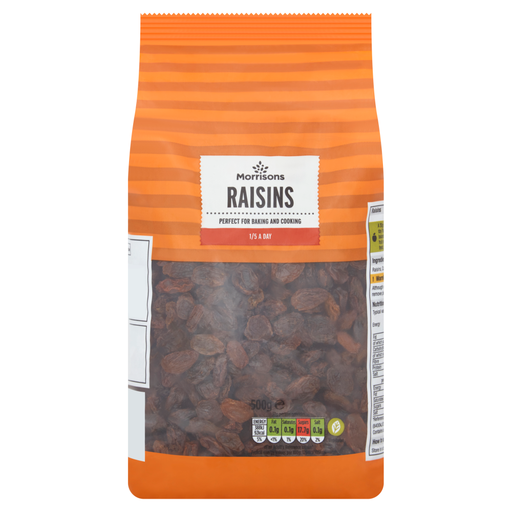
This 500g pack can be portioned for a training session. Product information also identifies cottonseed oil as an ingredient, so check the current ingredients and allergen warnings rather than assuming it contains raisins alone.
No. Check what the claim refers to and compare the current pack with the specific allergen you avoid. The Food Standards Agency explains that precautionary wording can flag possible unintended allergen presence; M&S also describes warnings where manufacturing methods may make a product unsuitable for particular allergy sufferers.
Yes, dried fruit is one compact carbohydrate option identified by the UK Sports Institute. Check the chosen portion’s carbohydrate information and practise eating it during training; World Athletics advises replacing carbohydrate and fluid during prolonged events and practising competition eating.
Do not assume so. M&S lists sulphur dioxide or sulphites in its soft apricots, dried pineapple and orchard fruit medley. Check the exact variant’s current pack if sulphites are something you avoid.
Use the chosen pack’s carbohydrate per 100g and your planned portion to work out what that food contributes. For context, World Athletics gives 30–60g carbohydrate per hour for events lasting 1–2.5 hours and up to 90g per hour for events over 2.5 hours; practise how your chosen food and fluids fit together during training.