Runners practising a portable fuelling plan
Small dried-fruit portions can be counted and carried on a long training run. Compare the carbohydrate per portion with your planned intake rather than assuming a snack box covers an entire hour.


Choose individual raisin boxes when you want portions that are easy to count, carry and share during training; a larger bag makes more sense if you can prepare portions before the run. Check the carbohydrate amount on the exact pack rather than treating one small box as an hour’s fuel: Tesco lists 9.2g per 14g box, while World Athletics gives a range of 30–60g per hour for endurance events lasting 1–2.5 hours. Fruit-and-nut packs have different ingredients and allergen considerations, and a dried-fruit multipack should be considered within a rehearsed fuelling plan rather than assumed to cover every run.
Small dried-fruit portions can be counted and carried on a long training run. Compare the carbohydrate per portion with your planned intake rather than assuming a snack box covers an entire hour.
Individual boxes make it straightforward to allocate a defined portion to each runner. A larger bag is another option when someone can divide and pack portions before the session.
Plain raisins and fruit-and-nut mixes are different foods. Check the ingredients and allergen wording for everyone who will share a pack, and practise with the chosen food during training before relying on it for an event.
Start with carbohydrate per portion and the number of portions needed, then decide whether ready-made boxes or portions prepared at home fit the way you will carry and share them.
| Priority | What to check | Your needs |
|---|---|---|
| Carbohydrate per portion | Read the carbohydrate value for the exact serving and count the servings you plan to carry. Tesco lists 9.2g per 14g raisin box. World Athletics gives 30–60g per hour for endurance events lasting 1–2.5 hours; its guidance for events over 2.5 hours specifies multiple-transportable carbohydrates for intakes of up to 90g per hour. | I need to know how several small portions fit into the fuelling plan I have practised, rather than counting one box as a complete hourly supply. |
| Portions for sharing | Compare the number of boxes with the number of runners and planned eating occasions. If choosing one large bag, decide how you will divide and carry it before setting off. | For a group run, I want each person’s portion to be easy to identify without passing around an open bag. |
| Ingredients and allergens | Check the ingredients and allergen wording on the pack that will be shared. Whitworths lists peanuts, raisins and sweetened dried cranberries in its 1DERS mix and says it may also contain nuts and sesame. | If someone needs to avoid an ingredient, I cannot treat a fruit-and-nut pack as interchangeable with plain raisins. |
| Repeated snacking | Consider when the dried fruit will be eaten. The NHS advises eating dried fruit at mealtimes rather than between meals to reduce tooth-decay risk; a small snack box is not automatically its stated 30g dried-fruit 5 A Day portion. | I want to account for repeated dried-fruit snacking as well as what is practical to carry on a training run. |
Tesco’s 14g raisin box contains 9.2g carbohydrate. That is less than the 30–60g per hour range World Athletics gives for endurance events lasting 1–2.5 hours.
Use the exact pack’s carbohydrate value to plan how many portions to carry, alongside the other food and drink in your rehearsed plan.
Whitworths’ 1DERS mix contains peanuts and sweetened dried cranberries, lists 7.1g fat per 30g portion and may contain nuts and sesame. It is not the same ingredient or portion format as a plain-raisin box.
Read the physical pack before sharing it, and choose the ingredients and portion size that fit everyone who will eat it.
A sharing bag does not provide individually defined portions to hand out during a run.
Divide it before the session if you want each runner to carry a known amount.
Home portioning also takes preparation and separate containers or wrappers.
The NHS advises having dried fruit at mealtimes rather than as a between-meal snack to reduce tooth-decay risk.
Keep that guidance in mind when deciding how often dried fruit appears in a training routine.
These examples show different pack formats and ingredients; a brand’s wider range should not be assumed to have the same portion size or labelling.
Tesco lists a 12-box seedless-raisin pack with 14g in each box.
M&S lists Taste Buds raisin snack boxes in a ten-box, 140g pack.
Whitworths’ 1DERS fruit-and-nut mix is a mixed snack rather than plain dried fruit.
Sainsbury's lists seedless raisins in 500g and 1kg bags.
Sunsweet’s European range lists pitted prunes in a 200g pouch and a 500g canister.
These options include two dried-fruit packs with stated individual portion sizes and one bag of figs to portion at home. Compare each pack’s label with the amount you intend to carry and share.
 No image available
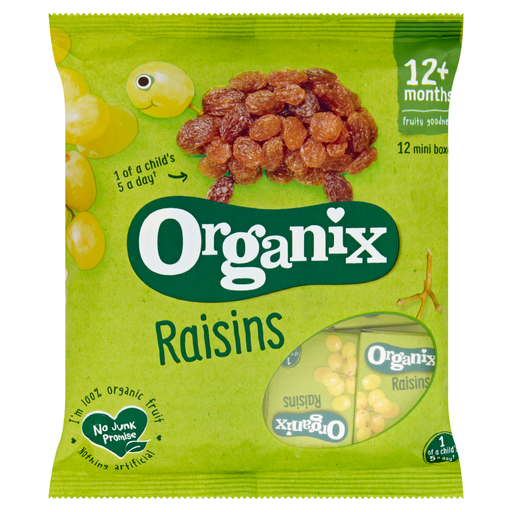
The 12 individual 14g raisin portions can be counted out for runners before a session. Check this product’s own carbohydrate label when deciding how many boxes fit your plan; the pack is labelled for ages 12+ months.
 No image available
Sixteen stated 16g packs provide separate portions for carrying or sharing. Check the exact pack’s ingredients and carbohydrate per serving before using it in a training plan.
 No image available
This 175g bag suits a plan to divide dried figs into carryable portions before a group run. It is a single bag, not an individual multipack; check its label when setting portion sizes and sharing it.
Do not assume that it will. World Athletics gives 30–60g carbohydrate per hour for endurance events lasting 1–2.5 hours and specifies multiple-transportable carbohydrates for intakes of up to 90g per hour in events over 2.5 hours. Tesco lists 9.2g carbohydrate in one 14g raisin box, so calculate portions from the exact label and practise the wider food-and-drink plan in training.
Work from the carbohydrate per box on the product you will carry and the intake you have planned for that session. Four of Tesco’s 14g boxes would provide 36.8g carbohydrate in total, based on its listed 9.2g per box; that calculation does not determine how many boxes any particular runner should use.
Only after checking the different ingredients, allergens and serving values. Whitworths’ 1DERS mix contains peanuts, raisins and sweetened dried cranberries, lists 7.1g fat per 30g portion and may contain nuts and sesame. Do not share a mixed pack without checking what each intended recipient can eat.
Check the physical pack’s ingredients, highlighted allergens, precautionary wording and serving information before dividing it. GOV.UK’s food-labelling guidance explains that ingredients are listed by weight and allergens must be highlighted in the ingredients list; a product name alone does not provide the same detail.
Not automatically: the NHS states that 30g dried fruit counts as one 5 A Day portion, while the raisin boxes discussed here are 14g each. The NHS also advises eating dried fruit at mealtimes rather than between meals to reduce tooth-decay risk.