Who is this choice for?

People who chew soft food independently

If firm food is tiring to chew, you may prefer pasta cooked until soft and served moist. IDDSI limits its Level 7 Regular Easy to Chew guidance to people who can chew soft, tender food independently and have no swallowing problems or increased choking risk.

Sauce-first weeknight cooks

If a smooth, generous sauce is central to the meal, compare short shapes by how they work with the sauce you plan to serve. NHS Lothian Speech and Language Therapy advises adding moisture to easy-chew food with sauce or other suitable additions.

Shoppers with ingredient requirements

If you are comparing standard wheat pasta with a gluten-free, wheat-free or wholewheat variant, check the ingredients on the exact pack. The finished pasta and sauce still need to suit the eater’s chewing requirements.

What matters when choosing?

Decide whether ordinary easy-chew preparation is appropriate before comparing pasta shapes, sauces or pack instructions. The groups below reflect different primary concerns among consumers choosing dried pasta for this kind of meal.

Concern What to check Who this matters to
Softness and chewing ability Check whether ordinary soft food is appropriate for the eater; if a texture level is prescribed, follow the clinician’s guidance. If chewing or swallowing requirements determine the meal, I need to establish the appropriate texture before choosing a pasta shape. About 42% of consumers put that question first.
Moisture and sauce fit Match a short shape to a suitable sauce, and check the softness of any pieces mixed into it. When sauce is what keeps my pasta meal moist, I want a shape that works with the sauce I will actually serve. Keeping the meal moist is the primary concern for about 33% of consumers.
Preparation and ingredients Read the exact variant’s ingredients, allergen information and cooking directions; assess its texture after cooking. If I need a particular ingredient choice or a straightforward cupboard meal, the pack details decide which pasta I pick. About 25% of consumers place preparation or ingredient fit first.

What can make the meal harder to chew?

  • Assuming “easy chew” covers swallowing difficulties

    IDDSI says Level 7 Regular Easy to Chew is not intended for someone with an increased choking risk. Its framework assigns individual food-texture recommendations to a clinician following assessment.

    If the eater has dysphagia, choking concerns or a prescribed texture level, follow their professional guidance rather than relying on a pasta shape or a general cooking suggestion.

  • Leaving the pasta firm because it has sauce

    Sauce adds moisture, but it does not establish that a firm piece of pasta is suitable. A pack’s cooking time is a direction for that product, not an individual texture prescription.

    Use the pack directions as a starting point, then check the cooked pasta’s softness and serve it with enough suitable sauce.

  • Overlooking pieces caught in ridges or spirals

    A sauce-holding shape can also carry hard, fibrous or chunky additions. IDDSI’s easy-chew guidance excludes hard, tough, chewy, fibrous, stringy and seedy textures.

    Prepare additions to the texture the eater requires, and check the complete dish rather than the pasta alone.

  • Assuming variants share the same ingredients

    A standard wheat pasta and a special-diet variant need separate label checks. The cited M&S tri-colour spaghetti, for example, contains durum wheat semolina.

    Read the current label of the precise pasta and sauce you intend to use, including any allergen information relevant to the eater.

Brands and ranges to consider

Barilla

Barilla’s UK dried-pasta pages include smooth penne, ridged penne and fusilli, giving shoppers short shapes to compare for sauce-led meals.

  • Barilla states an 8-minute cooking time for Penne Lisce N°71 and describes how the shape pairs with sauce.
  • Manufacturer cooking times and sauce suggestions do not establish whether the finished pasta meets an individual’s easy-chew requirements.

Tesco

Tesco Groceries lists own-label short shapes including penne, macaroni and rigatoni.

  • The listed shapes offer familiar formats to compare with a planned sauce.
  • Check the exact pack for its ingredients and cooking directions rather than applying one variant’s details to another.

M&S

Marks & Spencer lists standard pasta alongside gluten-free and high-protein options.

  • The range gives shoppers different ingredient options to check against their requirements.
  • Variants differ: the cited M&S tri-colour spaghetti contains durum wheat semolina, so read the label of the precise product.

Dolmio

Dolmio is relevant here as a sauce option rather than as a dried-pasta range.

  • Dolmio describes its Tomato and Basil Stir-In sauce as something to mix into hot cooked pasta.
  • A ready-to-use sauce does not establish that the complete meal meets easy-chew or prescribed texture requirements.

Joybuy fusilli selections

These two fusilli packs are short-pasta options for meals served with a suitable sauce. For either one, check the finished texture and the current pack label before serving.

Morrisons Fusilli 500g pack

Morrisons Fusilli 500g

Consider this short pasta if you plan to serve a sauce-led meal. The pack is 500g; check its current ingredients and cooking directions, then assess the pasta’s softness with the sauce you intend to use. Do not rely on ordinary easy-chew preparation where a texture level has been prescribed.

View on Joybuy
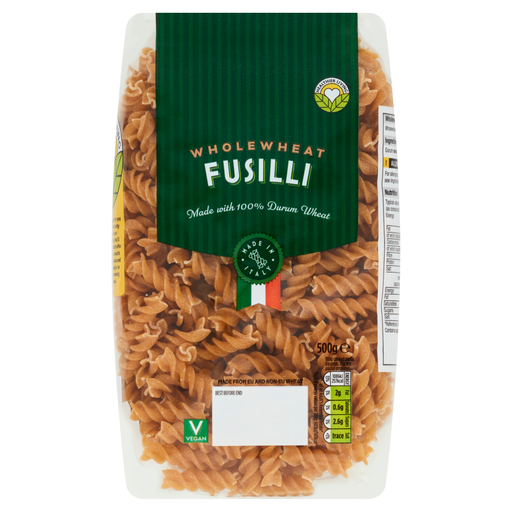
Morrisons Wholewheat Fusilli 500g pack

Morrisons Wholewheat Fusilli 500g

Consider this variant if you specifically want wholewheat fusilli for a sauce-led meal. The pack is 500g; check its current ingredients and cooking directions, and assess the cooked pasta with its sauce rather than assuming it will have the same texture as another variant. Follow prescribed texture guidance where applicable.

View on Joybuy

Questions about dried pasta and easy-chew meals

Can dried pasta be used for an easy-chew meal?

Yes, if the cooked pasta is soft enough for the eater and is served moist with a suitable sauce. NHS Lothian Speech and Language Therapy includes pasta with sauce in its easy-chew advice. That does not make ordinary pasta preparation appropriate for someone with swallowing problems, an increased choking risk or a different prescribed texture.

Should I choose smooth penne, ridged penne or fusilli?

Choose according to the sauce you plan to serve: smooth penne offers a smooth surface, while Barilla describes its Penne Rigate as retaining sauce inside and outside the tube and its Fusilli as capturing sauce in the spiral. None of those shape descriptions replaces checking the softness of the complete meal.

Should I follow the cooking time on the pack?

Use the directions for the exact pasta as a starting point, then assess its finished texture rather than serving it firm by default. For an easy-chew meal, NHS Lothian Speech and Language Therapy advises cooking food until soft and adding moisture with a suitable sauce or other accompaniment.

What if I need to avoid wheat or gluten?

Check the current ingredients and allergen information on the exact pasta and sauce packs. For example, Marks & Spencer lists gluten-free options, but its cited tri-colour spaghetti contains durum wheat semolina; a brand name alone does not identify the ingredients of every variant.