
24/7 Customer Support

Free returns

Same-day & Next-day Delivery

Quality Guaranteed

Unlock Your Welcome Offers: FREE Delivery | Up to 80% OFF | Free 30-day JoyPlus trial
Download the APP
Buying drill bits and cordless drills can seem straightforward until a project demands the correct bit, enough torque or a tool that can handle masonry. Many UK shoppers end up paying for accessories they rarely use, or damage a workpiece by choosing a drill setting that does not match the material.
This guide explains the specifications that matter, highlights common buying pitfalls and matches practical products to different usage profiles.
A 100-piece drill bit set may look economical, but the number can include many screwdriver bits, duplicate sizes and accessories unsuitable for your main projects. Check the actual contents carefully. A smaller drill bit set containing the sizes and materials you regularly use may be more useful than a large mixed kit.
Woodworking drill bits are designed differently from metal drill bits, while masonry bits require a hard-wearing tip and may be used with hammer action. A standard twist bit is not a suitable substitute for every surface. Using the wrong accessory can create rough holes, excessive heat, blunt edges or damage to the drill chuck.
An 18V cordless drill can offer useful power, but voltage alone does not indicate how well it will suit a task. Torque, clutch settings, speed range, chuck capacity and battery size all affect practical performance. Similarly, a high maximum speed is not automatically preferable: larger holesaws and metal drilling often require slower operation.
For sheet metal, alloys and some plastics, titanium-coated HSS drill bits can offer a durable cutting surface and reduced friction compared with untreated high-speed steel. They still require the correct speed, steady pressure and suitable lubrication when drilling metal.
A step drill is useful where one bit needs to create multiple hole diameters. For example, the Silverline Titanium-Coated HSS Step Drill 20–36mm has clearly marked 2mm graduations, a self-starting design and a 12mm shank. It is specified for sheet metals, alloys and plastics up to 4mm thick. A three-piece step drill set uses a 6.35mm (1/4-inch) hex shank, making it suitable for many drills and impact drivers.
Step drill bits are not intended for hardwood, masonry or thick metal. Always compare the stated material thickness with your workpiece.
Check the bit shank before ordering. A standard drill may accept round shanks through a keyless chuck, while quick-change accessories commonly use a 1/4-inch hex shank. Holesaws require a compatible arbor and pilot drill, not simply an open chuck.
For larger accessories, confirm the drill’s chuck range and whether it can securely grip the shank. A loose connection can cause wobble, poor accuracy and unnecessary wear.
For screwdriving, a clutch with several settings helps limit over-tightening. Lower speeds generally provide more control and torque, while higher speeds suit smaller holes in appropriate materials. Hammer mode is intended for masonry with a compatible masonry bit; it should not be used with ordinary woodworking or metal bits.
The HYCHIKA cordless hammer drill provides two speed ranges of 0–500 and 0–2,000 RPM, a stated 60Nm maximum torque, 21+3 clutch settings and screwdriving, drilling and hammer-drilling modes. The BLACK+DECKER 18V cordless hammer drill offers two speeds of 0–360 and 0–1,400 RPM, an 11-position clutch and a 1–10mm keyless chuck.
Battery capacity also affects working time. A larger Ah rating can provide more stored energy, although charging time, load and material resistance influence actual run time.

Why This Fits Their Persona: A practical option for new homeowners and DIY users who need one battery drill and a broad selection of accessories for hanging, assembling and occasional masonry work.
The listed contents identify wood, titanium-coated metal and masonry bits separately, helping users select an accessory suited to the surface.
Includes a 104-piece accessory set, 18V battery, 11-position clutch, two-speed gearbox and 19-inch toolbox.
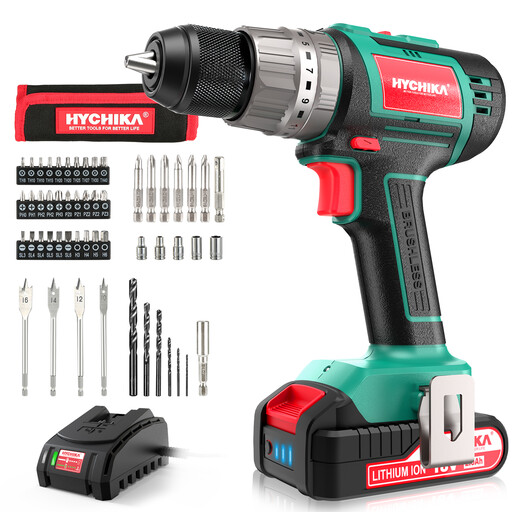
Why This Fits Their Persona: Suits workshop users, installers and DIYers who want adjustable control for repeated screwdriving, drilling and lighter masonry tasks.
Its stated torque, speed ranges and clutch settings provide more useful information than voltage alone when comparing workloads.
Features a 13mm auto-lock chuck, brushless motor, two 2.0Ah batteries and a 53-piece accessory set.

Why This Fits Their Persona: Useful for electricians, installers and workshop users cutting larger openings through suitable wood, plastic or light metal materials.
The kit states its seven hole sizes, two arbors, pilot drill and maximum operating speed of 1,500rpm, rather than relying on a vague accessory count.
Includes 21mm to 64mm holesaws, a pilot drill, two arbors, hex key and compact storage case.
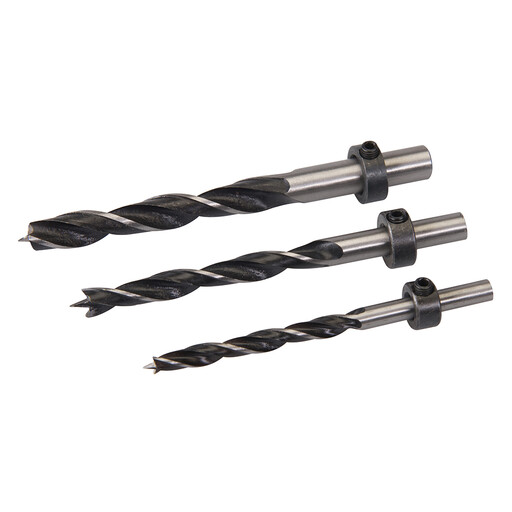
Why This Fits Their Persona: Designed for joinery, furniture assembly and cabinet work where repeatable dowel-hole depth and cleaner timber cuts are important.
Depth collars help control hole depth, while precision ground pre-cutting blades are specified for cleaner cuts in timber and man-made woods.
Contains 6mm, 8mm and 10mm bits with depth collars and high-carbon steel construction.
We have compiled a complete, real-time list of products that fully satisfy these strict selection criteria and UK safety regulations.
A cordless hammer drill can be suitable for occasional holes in brick or similar masonry when paired with a compatible masonry bit and used in hammer mode. For extensive concrete drilling, check the tool’s stated capabilities and consider whether a dedicated rotary hammer is more appropriate.
Run time depends on battery capacity, material resistance, bit size and workload. Two batteries allow one pack to charge while the other is in use. Keeping contacts clean, using the supplied charger and storing batteries in a cool, dry location can support reliable operation.