
24/7 Customer Support

Free returns

Same-day & Next-day Delivery

Quality Guaranteed

Unlock Your Welcome Offers: FREE Delivery | Up to 80% OFF | Free 30-day JoyPlus trial
Download the APP
Choosing dry cat food can seem straightforward until you compare life stages, ingredients, pack sizes and feeding claims. A colourful bag or a low price does not necessarily mean the food suits your cat’s age, activity level or digestion.
For UK cat owners, the practical choice is to start with the product label rather than the front-of-pack marketing. Check whether it is a complete pet food, whether it matches your cat’s life stage and whether the feeding guidance works for your household budget.
“Chicken”, “salmon” or “tuna” on the front does not always mean that ingredient is the main component. For example, some recipes list cereals or meat and animal derivatives first, with a specified percentage of chicken or fish in particular kibbles.
Read the composition in descending order and look for the percentage of the named ingredient. This helps you compare chicken cat food, salmon cat food and tuna cat food more realistically.
Kitten food is designed for growth, while adult dry cat food is intended for maintenance. Senior recipes may have different nutrient proportions for older cats. Feeding a general adult formula to a kitten or assuming every “senior” product suits a cat of any age can create an unsuitable match.
Look for clear wording such as “kittens up to 1 year”, “adult cats aged 1–7 years” or “11+”. If your cat has a diagnosed condition, ask your vet before changing diet.
A cat food multipack or large bag can reduce the cost per kilogram, but it may be poor value if your cat refuses it or the kibble loses freshness. Smaller packs are useful when introducing a new flavour or formula. Once accepted, a larger pack may suit multi-cat homes or owners seeking more affordable cat food.
Reseal opened packaging tightly and store it in a cool, dry place away from sunlight and moisture.
For everyday feeding, select food labelled as complete and balanced cat food or equivalent complete pet food. This indicates that the product is intended to provide the required nutrients when fed according to the instructions. Complementary food is not designed to be the sole diet.
Also check the analytical constituents, including protein, fat, fibre and ash. These figures allow useful comparisons, although they should not be viewed in isolation. A higher protein percentage alone does not automatically make a formula suitable for every cat.
Use the age guidance as a non-negotiable starting point:
Age ranges vary between products, so always follow the individual pack rather than relying on a general rule.
For cats with sensitive digestion, look for a clearly described recipe and review potential triggers in the ingredient list. “No added wheat” does not mean grain-free and a grain-free cat food is not automatically necessary or suitable for every cat.
Dry food contains less moisture than wet food. Keep fresh, clean drinking water available at all times and monitor your cat’s body condition. Feeding guides are starting points: indoor or less active cats may need less, while highly active cats may need more. Include treats in the daily calorie allowance.
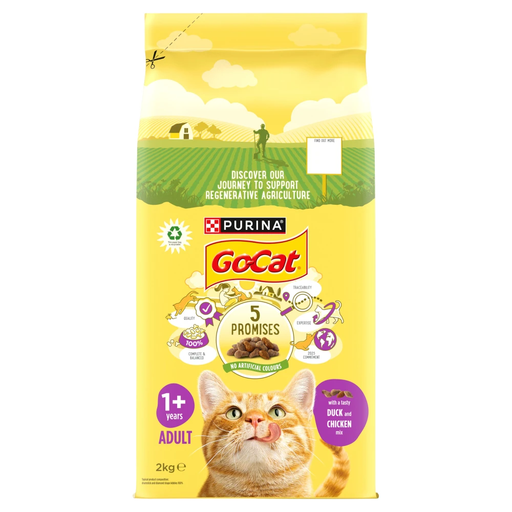
Why This Fits Their Persona: The 2kg pack is practical for owners feeding an adult cat daily and comparing cost per kilogram.
It is clearly listed as complete pet food for adult cats, helping shoppers avoid buying kitten or complementary food by mistake.
The recipe provides 30% protein and 11% fat, with feeding guidance based on weight.

Why This Fits Their Persona: A salmon-led, grain-free recipe may appeal to adult cats whose owners prioritise a clearly defined fish-based formula.
The ingredient list identifies salmon meal at 30% and states that the formula contains no wheat, corn or soy.
It provides at least 30% crude protein, 17% fat and a 1.5kg pack size that is manageable for single-cat homes.
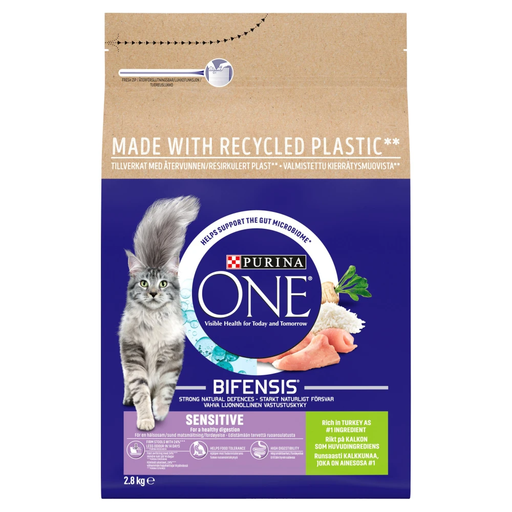
Why This Fits Their Persona: The larger pack suits households that want a sensitive-digestion formula for regular feeding.
The composition clearly identifies turkey at 18%, rice at 15%, chicory root at 2% and no added wheat.
The stated analysis includes 36% protein, 16% fat, fish oil and added vitamins and minerals.
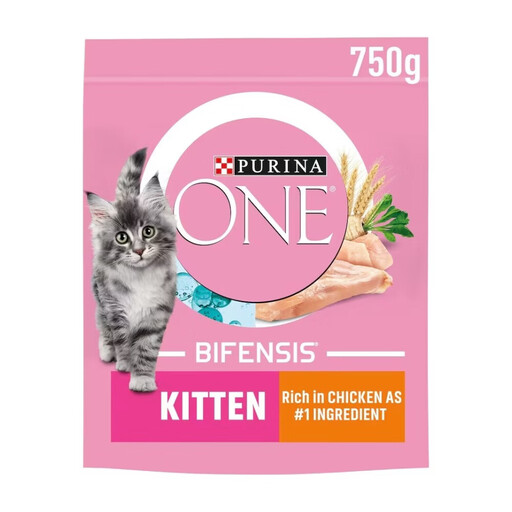
Why This Fits Their Persona: It is intended for kittens from weaning to 12 months and can also be used for pregnant or lactating cats.
The life-stage wording makes it easier to avoid using adult dry cat food during the growth period.
The formula lists 41% protein, 20% fat and DHA at 0.05%, with feeding guidance for weaning kittens.
We have compiled a complete, real-time list of products that fully satisfy these strict selection criteria and UK safety regulations.
Yes, if the packaging identifies it as a complete pet food for your cat’s life stage and you follow the feeding guidance. Fresh water should always be available. Some owners combine dry and wet food, but adjust portions to account for both.
This depends on the pack guidance, storage conditions and your cat’s consumption. Reseal the bag after every use, keep it cool and dry and avoid buying more than you can use while the kibble remains fresh and palatable.
Not necessarily. Grain-free and “no added wheat” describe ingredients, not a universal solution for digestive problems. Check the full composition and introduce any new food gradually. If symptoms continue, consult a vet rather than repeatedly changing formulas.